

Hexagonal Boron Nitride (h-BN) in Solutes Separation
175
Table 1 The permeability of
the BNNS membranes [74]
Pore
System
Pore area (Å 2 )
Permeability
(L/m 2 .h.bar)
a
System 1
14
663.16
b
System 2
6.2
224.78
c
System 3
15.8
3283.16
d
System 4
15.2
1219.53
exerted to the system for salt rejection in the range of 10–100 MPa. All MD simulations were carried out by NAMD 2.11 package with applying periodic boundary
conditions in all directions. As illustrated in Table 1, the pore size showed a notable
influence on the water permeability, which revealed that the chemical function types
at the pore edge is a key factor.
The results revealed that the functionalities such as –OH and –F groups can
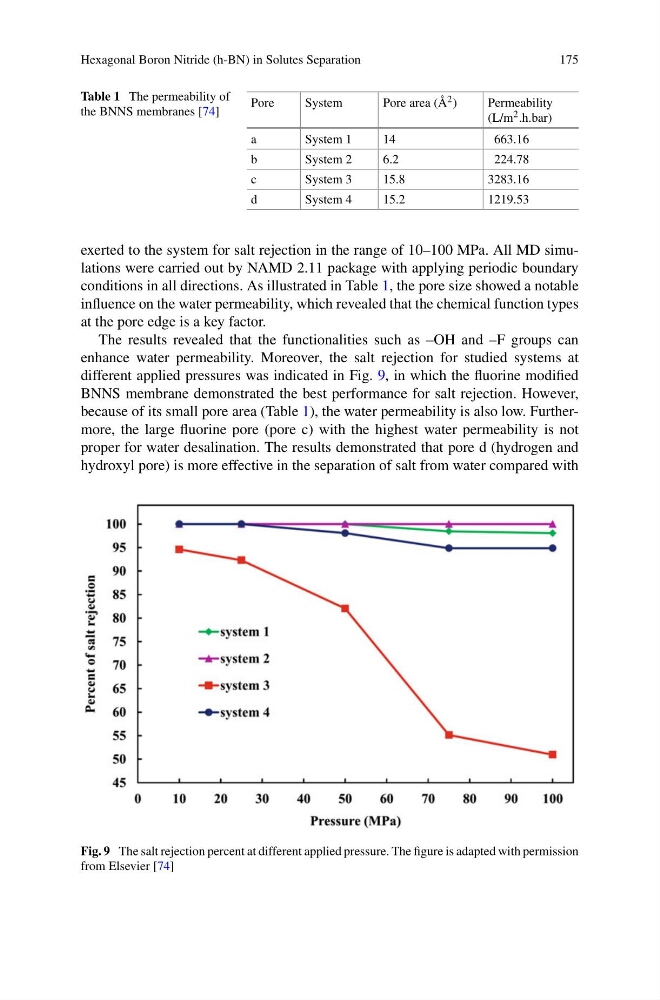
enhance water permeability. Moreover, the salt rejection for studied systems at
different applied pressures was indicated in Fig. 9, in which the fluorine modified
BNNS membrane demonstrated the best performance for salt rejection. However,
because of its small pore area (Table 1), the water permeability is also low. Furthermore, the large fluorine pore (pore c) with the highest water permeability is not
proper for water desalination. The results demonstrated that pore d (hydrogen and
hydroxyl pore) is more effective in the separation of salt from water compared with
Fig. 9 The salt rejection percent at different applied pressure. The figure is adapted with permission
from Elsevier [74]
175
Table 1 The permeability of
the BNNS membranes [74]
Pore
System
Pore area (Å 2 )
Permeability
(L/m 2 .h.bar)
a
System 1
14
663.16
b
System 2
6.2
224.78
c
System 3
15.8
3283.16
d
System 4
15.2
1219.53
exerted to the system for salt rejection in the range of 10–100 MPa. All MD simulations were carried out by NAMD 2.11 package with applying periodic boundary
conditions in all directions. As illustrated in Table 1, the pore size showed a notable
influence on the water permeability, which revealed that the chemical function types
at the pore edge is a key factor.
The results revealed that the functionalities such as –OH and –F groups can
enhance water permeability. Moreover, the salt rejection for studied systems at
different applied pressures was indicated in Fig. 9, in which the fluorine modified
BNNS membrane demonstrated the best performance for salt rejection. However,
because of its small pore area (Table 1), the water permeability is also low. Furthermore, the large fluorine pore (pore c) with the highest water permeability is not
proper for water desalination. The results demonstrated that pore d (hydrogen and
hydroxyl pore) is more effective in the separation of salt from water compared with
Fig. 9 The salt rejection percent at different applied pressure. The figure is adapted with permission
from Elsevier [74]