

3 Reactor Kinetics
77
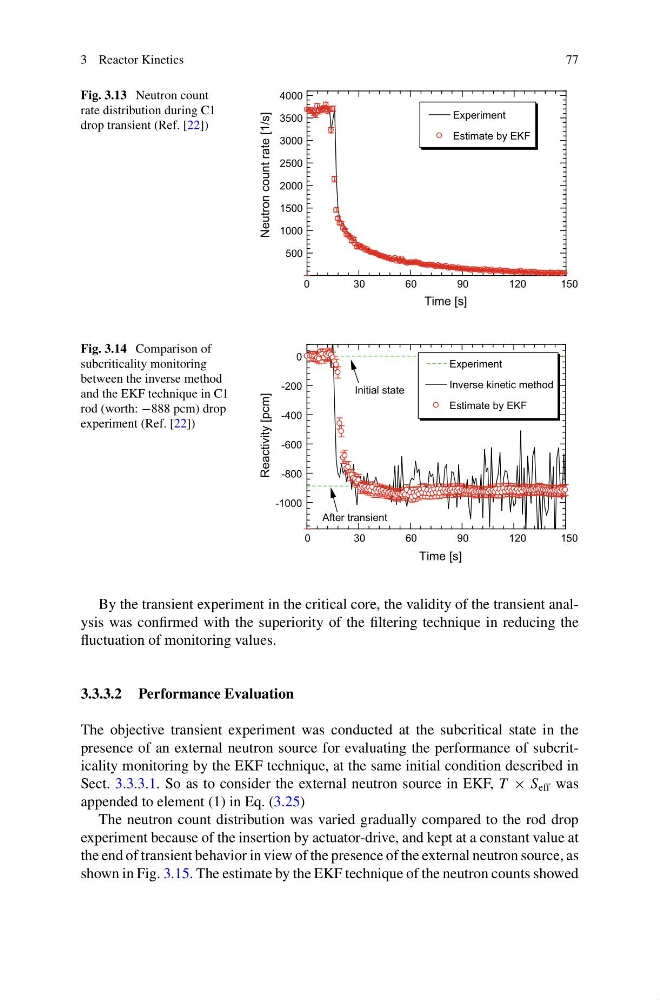
Fig. 3.13 Neutron count
rate distribution during C1
drop transient (Ref. [22])
30
60
90
120
150
500
1000
1500
2000
2500
3000
3500
4000
0
Time [s]
Neutron count rate [1/s]
Experiment
Estimate by EKF
Fig. 3.14 Comparison of
subcriticality monitoring
between the inverse method
and the EKF technique in C1
rod (worth: −888 pcm) drop
experiment (Ref. [22])
0
30
60
90
120
150
-1000
-800
-600
-400
-200
0
Time [s]
Reactivity [pcm]
Experiment
Inverse kinetic method
Estimate by EKF
Initial state
After transient
By the transient experiment in the critical core, the validity of the transient analysis was confirmed with the superiority of the filtering technique in reducing the
fluctuation of monitoring values.
3.3.3.2 Performance Evaluation
The objective transient experiment was conducted at the subcritical state in the
presence of an external neutron source for evaluating the performance of subcriticality monitoring by the EKF technique, at the same initial condition described in
Sect. 3.3.3.1. So as to consider the external neutron source in EKF, T × S eff was
appended to element (1) in Eq. (3.25)
The neutron count distribution was varied gradually compared to the rod drop
experiment because of the insertion by actuator-drive, and kept at a constant value at
the end of transient behavior in view of the presence of the external neutron source, as
shown in Fig. 3.15. The estimate by the EKF technique of the neutron counts showed
77
Fig. 3.13 Neutron count
rate distribution during C1
drop transient (Ref. [22])
30
60
90
120
150
500
1000
1500
2000
2500
3000
3500
4000
0
Time [s]
Neutron count rate [1/s]
Experiment
Estimate by EKF
Fig. 3.14 Comparison of
subcriticality monitoring
between the inverse method
and the EKF technique in C1
rod (worth: −888 pcm) drop
experiment (Ref. [22])
0
30
60
90
120
150
-1000
-800
-600
-400
-200
0
Time [s]
Reactivity [pcm]
Experiment
Inverse kinetic method
Estimate by EKF
Initial state
After transient
By the transient experiment in the critical core, the validity of the transient analysis was confirmed with the superiority of the filtering technique in reducing the
fluctuation of monitoring values.
3.3.3.2 Performance Evaluation
The objective transient experiment was conducted at the subcritical state in the
presence of an external neutron source for evaluating the performance of subcriticality monitoring by the EKF technique, at the same initial condition described in
Sect. 3.3.3.1. So as to consider the external neutron source in EKF, T × S eff was
appended to element (1) in Eq. (3.25)
The neutron count distribution was varied gradually compared to the rod drop
experiment because of the insertion by actuator-drive, and kept at a constant value at
the end of transient behavior in view of the presence of the external neutron source, as
shown in Fig. 3.15. The estimate by the EKF technique of the neutron counts showed