

3 Reactor Kinetics
75
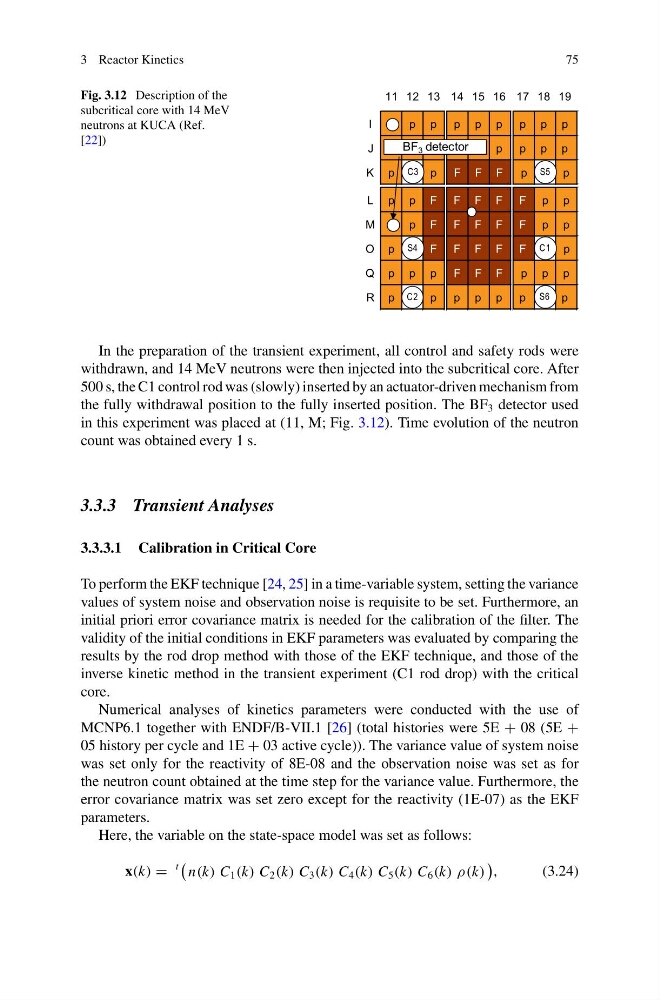
Fig. 3.12 Description of the
subcritical core with 14 MeV
neutrons at KUCA (Ref.
[22])
11 12 13 14 15 16 17 18 19
I p p p
p p p
p p p
J p p p
p p p
p p p
K p
p
F F F
p
p
L p p F F F F F p p
M p p F F F F F p p
O p
F F F F F
p
Q p p p
F F F
p p p
R p
p
p p p
p
p
C2
S4
C3
S5
C1
S6
BF 3 detector
In the preparation of the transient experiment, all control and safety rods were
withdrawn, and 14 MeV neutrons were then injected into the subcritical core. After
500 s, the C1 control rod was (slowly) inserted by an actuator-driven mechanism from
the fully withdrawal position to the fully inserted position. The BF 3 detector used
in this experiment was placed at (11, M; Fig. 3.12). Time evolution of the neutron
count was obtained every 1 s.
3.3.3 Transient Analyses
3.3.3.1 Calibration in Critical Core
To perform the EKF technique [24, 25] in a time-variable system, setting the variance
values of system noise and observation noise is requisite to be set. Furthermore, an
initial priori error covariance matrix is needed for the calibration of the filter. The
validity of the initial conditions in EKF parameters was evaluated by comparing the
results by the rod drop method with those of the EKF technique, and those of the
inverse kinetic method in the transient experiment (C1 rod drop) with the critical
core.
Numerical analyses of kinetics parameters were conducted with the use of
MCNP6.1 together with ENDF/B-VII.1 [26] (total histories were 5E + 08 (5E +
05 history per cycle and 1E + 03 active cycle)). The variance value of system noise
was set only for the reactivity of 8E-08 and the observation noise was set as for
the neutron count obtained at the time step for the variance value. Furthermore, the
error covariance matrix was set zero except for the reactivity (1E-07) as the EKF
parameters.
Here, the variable on the state-space model was set as follows:
x(k) =
t
n(k) C 1 (k) C 2 (k) C 3 (k) C 4 (k) C 5 (k) C 6 (k) ρ(k)
,
(3.24)
75
Fig. 3.12 Description of the
subcritical core with 14 MeV
neutrons at KUCA (Ref.
[22])
11 12 13 14 15 16 17 18 19
I p p p
p p p
p p p
J p p p
p p p
p p p
K p
p
F F F
p
p
L p p F F F F F p p
M p p F F F F F p p
O p
F F F F F
p
Q p p p
F F F
p p p
R p
p
p p p
p
p
C2
S4
C3
S5
C1
S6
BF 3 detector
In the preparation of the transient experiment, all control and safety rods were
withdrawn, and 14 MeV neutrons were then injected into the subcritical core. After
500 s, the C1 control rod was (slowly) inserted by an actuator-driven mechanism from
the fully withdrawal position to the fully inserted position. The BF 3 detector used
in this experiment was placed at (11, M; Fig. 3.12). Time evolution of the neutron
count was obtained every 1 s.
3.3.3 Transient Analyses
3.3.3.1 Calibration in Critical Core
To perform the EKF technique [24, 25] in a time-variable system, setting the variance
values of system noise and observation noise is requisite to be set. Furthermore, an
initial priori error covariance matrix is needed for the calibration of the filter. The
validity of the initial conditions in EKF parameters was evaluated by comparing the
results by the rod drop method with those of the EKF technique, and those of the
inverse kinetic method in the transient experiment (C1 rod drop) with the critical
core.
Numerical analyses of kinetics parameters were conducted with the use of
MCNP6.1 together with ENDF/B-VII.1 [26] (total histories were 5E + 08 (5E +
05 history per cycle and 1E + 03 active cycle)). The variance value of system noise
was set only for the reactivity of 8E-08 and the observation noise was set as for
the neutron count obtained at the time step for the variance value. Furthermore, the
error covariance matrix was set zero except for the reactivity (1E-07) as the EKF
parameters.
Here, the variable on the state-space model was set as follows:
x(k) =
t
n(k) C 1 (k) C 2 (k) C 3 (k) C 4 (k) C 5 (k) C 6 (k) ρ(k)
,
(3.24)