

74
C. H. Pyeon
ρ(t) =
dn(t)
dt
t=1
Λ
n(k)
+ β eff −
Λ
n(k)
6
i=1
λ i
1 + λ i k
β eff,i
Λ
n(k))kC i (k − 1)
−
Λ
n(k)
S eff .
(3.22)
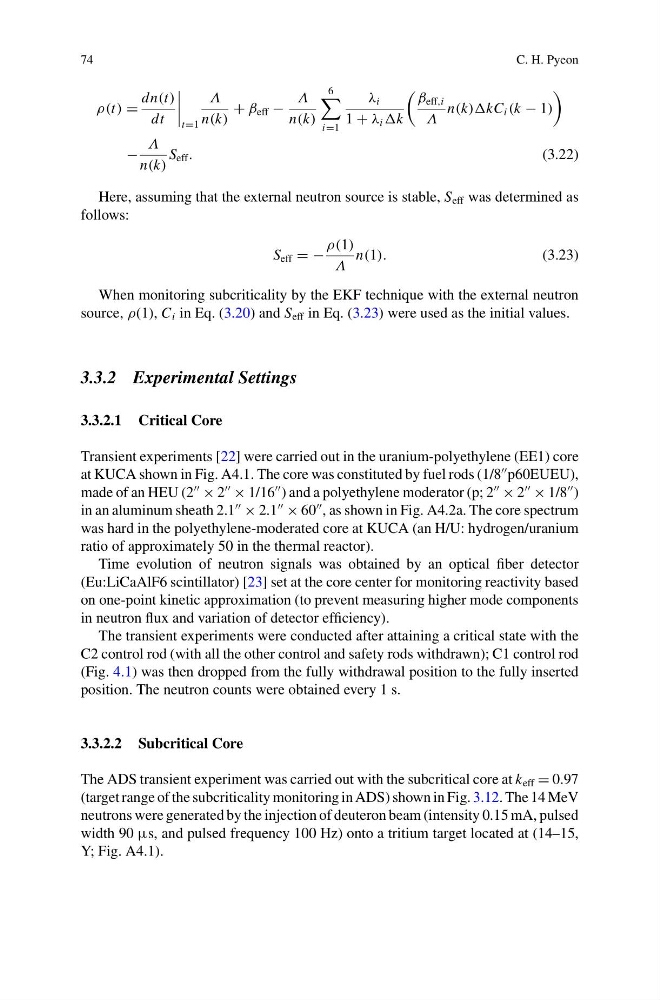
Here, assuming that the external neutron source is stable, S eff was determined as
follows:
S eff = −
ρ(1)
Λ
n(1).
(3.23)
When monitoring subcriticality by the EKF technique with the external neutron
source, ρ(1), C i in Eq. (3.20) and S eff in Eq. (3.23) were used as the initial values.
3.3.2 Experimental Settings
3.3.2.1 Critical Core
Transient experiments [22] were carried out in the uranium-polyethylene (EE1) core
at KUCA shown in Fig. A4.1. The core was constituted by fuel rods (1/8
p60EUEU),
made of an HEU (2
× 2
× 1/16
) and a polyethylene moderator (p; 2
× 2
× 1/8
)
in an aluminum sheath 2.1
× 2.1
× 60
, as shown in Fig. A4.2a. The core spectrum
was hard in the polyethylene-moderated core at KUCA (an H/U: hydrogen/uranium
ratio of approximately 50 in the thermal reactor).
Time evolution of neutron signals was obtained by an optical fiber detector
(Eu:LiCaAlF6 scintillator) [23] set at the core center for monitoring reactivity based
on one-point kinetic approximation (to prevent measuring higher mode components
in neutron flux and variation of detector efficiency).
The transient experiments were conducted after attaining a critical state with the
C2 control rod (with all the other control and safety rods withdrawn); C1 control rod
(Fig. 4.1) was then dropped from the fully withdrawal position to the fully inserted
position. The neutron counts were obtained every 1 s.
3.3.2.2 Subcritical Core
The ADS transient experiment was carried out with the subcritical core at k eff = 0.97
(target range of the subcriticality monitoring in ADS) shown in Fig. 3.12. The 14 MeV
neutrons were generated by the injection of deuteron beam (intensity 0.15 mA, pulsed
width 90 μs, and pulsed frequency 100 Hz) onto a tritium target located at (14–15,
Y; Fig. A4.1).
C. H. Pyeon
ρ(t) =
dn(t)
dt
t=1
Λ
n(k)
+ β eff −
Λ
n(k)
6
i=1
λ i
1 + λ i k
β eff,i
Λ
n(k))kC i (k − 1)
−
Λ
n(k)
S eff .
(3.22)
Here, assuming that the external neutron source is stable, S eff was determined as
follows:
S eff = −
ρ(1)
Λ
n(1).
(3.23)
When monitoring subcriticality by the EKF technique with the external neutron
source, ρ(1), C i in Eq. (3.20) and S eff in Eq. (3.23) were used as the initial values.
3.3.2 Experimental Settings
3.3.2.1 Critical Core
Transient experiments [22] were carried out in the uranium-polyethylene (EE1) core
at KUCA shown in Fig. A4.1. The core was constituted by fuel rods (1/8
p60EUEU),
made of an HEU (2
× 2
× 1/16
) and a polyethylene moderator (p; 2
× 2
× 1/8
)
in an aluminum sheath 2.1
× 2.1
× 60
, as shown in Fig. A4.2a. The core spectrum
was hard in the polyethylene-moderated core at KUCA (an H/U: hydrogen/uranium
ratio of approximately 50 in the thermal reactor).
Time evolution of neutron signals was obtained by an optical fiber detector
(Eu:LiCaAlF6 scintillator) [23] set at the core center for monitoring reactivity based
on one-point kinetic approximation (to prevent measuring higher mode components
in neutron flux and variation of detector efficiency).
The transient experiments were conducted after attaining a critical state with the
C2 control rod (with all the other control and safety rods withdrawn); C1 control rod
(Fig. 4.1) was then dropped from the fully withdrawal position to the fully inserted
position. The neutron counts were obtained every 1 s.
3.3.2.2 Subcritical Core
The ADS transient experiment was carried out with the subcritical core at k eff = 0.97
(target range of the subcriticality monitoring in ADS) shown in Fig. 3.12. The 14 MeV
neutrons were generated by the injection of deuteron beam (intensity 0.15 mA, pulsed
width 90 μs, and pulsed frequency 100 Hz) onto a tritium target located at (14–15,
Y; Fig. A4.1).