

3 Reactor Kinetics
73
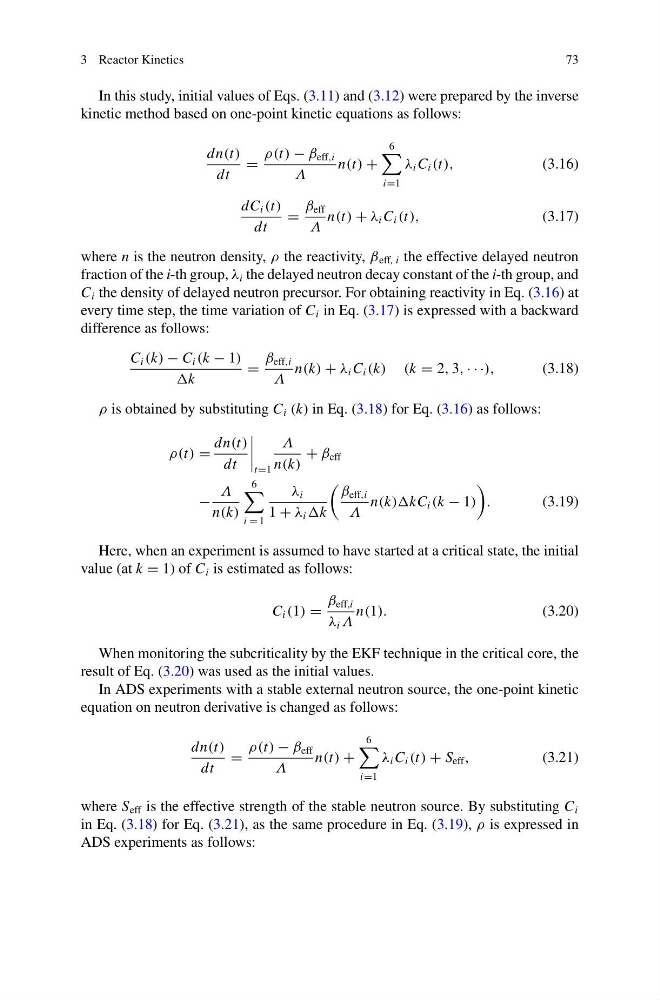
In this study, initial values of Eqs. (3.11) and (3.12) were prepared by the inverse
kinetic method based on one-point kinetic equations as follows:
dn(t)
dt
=
ρ(t) − β eff,i
Λ
n(t) +
6
i=1
λ i C i (t),
(3.16)
dC i (t)
dt
=
β eff
Λ
n(t) + λ i C i (t),
(3.17)
where n is the neutron density, ρ the reactivity, β eff, i the effective delayed neutron
fraction of the i-th group, λ i the delayed neutron decay constant of the i-th group, and
C i the density of delayed neutron precursor. For obtaining reactivity in Eq. (3.16) at
every time step, the time variation of C i in Eq. (3.17) is expressed with a backward
difference as follows:
C i (k) − C i (k − 1)
k
=
β eff,i
Λ
n(k) + λ i C i (k) (k = 2, 3, · · ·),
(3.18)
ρ is obtained by substituting C i (k) in Eq. (3.18) for Eq. (3.16) as follows:
ρ(t) =
dn(t)
dt
t=1
Λ
n(k)
+ β eff
−
Λ
n(k)
6
i = 1
λ i
1 + λ i k
β eff,i
Λ
n(k))kC i (k − 1)
.
(3.19)
Here, when an experiment is assumed to have started at a critical state, the initial
value (at k = 1) of C i is estimated as follows:
C i (1) =
β eff,i
λ i Λ
n(1).
(3.20)
When monitoring the subcriticality by the EKF technique in the critical core, the
result of Eq. (3.20) was used as the initial values.
In ADS experiments with a stable external neutron source, the one-point kinetic
equation on neutron derivative is changed as follows:
dn(t)
dt
=
ρ(t) − β eff
Λ
n(t) +
6
i=1
λ i C i (t) + S eff ,
(3.21)
where S eff is the effective strength of the stable neutron source. By substituting C i
in Eq. (3.18) for Eq. (3.21), as the same procedure in Eq. (3.19), ρ is expressed in
ADS experiments as follows:
73
In this study, initial values of Eqs. (3.11) and (3.12) were prepared by the inverse
kinetic method based on one-point kinetic equations as follows:
dn(t)
dt
=
ρ(t) − β eff,i
Λ
n(t) +
6
i=1
λ i C i (t),
(3.16)
dC i (t)
dt
=
β eff
Λ
n(t) + λ i C i (t),
(3.17)
where n is the neutron density, ρ the reactivity, β eff, i the effective delayed neutron
fraction of the i-th group, λ i the delayed neutron decay constant of the i-th group, and
C i the density of delayed neutron precursor. For obtaining reactivity in Eq. (3.16) at
every time step, the time variation of C i in Eq. (3.17) is expressed with a backward
difference as follows:
C i (k) − C i (k − 1)
k
=
β eff,i
Λ
n(k) + λ i C i (k) (k = 2, 3, · · ·),
(3.18)
ρ is obtained by substituting C i (k) in Eq. (3.18) for Eq. (3.16) as follows:
ρ(t) =
dn(t)
dt
t=1
Λ
n(k)
+ β eff
−
Λ
n(k)
6
i = 1
λ i
1 + λ i k
β eff,i
Λ
n(k))kC i (k − 1)
.
(3.19)
Here, when an experiment is assumed to have started at a critical state, the initial
value (at k = 1) of C i is estimated as follows:
C i (1) =
β eff,i
λ i Λ
n(1).
(3.20)
When monitoring the subcriticality by the EKF technique in the critical core, the
result of Eq. (3.20) was used as the initial values.
In ADS experiments with a stable external neutron source, the one-point kinetic
equation on neutron derivative is changed as follows:
dn(t)
dt
=
ρ(t) − β eff
Λ
n(t) +
6
i=1
λ i C i (t) + S eff ,
(3.21)
where S eff is the effective strength of the stable neutron source. By substituting C i
in Eq. (3.18) for Eq. (3.21), as the same procedure in Eq. (3.19), ρ is expressed in
ADS experiments as follows: