

28
K. Hashimoto
The above equation has no detection efficiency and asymptotically approaches
the second term with an increase in the subcriticality. The second term quantitatively
expresses a non-Poisson character of the spallation source and may be referred to
as “the Degweker’s factor” of multiplicity distribution of neutrons in a pulse bunch.
When the multiplicity follows the Poisson distribution, the factor becomes zero.
Degweker et al. theoretically simulated the Rossi-α analysis changing parametrically
the above factor to investigate an impact of non-Poisson source [8].
Generally, the ratio of the second factorial moment to the first factorial moment
squared of a multiplicity distribution has been employed as an indication characterizing the distribution. As an example, Diven factor [19] is defined as the ratio of
the second factorial moment to the first factorial moment squared of a multiplicity
distribution of fission neutrons emitted from a fission event and is a useful indication
characterizing the multiplicity distribution. Adding 1 to the Degweker’s factor, the
result is the ratio of the second factorial moment to the first factorial moment squared
of the multiplicity distribution of neutrons in a pulse bunch. Consequently, this factor
is eligible to employ as the indication characterizing the multiplicity distribution and
should be determined experimentally.
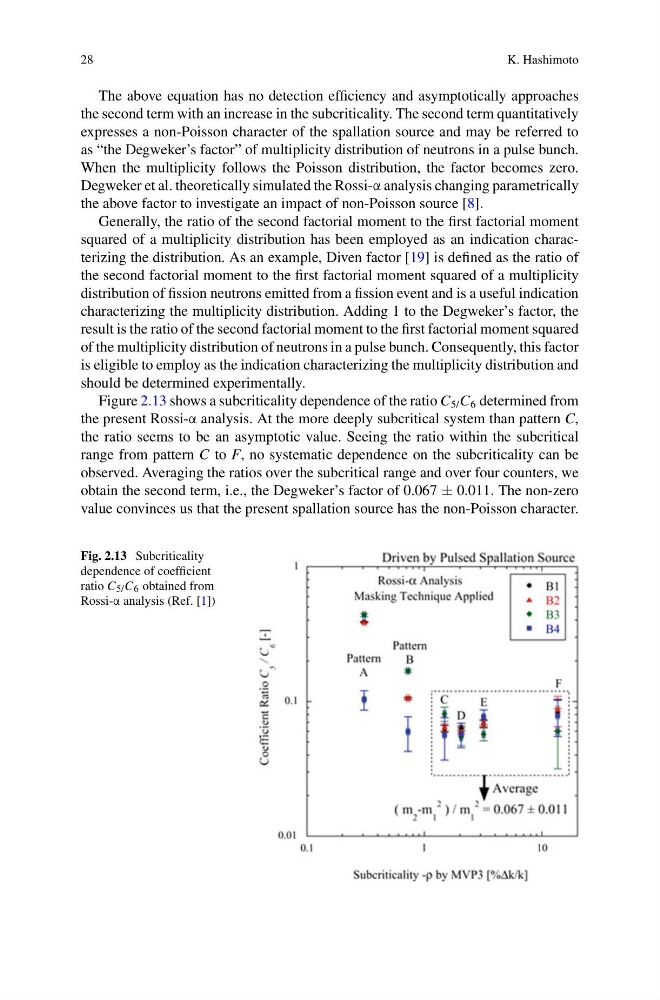
Figure 2.13 shows a subcriticality dependence of the ratio C 5/ C 6 determined from
the present Rossi-α analysis. At the more deeply subcritical system than pattern C,
the ratio seems to be an asymptotic value. Seeing the ratio within the subcritical
range from pattern C to F, no systematic dependence on the subcriticality can be
observed. Averaging the ratios over the subcritical range and over four counters, we
obtain the second term, i.e., the Degweker’s factor of 0.067 ± 0.011. The non-zero
value convinces us that the present spallation source has the non-Poisson character.
Fig. 2.13 Subcriticality
dependence of coefficient
ratio C 5/ C 6 obtained from
Rossi-α analysis (Ref. [1])
K. Hashimoto
The above equation has no detection efficiency and asymptotically approaches
the second term with an increase in the subcriticality. The second term quantitatively
expresses a non-Poisson character of the spallation source and may be referred to
as “the Degweker’s factor” of multiplicity distribution of neutrons in a pulse bunch.
When the multiplicity follows the Poisson distribution, the factor becomes zero.
Degweker et al. theoretically simulated the Rossi-α analysis changing parametrically
the above factor to investigate an impact of non-Poisson source [8].
Generally, the ratio of the second factorial moment to the first factorial moment
squared of a multiplicity distribution has been employed as an indication characterizing the distribution. As an example, Diven factor [19] is defined as the ratio of
the second factorial moment to the first factorial moment squared of a multiplicity
distribution of fission neutrons emitted from a fission event and is a useful indication
characterizing the multiplicity distribution. Adding 1 to the Degweker’s factor, the
result is the ratio of the second factorial moment to the first factorial moment squared
of the multiplicity distribution of neutrons in a pulse bunch. Consequently, this factor
is eligible to employ as the indication characterizing the multiplicity distribution and
should be determined experimentally.
Figure 2.13 shows a subcriticality dependence of the ratio C 5/ C 6 determined from
the present Rossi-α analysis. At the more deeply subcritical system than pattern C,
the ratio seems to be an asymptotic value. Seeing the ratio within the subcritical
range from pattern C to F, no systematic dependence on the subcriticality can be
observed. Averaging the ratios over the subcritical range and over four counters, we
obtain the second term, i.e., the Degweker’s factor of 0.067 ± 0.011. The non-zero
value convinces us that the present spallation source has the non-Poisson character.
Fig. 2.13 Subcriticality
dependence of coefficient
ratio C 5/ C 6 obtained from
Rossi-α analysis (Ref. [1])