

2 Subcriticality
27
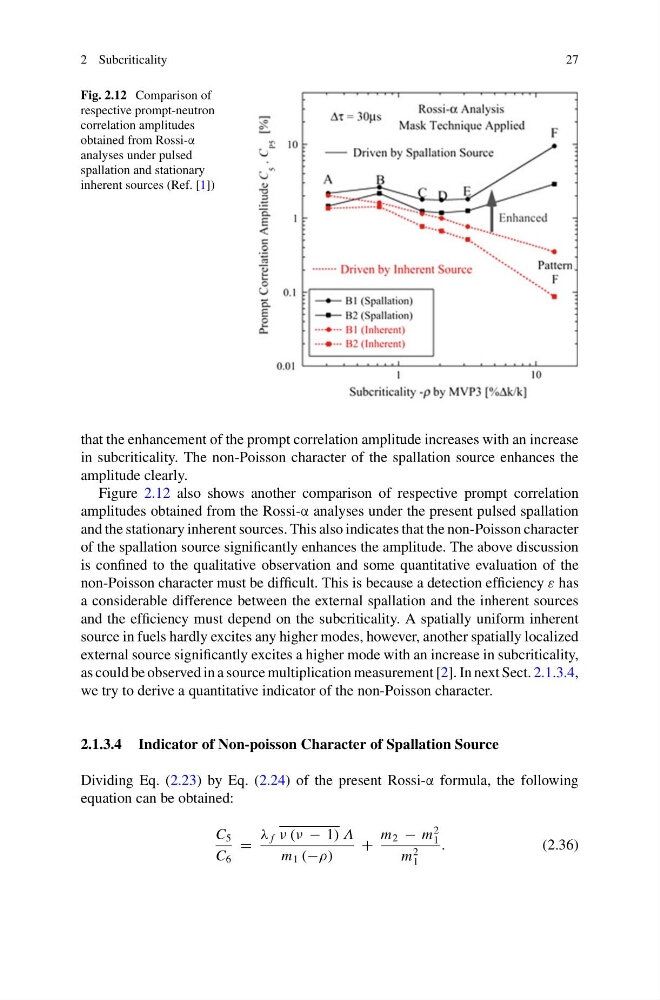
Fig. 2.12 Comparison of
respective prompt-neutron
correlation amplitudes
obtained from Rossi-α
analyses under pulsed
spallation and stationary
inherent sources (Ref. [1])
that the enhancement of the prompt correlation amplitude increases with an increase
in subcriticality. The non-Poisson character of the spallation source enhances the
amplitude clearly.
Figure 2.12 also shows another comparison of respective prompt correlation
amplitudes obtained from the Rossi-α analyses under the present pulsed spallation
and the stationary inherent sources. This also indicates that the non-Poisson character
of the spallation source significantly enhances the amplitude. The above discussion
is confined to the qualitative observation and some quantitative evaluation of the
non-Poisson character must be difficult. This is because a detection efficiency ε has
a considerable difference between the external spallation and the inherent sources
and the efficiency must depend on the subcriticality. A spatially uniform inherent
source in fuels hardly excites any higher modes, however, another spatially localized
external source significantly excites a higher mode with an increase in subcriticality,
as could be observed in a source multiplication measurement [2]. In next Sect. 2.1.3.4,
we try to derive a quantitative indicator of the non-Poisson character.
2.1.3.4 Indicator of Non-poisson Character of Spallation Source
Dividing Eq. (2.23) by Eq. (2.24) of the present Rossi-α formula, the following
equation can be obtained:
C 5
C 6
=
λ f ν (ν − 1) Λ
m 1 (−ρ)
+
m 2 − m
2
1
m
2
1
.
(2.36)
27
Fig. 2.12 Comparison of
respective prompt-neutron
correlation amplitudes
obtained from Rossi-α
analyses under pulsed
spallation and stationary
inherent sources (Ref. [1])
that the enhancement of the prompt correlation amplitude increases with an increase
in subcriticality. The non-Poisson character of the spallation source enhances the
amplitude clearly.
Figure 2.12 also shows another comparison of respective prompt correlation
amplitudes obtained from the Rossi-α analyses under the present pulsed spallation
and the stationary inherent sources. This also indicates that the non-Poisson character
of the spallation source significantly enhances the amplitude. The above discussion
is confined to the qualitative observation and some quantitative evaluation of the
non-Poisson character must be difficult. This is because a detection efficiency ε has
a considerable difference between the external spallation and the inherent sources
and the efficiency must depend on the subcriticality. A spatially uniform inherent
source in fuels hardly excites any higher modes, however, another spatially localized
external source significantly excites a higher mode with an increase in subcriticality,
as could be observed in a source multiplication measurement [2]. In next Sect. 2.1.3.4,
we try to derive a quantitative indicator of the non-Poisson character.
2.1.3.4 Indicator of Non-poisson Character of Spallation Source
Dividing Eq. (2.23) by Eq. (2.24) of the present Rossi-α formula, the following
equation can be obtained:
C 5
C 6
=
λ f ν (ν − 1) Λ
m 1 (−ρ)
+
m 2 − m
2
1
m
2
1
.
(2.36)