

26
K. Hashimoto
where
λ d = ε λ f .
(2.33)
Assuming that a detection efficiency ε has no difference between the non-Poisson
spallation and the Poisson sources, the following relationships hold:
C 1 = C 1P +
λ d
m 2 − m
2
1
(−ρ)
m 1 α 2 Λ
,
(2.34)
and
C 5 = C 5P +
λ d
m 2 − m
2
1
(−ρ)
2 m 1 α Λ
τ.
(2.35)
The respective second terms of the right-hand sides of the above two equations
express the enhancement by the non-Poisson character of the spallation source.
The enhancement disappears at a critical state and increases with an increase in
subcriticality.
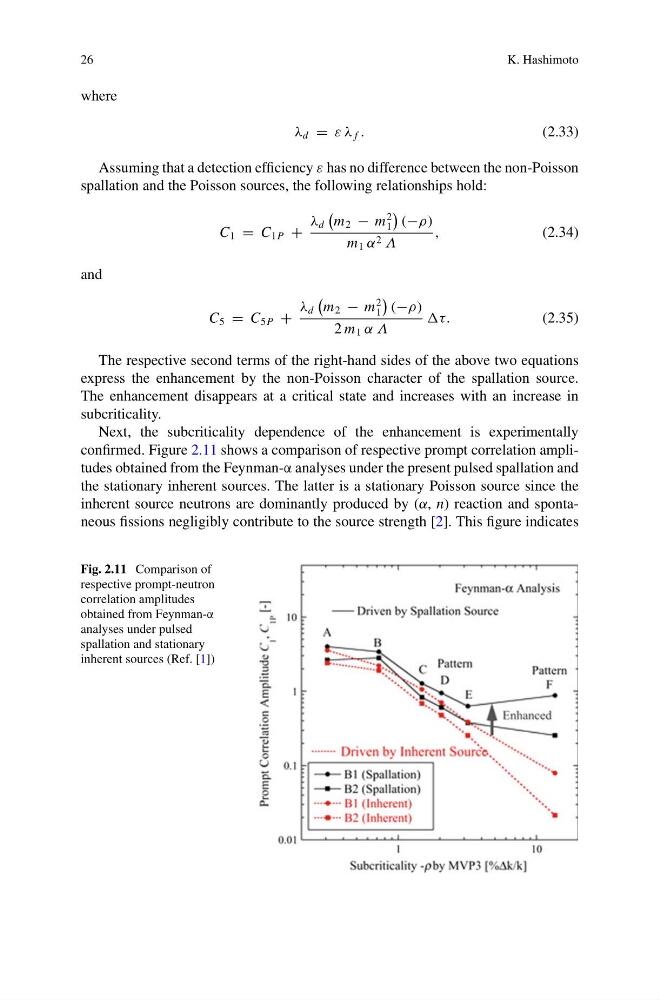
Next, the subcriticality dependence of the enhancement is experimentally
confirmed. Figure 2.11 shows a comparison of respective prompt correlation amplitudes obtained from the Feynman-α analyses under the present pulsed spallation and
the stationary inherent sources. The latter is a stationary Poisson source since the
inherent source neutrons are dominantly produced by (α, n) reaction and spontaneous fissions negligibly contribute to the source strength [2]. This figure indicates
Fig. 2.11 Comparison of
respective prompt-neutron
correlation amplitudes
obtained from Feynman-α
analyses under pulsed
spallation and stationary
inherent sources (Ref. [1])
K. Hashimoto
where
λ d = ε λ f .
(2.33)
Assuming that a detection efficiency ε has no difference between the non-Poisson
spallation and the Poisson sources, the following relationships hold:
C 1 = C 1P +
λ d
m 2 − m
2
1
(−ρ)
m 1 α 2 Λ
,
(2.34)
and
C 5 = C 5P +
λ d
m 2 − m
2
1
(−ρ)
2 m 1 α Λ
τ.
(2.35)
The respective second terms of the right-hand sides of the above two equations
express the enhancement by the non-Poisson character of the spallation source.
The enhancement disappears at a critical state and increases with an increase in
subcriticality.
Next, the subcriticality dependence of the enhancement is experimentally
confirmed. Figure 2.11 shows a comparison of respective prompt correlation amplitudes obtained from the Feynman-α analyses under the present pulsed spallation and
the stationary inherent sources. The latter is a stationary Poisson source since the
inherent source neutrons are dominantly produced by (α, n) reaction and spontaneous fissions negligibly contribute to the source strength [2]. This figure indicates
Fig. 2.11 Comparison of
respective prompt-neutron
correlation amplitudes
obtained from Feynman-α
analyses under pulsed
spallation and stationary
inherent sources (Ref. [1])