

2 Subcriticality
25
B4, well agreed with the previous decay constant. We can have this fortunate agreement because the respective negative and positive sharp cusps of the uncorrelated
second and third terms of Eq. (2.12) barely cancel out, as shown in Fig. 2.5. In
contrast, the present Rossi-α formula has no cancelation mechanism and has sharp
cups at every integral multiple of pulse period.
2.1.3.3 Comparison of Correlation Amplitude Between Spallation
and Poisson Sources
Many authors [6, 8, 15–18] theoretically showed that the non-Poisson spallation
source enhanced the correlation amplitudes of various reactor noise analyses. Here,
we compare the correlation amplitudes obtained from the Feynman-α and Rossiα analyses under the present non-Poisson spallation source with those under the
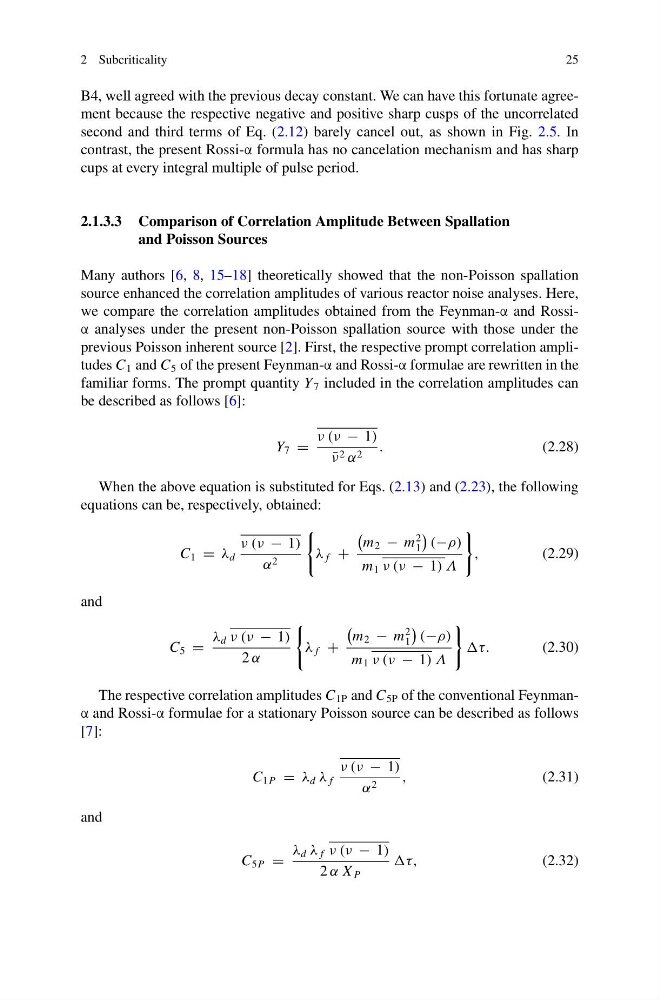
previous Poisson inherent source [2]. First, the respective prompt correlation amplitudes C 1 and C 5 of the present Feynman-α and Rossi-α formulae are rewritten in the
familiar forms. The prompt quantity Y 7 included in the correlation amplitudes can
be described as follows [6]:
Y 7 =
ν (ν − 1)
¯
ν 2 α 2 .
(2.28)
When the above equation is substituted for Eqs. (2.13) and (2.23), the following
equations can be, respectively, obtained:
C 1 = λ d
ν (ν − 1)
α 2
λ f +
m 2 − m
2
1
(−ρ)
m 1 ν (ν − 1) Λ
,
(2.29)
and
C 5 =
λ d ν (ν − 1)
2 α
λ f +
m 2 − m
2
1
(−ρ)
m 1 ν (ν − 1) Λ
τ.
(2.30)
The respective correlation amplitudes C 1P and C 5P of the conventional Feynmanα and Rossi-α formulae for a stationary Poisson source can be described as follows
[7]:
C 1P = λ d λ f
ν (ν − 1)
α 2
,
(2.31)
and
C 5P =
λ d λ f ν (ν − 1)
2 α X P
τ,
(2.32)
25
B4, well agreed with the previous decay constant. We can have this fortunate agreement because the respective negative and positive sharp cusps of the uncorrelated
second and third terms of Eq. (2.12) barely cancel out, as shown in Fig. 2.5. In
contrast, the present Rossi-α formula has no cancelation mechanism and has sharp
cups at every integral multiple of pulse period.
2.1.3.3 Comparison of Correlation Amplitude Between Spallation
and Poisson Sources
Many authors [6, 8, 15–18] theoretically showed that the non-Poisson spallation
source enhanced the correlation amplitudes of various reactor noise analyses. Here,
we compare the correlation amplitudes obtained from the Feynman-α and Rossiα analyses under the present non-Poisson spallation source with those under the
previous Poisson inherent source [2]. First, the respective prompt correlation amplitudes C 1 and C 5 of the present Feynman-α and Rossi-α formulae are rewritten in the
familiar forms. The prompt quantity Y 7 included in the correlation amplitudes can
be described as follows [6]:
Y 7 =
ν (ν − 1)
¯
ν 2 α 2 .
(2.28)
When the above equation is substituted for Eqs. (2.13) and (2.23), the following
equations can be, respectively, obtained:
C 1 = λ d
ν (ν − 1)
α 2
λ f +
m 2 − m
2
1
(−ρ)
m 1 ν (ν − 1) Λ
,
(2.29)
and
C 5 =
λ d ν (ν − 1)
2 α
λ f +
m 2 − m
2
1
(−ρ)
m 1 ν (ν − 1) Λ
τ.
(2.30)
The respective correlation amplitudes C 1P and C 5P of the conventional Feynmanα and Rossi-α formulae for a stationary Poisson source can be described as follows
[7]:
C 1P = λ d λ f
ν (ν − 1)
α 2
,
(2.31)
and
C 5P =
λ d λ f ν (ν − 1)
2 α X P
τ,
(2.32)