

22
K. Hashimoto
The error of the present decay constant represents statistical uncertainty ±1σ derived
from a nonlinear least-squares method. Since counter B4 was placed far from the
core and consequently had very small detection efficiency, the previous analysis for
the counter was unsuccessful.
The present decay constants of counters B1, B2, and B3 agree well with the
previous average decay constant, while the decay constant of counter B4 is much
larger than the previous one. As mentioned in Fig. 2.4, the counter B4 placed far
from the fuel region and closely to the target must scarcely detect fission neutrons
and consequently have little information about fission chain. Most of neutron counts
of the counters B1, B2, and B3 located closely to the fuel region are expected to be
generated from the detection of fission neutrons.
2.1.3.2 Rossi-α Analyses
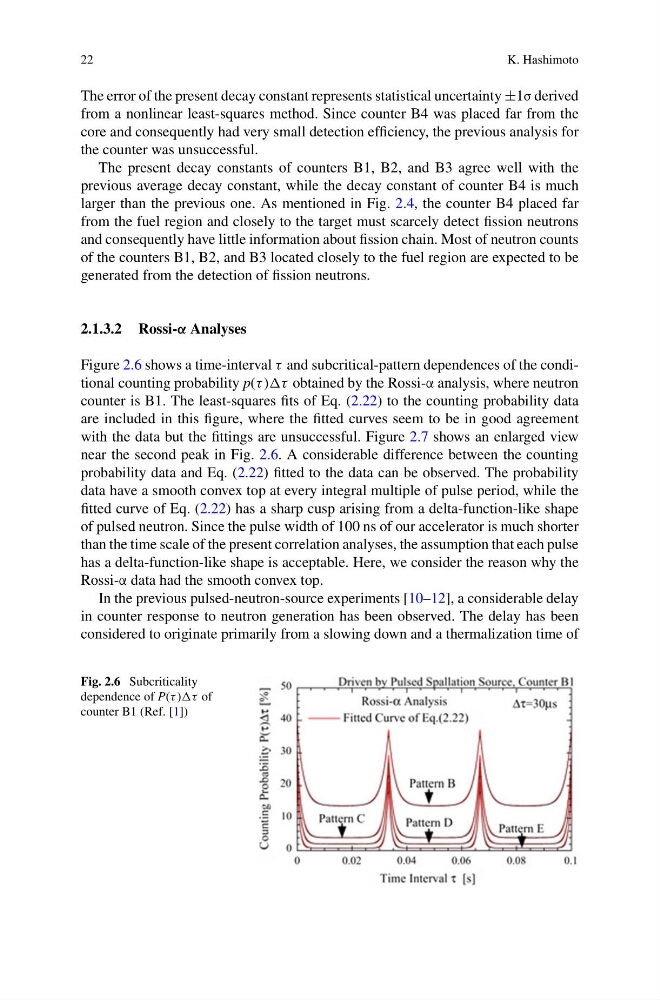
Figure 2.6 shows a time-interval τ and subcritical-pattern dependences of the conditional counting probability p(τ )τ obtained by the Rossi-α analysis, where neutron
counter is B1. The least-squares fits of Eq. (2.22) to the counting probability data
are included in this figure, where the fitted curves seem to be in good agreement
with the data but the fittings are unsuccessful. Figure 2.7 shows an enlarged view
near the second peak in Fig. 2.6. A considerable difference between the counting
probability data and Eq. (2.22) fitted to the data can be observed. The probability
data have a smooth convex top at every integral multiple of pulse period, while the
fitted curve of Eq. (2.22) has a sharp cusp arising from a delta-function-like shape
of pulsed neutron. Since the pulse width of 100 ns of our accelerator is much shorter
than the time scale of the present correlation analyses, the assumption that each pulse
has a delta-function-like shape is acceptable. Here, we consider the reason why the
Rossi-α data had the smooth convex top.
In the previous pulsed-neutron-source experiments [10–12], a considerable delay
in counter response to neutron generation has been observed. The delay has been
considered to originate primarily from a slowing down and a thermalization time of
Fig. 2.6 Subcriticality
dependence of P(τ )τ of
counter B1 (Ref. [1])
K. Hashimoto
The error of the present decay constant represents statistical uncertainty ±1σ derived
from a nonlinear least-squares method. Since counter B4 was placed far from the
core and consequently had very small detection efficiency, the previous analysis for
the counter was unsuccessful.
The present decay constants of counters B1, B2, and B3 agree well with the
previous average decay constant, while the decay constant of counter B4 is much
larger than the previous one. As mentioned in Fig. 2.4, the counter B4 placed far
from the fuel region and closely to the target must scarcely detect fission neutrons
and consequently have little information about fission chain. Most of neutron counts
of the counters B1, B2, and B3 located closely to the fuel region are expected to be
generated from the detection of fission neutrons.
2.1.3.2 Rossi-α Analyses
Figure 2.6 shows a time-interval τ and subcritical-pattern dependences of the conditional counting probability p(τ )τ obtained by the Rossi-α analysis, where neutron
counter is B1. The least-squares fits of Eq. (2.22) to the counting probability data
are included in this figure, where the fitted curves seem to be in good agreement
with the data but the fittings are unsuccessful. Figure 2.7 shows an enlarged view
near the second peak in Fig. 2.6. A considerable difference between the counting
probability data and Eq. (2.22) fitted to the data can be observed. The probability
data have a smooth convex top at every integral multiple of pulse period, while the
fitted curve of Eq. (2.22) has a sharp cusp arising from a delta-function-like shape
of pulsed neutron. Since the pulse width of 100 ns of our accelerator is much shorter
than the time scale of the present correlation analyses, the assumption that each pulse
has a delta-function-like shape is acceptable. Here, we consider the reason why the
Rossi-α data had the smooth convex top.
In the previous pulsed-neutron-source experiments [10–12], a considerable delay
in counter response to neutron generation has been observed. The delay has been
considered to originate primarily from a slowing down and a thermalization time of
Fig. 2.6 Subcriticality
dependence of P(τ )τ of
counter B1 (Ref. [1])