

210
C. H. Pyeon
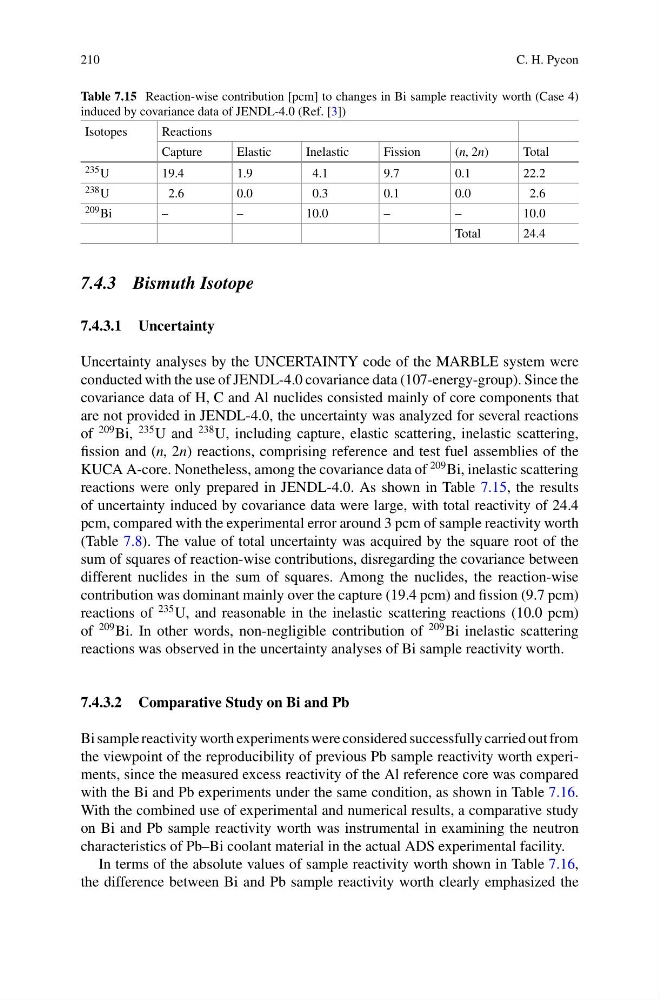
Table 7.15 Reaction-wise contribution [pcm] to changes in Bi sample reactivity worth (Case 4)
induced by covariance data of JENDL-4.0 (Ref. [3])
Isotopes
Reactions
Capture
Elastic
Inelastic
Fission
(n, 2n)
Total
235 U
19.4
1.9
4.1
9.7
0.1
22.2
238 U
2.6
0.0
0.3
0.1
0.0
2.6
209 Bi
–
–
10.0
–
–
10.0
Total
24.4
7.4.3 Bismuth Isotope
7.4.3.1 Uncertainty
Uncertainty analyses by the UNCERTAINTY code of the MARBLE system were
conducted with the use of JENDL-4.0 covariance data (107-energy-group). Since the
covariance data of H, C and Al nuclides consisted mainly of core components that
are not provided in JENDL-4.0, the uncertainty was analyzed for several reactions
of
209 Bi,
235 U and
238 U, including capture, elastic scattering, inelastic scattering,
fission and (n, 2n) reactions, comprising reference and test fuel assemblies of the
KUCA A-core. Nonetheless, among the covariance data of
209 Bi, inelastic scattering
reactions were only prepared in JENDL-4.0. As shown in Table 7.15, the results
of uncertainty induced by covariance data were large, with total reactivity of 24.4
pcm, compared with the experimental error around 3 pcm of sample reactivity worth
(Table 7.8). The value of total uncertainty was acquired by the square root of the
sum of squares of reaction-wise contributions, disregarding the covariance between
different nuclides in the sum of squares. Among the nuclides, the reaction-wise
contribution was dominant mainly over the capture (19.4 pcm) and fission (9.7 pcm)
reactions of
235 U, and reasonable in the inelastic scattering reactions (10.0 pcm)
of
209 Bi. In other words, non-negligible contribution of
209 Bi inelastic scattering
reactions was observed in the uncertainty analyses of Bi sample reactivity worth.
7.4.3.2 Comparative Study on Bi and Pb
Bi sample reactivity worth experiments were considered successfully carried out from
the viewpoint of the reproducibility of previous Pb sample reactivity worth experiments, since the measured excess reactivity of the Al reference core was compared
with the Bi and Pb experiments under the same condition, as shown in Table 7.16.
With the combined use of experimental and numerical results, a comparative study
on Bi and Pb sample reactivity worth was instrumental in examining the neutron
characteristics of Pb–Bi coolant material in the actual ADS experimental facility.
In terms of the absolute values of sample reactivity worth shown in Table 7.16,
the difference between Bi and Pb sample reactivity worth clearly emphasized the
C. H. Pyeon
Table 7.15 Reaction-wise contribution [pcm] to changes in Bi sample reactivity worth (Case 4)
induced by covariance data of JENDL-4.0 (Ref. [3])
Isotopes
Reactions
Capture
Elastic
Inelastic
Fission
(n, 2n)
Total
235 U
19.4
1.9
4.1
9.7
0.1
22.2
238 U
2.6
0.0
0.3
0.1
0.0
2.6
209 Bi
–
–
10.0
–
–
10.0
Total
24.4
7.4.3 Bismuth Isotope
7.4.3.1 Uncertainty
Uncertainty analyses by the UNCERTAINTY code of the MARBLE system were
conducted with the use of JENDL-4.0 covariance data (107-energy-group). Since the
covariance data of H, C and Al nuclides consisted mainly of core components that
are not provided in JENDL-4.0, the uncertainty was analyzed for several reactions
of
209 Bi,
235 U and
238 U, including capture, elastic scattering, inelastic scattering,
fission and (n, 2n) reactions, comprising reference and test fuel assemblies of the
KUCA A-core. Nonetheless, among the covariance data of
209 Bi, inelastic scattering
reactions were only prepared in JENDL-4.0. As shown in Table 7.15, the results
of uncertainty induced by covariance data were large, with total reactivity of 24.4
pcm, compared with the experimental error around 3 pcm of sample reactivity worth
(Table 7.8). The value of total uncertainty was acquired by the square root of the
sum of squares of reaction-wise contributions, disregarding the covariance between
different nuclides in the sum of squares. Among the nuclides, the reaction-wise
contribution was dominant mainly over the capture (19.4 pcm) and fission (9.7 pcm)
reactions of
235 U, and reasonable in the inelastic scattering reactions (10.0 pcm)
of
209 Bi. In other words, non-negligible contribution of
209 Bi inelastic scattering
reactions was observed in the uncertainty analyses of Bi sample reactivity worth.
7.4.3.2 Comparative Study on Bi and Pb
Bi sample reactivity worth experiments were considered successfully carried out from
the viewpoint of the reproducibility of previous Pb sample reactivity worth experiments, since the measured excess reactivity of the Al reference core was compared
with the Bi and Pb experiments under the same condition, as shown in Table 7.16.
With the combined use of experimental and numerical results, a comparative study
on Bi and Pb sample reactivity worth was instrumental in examining the neutron
characteristics of Pb–Bi coolant material in the actual ADS experimental facility.
In terms of the absolute values of sample reactivity worth shown in Table 7.16,
the difference between Bi and Pb sample reactivity worth clearly emphasized the