

7 Neutronics of Lead and Bismuth
211
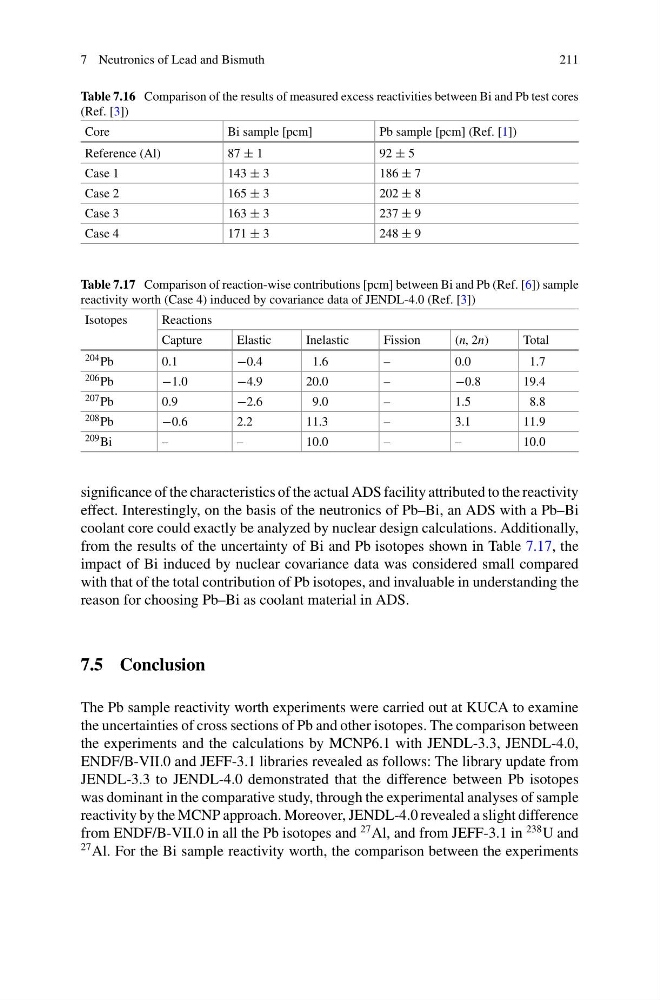
Table 7.16 Comparison of the results of measured excess reactivities between Bi and Pb test cores
(Ref. [3])
Core
Bi sample [pcm]
Pb sample [pcm] (Ref. [1])
Reference (Al)
87 ± 1
92 ± 5
Case 1
143 ± 3
186 ± 7
Case 2
165 ± 3
202 ± 8
Case 3
163 ± 3
237 ± 9
Case 4
171 ± 3
248 ± 9
Table 7.17 Comparison of reaction-wise contributions [pcm] between Bi and Pb (Ref. [6]) sample
reactivity worth (Case 4) induced by covariance data of JENDL-4.0 (Ref. [3])
Isotopes
Reactions
Capture
Elastic
Inelastic
Fission
(n, 2n)
Total
204 Pb
0.1
−0.4
1.6
–
0.0
1.7
206 Pb
−1.0
−4.9
20.0
–
−0.8
19.4
207 Pb
0.9
−2.6
9.0
–
1.5
8.8
208 Pb
−0.6
2.2
11.3
–
3.1
11.9
209 Bi
–
–
10.0
–
–
10.0
significance of the characteristics of the actual ADS facility attributed to the reactivity
effect. Interestingly, on the basis of the neutronics of Pb–Bi, an ADS with a Pb–Bi
coolant core could exactly be analyzed by nuclear design calculations. Additionally,
from the results of the uncertainty of Bi and Pb isotopes shown in Table 7.17, the
impact of Bi induced by nuclear covariance data was considered small compared
with that of the total contribution of Pb isotopes, and invaluable in understanding the
reason for choosing Pb–Bi as coolant material in ADS.
7.5 Conclusion
The Pb sample reactivity worth experiments were carried out at KUCA to examine
the uncertainties of cross sections of Pb and other isotopes. The comparison between
the experiments and the calculations by MCNP6.1 with JENDL-3.3, JENDL-4.0,
ENDF/B-VII.0 and JEFF-3.1 libraries revealed as follows: The library update from
JENDL-3.3 to JENDL-4.0 demonstrated that the difference between Pb isotopes
was dominant in the comparative study, through the experimental analyses of sample
reactivity by the MCNP approach. Moreover, JENDL-4.0 revealed a slight difference
from ENDF/B-VII.0 in all the Pb isotopes and
27 Al, and from JEFF-3.1 in
238 U and
27 Al. For the Bi sample reactivity worth, the comparison between the experiments
211
Table 7.16 Comparison of the results of measured excess reactivities between Bi and Pb test cores
(Ref. [3])
Core
Bi sample [pcm]
Pb sample [pcm] (Ref. [1])
Reference (Al)
87 ± 1
92 ± 5
Case 1
143 ± 3
186 ± 7
Case 2
165 ± 3
202 ± 8
Case 3
163 ± 3
237 ± 9
Case 4
171 ± 3
248 ± 9
Table 7.17 Comparison of reaction-wise contributions [pcm] between Bi and Pb (Ref. [6]) sample
reactivity worth (Case 4) induced by covariance data of JENDL-4.0 (Ref. [3])
Isotopes
Reactions
Capture
Elastic
Inelastic
Fission
(n, 2n)
Total
204 Pb
0.1
−0.4
1.6
–
0.0
1.7
206 Pb
−1.0
−4.9
20.0
–
−0.8
19.4
207 Pb
0.9
−2.6
9.0
–
1.5
8.8
208 Pb
−0.6
2.2
11.3
–
3.1
11.9
209 Bi
–
–
10.0
–
–
10.0
significance of the characteristics of the actual ADS facility attributed to the reactivity
effect. Interestingly, on the basis of the neutronics of Pb–Bi, an ADS with a Pb–Bi
coolant core could exactly be analyzed by nuclear design calculations. Additionally,
from the results of the uncertainty of Bi and Pb isotopes shown in Table 7.17, the
impact of Bi induced by nuclear covariance data was considered small compared
with that of the total contribution of Pb isotopes, and invaluable in understanding the
reason for choosing Pb–Bi as coolant material in ADS.
7.5 Conclusion
The Pb sample reactivity worth experiments were carried out at KUCA to examine
the uncertainties of cross sections of Pb and other isotopes. The comparison between
the experiments and the calculations by MCNP6.1 with JENDL-3.3, JENDL-4.0,
ENDF/B-VII.0 and JEFF-3.1 libraries revealed as follows: The library update from
JENDL-3.3 to JENDL-4.0 demonstrated that the difference between Pb isotopes
was dominant in the comparative study, through the experimental analyses of sample
reactivity by the MCNP approach. Moreover, JENDL-4.0 revealed a slight difference
from ENDF/B-VII.0 in all the Pb isotopes and
27 Al, and from JEFF-3.1 in
238 U and
27 Al. For the Bi sample reactivity worth, the comparison between the experiments