

7 Neutronics of Lead and Bismuth
195
where A and F indicate operators of transport and fission terms, respectively, and
φ the forward neutron flux. Multiplying Eq. (7.8) by adjoint neutron flux φ
* and
integrating over whole volume and energy, the following equation is obtained:
1
k eff
=
φ
∗ Aφ
φ ∗ Fφ
,
(7.9)
where brackets <> indicate an integration over the whole volume and energy.
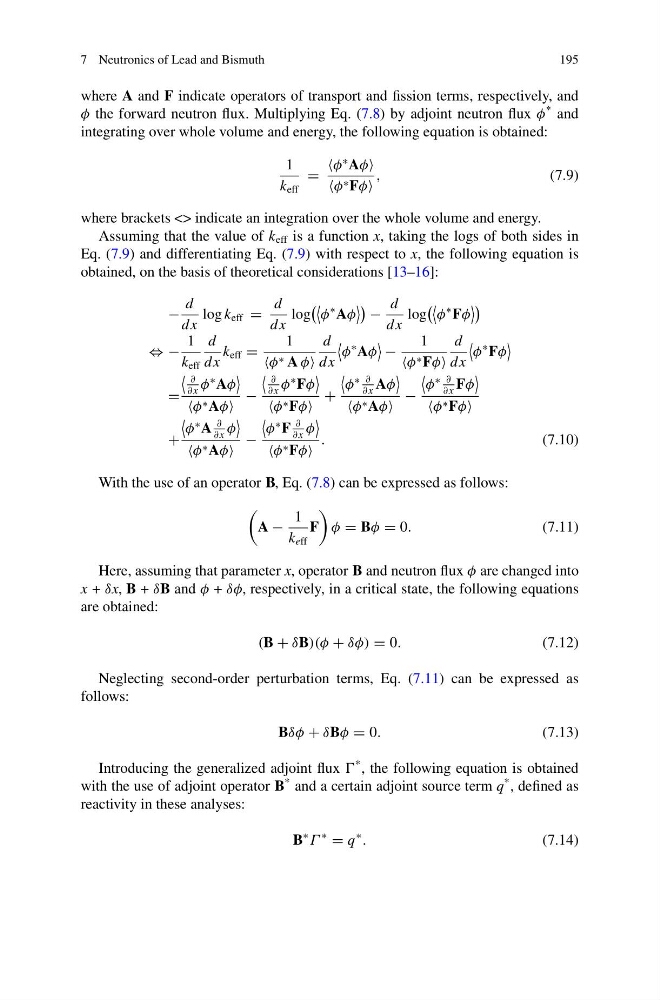
Assuming that the value of k eff is a function x, taking the logs of both sides in
Eq. (7.9) and differentiating Eq. (7.9) with respect to x, the following equation is
obtained, on the basis of theoretical considerations [13–16]:
−
d
dx
log k eff =
d
dx
log
φ
∗ Aφ
−
d
dx
log
φ
∗ Fφ
⇔ −
1
k eff
d
dx
k eff =
1
φ ∗ A φ
d
dx
φ
∗ Aφ
−
1
φ ∗ Fφ
d
dx
φ
∗ Fφ
=
∂
∂ x
φ
∗ Aφ
φ ∗ Aφ
−
∂
∂ x
φ
∗ Fφ
φ ∗ Fφ
+
φ
∗ ∂
∂ x
Aφ
φ ∗ Aφ
−
φ
∗ ∂
∂ x
Fφ
φ ∗ Fφ
+
φ
∗ A
∂
∂ x
φ
φ ∗ Aφ
−
φ
∗ F
∂
∂ x
φ
φ ∗ Fφ
.
(7.10)
With the use of an operator B, Eq. (7.8) can be expressed as follows:
A −
1
k eff
F
φ = Bφ = 0.
(7.11)
Here, assuming that parameter x, operator B and neutron flux φ are changed into
x + δx, B + δB and φ + δφ, respectively, in a critical state, the following equations
are obtained:
(B + δB)(φ + δφ) = 0.
(7.12)
Neglecting second-order perturbation terms, Eq. (7.11) can be expressed as
follows:
Bδφ + δBφ = 0.
(7.13)
Introducing the generalized adjoint flux
* , the following equation is obtained
with the use of adjoint operator B
* and a certain adjoint source term q
* , defined as
reactivity in these analyses:
B
∗
Γ
∗
= q
∗
.
(7.14)
195
where A and F indicate operators of transport and fission terms, respectively, and
φ the forward neutron flux. Multiplying Eq. (7.8) by adjoint neutron flux φ
* and
integrating over whole volume and energy, the following equation is obtained:
1
k eff
=
φ
∗ Aφ
φ ∗ Fφ
,
(7.9)
where brackets <> indicate an integration over the whole volume and energy.
Assuming that the value of k eff is a function x, taking the logs of both sides in
Eq. (7.9) and differentiating Eq. (7.9) with respect to x, the following equation is
obtained, on the basis of theoretical considerations [13–16]:
−
d
dx
log k eff =
d
dx
log
φ
∗ Aφ
−
d
dx
log
φ
∗ Fφ
⇔ −
1
k eff
d
dx
k eff =
1
φ ∗ A φ
d
dx
φ
∗ Aφ
−
1
φ ∗ Fφ
d
dx
φ
∗ Fφ
=
∂
∂ x
φ
∗ Aφ
φ ∗ Aφ
−
∂
∂ x
φ
∗ Fφ
φ ∗ Fφ
+
φ
∗ ∂
∂ x
Aφ
φ ∗ Aφ
−
φ
∗ ∂
∂ x
Fφ
φ ∗ Fφ
+
φ
∗ A
∂
∂ x
φ
φ ∗ Aφ
−
φ
∗ F
∂
∂ x
φ
φ ∗ Fφ
.
(7.10)
With the use of an operator B, Eq. (7.8) can be expressed as follows:
A −
1
k eff
F
φ = Bφ = 0.
(7.11)
Here, assuming that parameter x, operator B and neutron flux φ are changed into
x + δx, B + δB and φ + δφ, respectively, in a critical state, the following equations
are obtained:
(B + δB)(φ + δφ) = 0.
(7.12)
Neglecting second-order perturbation terms, Eq. (7.11) can be expressed as
follows:
Bδφ + δBφ = 0.
(7.13)
Introducing the generalized adjoint flux
* , the following equation is obtained
with the use of adjoint operator B
* and a certain adjoint source term q
* , defined as
reactivity in these analyses:
B
∗
Γ
∗
= q
∗
.
(7.14)