

194
C. H. Pyeon
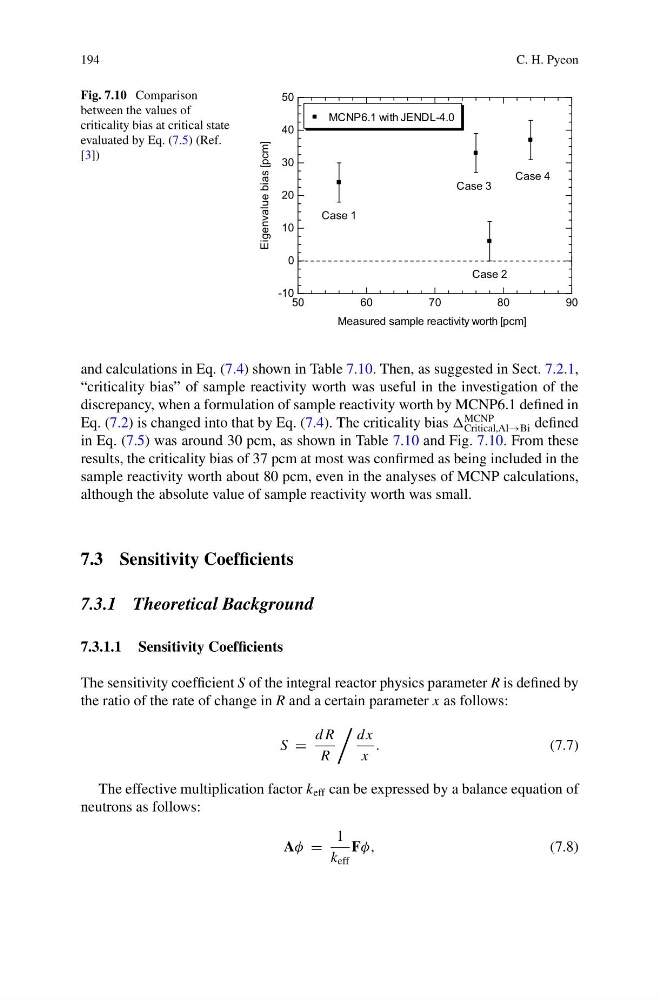
Fig. 7.10 Comparison
between the values of
criticality bias at critical state
evaluated by Eq. (7.5) (Ref.
[3])
50
60
70
80
90
-10
0
10
20
30
40
50
Measured sample reactivity worth [pcm]
Eigenvalue bias [pcm]
MCNP6.1 with JENDL-4.0
Case 1
Case 2
Case 3
Case 4
and calculations in Eq. (7.4) shown in Table 7.10. Then, as suggested in Sect. 7.2.1,
“criticality bias” of sample reactivity worth was useful in the investigation of the
discrepancy, when a formulation of sample reactivity worth by MCNP6.1 defined in
Eq. (7.2) is changed into that by Eq. (7.4). The criticality bias
MCNP
Critical,Al→Bi defined
in Eq. (7.5) was around 30 pcm, as shown in Table 7.10 and Fig. 7.10. From these
results, the criticality bias of 37 pcm at most was confirmed as being included in the
sample reactivity worth about 80 pcm, even in the analyses of MCNP calculations,
although the absolute value of sample reactivity worth was small.
7.3 Sensitivity Coefficients
7.3.1 Theoretical Background
7.3.1.1 Sensitivity Coefficients
The sensitivity coefficient S of the integral reactor physics parameter R is defined by
the ratio of the rate of change in R and a certain parameter x as follows:
S =
d R
R
dx
x
.
(7.7)
The effective multiplication factor k eff can be expressed by a balance equation of
neutrons as follows:
Aφ =
1
k eff
Fφ,
(7.8)
C. H. Pyeon
Fig. 7.10 Comparison
between the values of
criticality bias at critical state
evaluated by Eq. (7.5) (Ref.
[3])
50
60
70
80
90
-10
0
10
20
30
40
50
Measured sample reactivity worth [pcm]
Eigenvalue bias [pcm]
MCNP6.1 with JENDL-4.0
Case 1
Case 2
Case 3
Case 4
and calculations in Eq. (7.4) shown in Table 7.10. Then, as suggested in Sect. 7.2.1,
“criticality bias” of sample reactivity worth was useful in the investigation of the
discrepancy, when a formulation of sample reactivity worth by MCNP6.1 defined in
Eq. (7.2) is changed into that by Eq. (7.4). The criticality bias
MCNP
Critical,Al→Bi defined
in Eq. (7.5) was around 30 pcm, as shown in Table 7.10 and Fig. 7.10. From these
results, the criticality bias of 37 pcm at most was confirmed as being included in the
sample reactivity worth about 80 pcm, even in the analyses of MCNP calculations,
although the absolute value of sample reactivity worth was small.
7.3 Sensitivity Coefficients
7.3.1 Theoretical Background
7.3.1.1 Sensitivity Coefficients
The sensitivity coefficient S of the integral reactor physics parameter R is defined by
the ratio of the rate of change in R and a certain parameter x as follows:
S =
d R
R
dx
x
.
(7.7)
The effective multiplication factor k eff can be expressed by a balance equation of
neutrons as follows:
Aφ =
1
k eff
Fφ,
(7.8)