

196
C. H. Pyeon
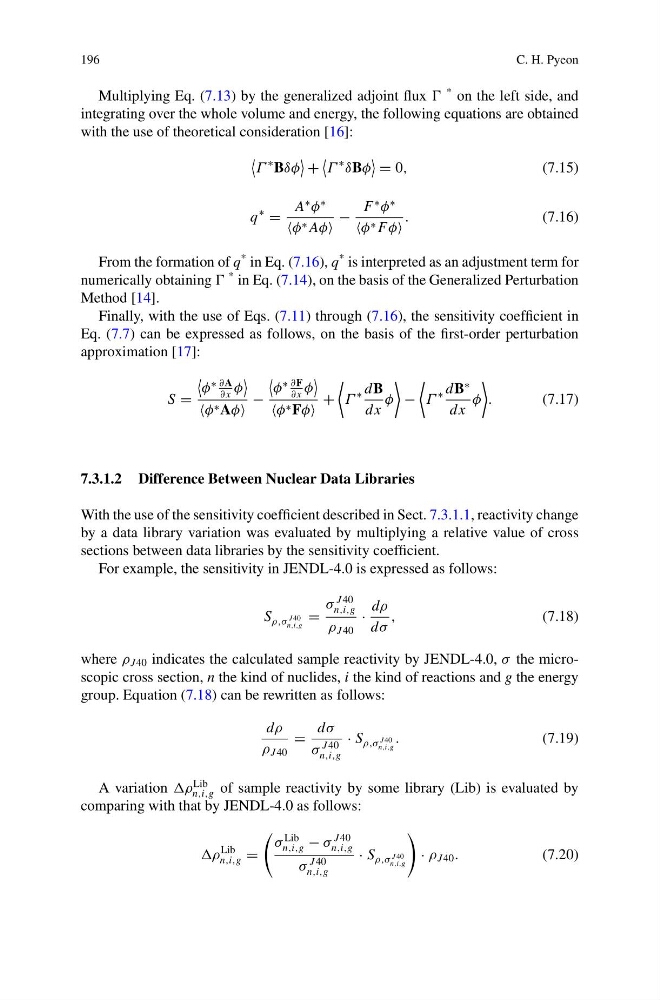
Multiplying Eq. (7.13) by the generalized adjoint flux
* on the left side, and
integrating over the whole volume and energy, the following equations are obtained
with the use of theoretical consideration [16]:
Γ
∗ Bδφ
+
Γ
∗
δBφ
= 0,
(7.15)
q
∗
=
A
∗
φ
∗
φ ∗ Aφ
−
F
∗
φ
∗
φ ∗ Fφ
.
(7.16)
From the formation of q
* in Eq. (7.16), q
* is interpreted as an adjustment term for
numerically obtaining
* in Eq. (7.14), on the basis of the Generalized Perturbation
Method [14].
Finally, with the use of Eqs. (7.11) through (7.16), the sensitivity coefficient in
Eq. (7.7) can be expressed as follows, on the basis of the first-order perturbation
approximation [17]:
S =
φ
∗ ∂A
∂ x
φ
φ ∗ Aφ
−
φ
∗ ∂F
∂ x
φ
φ ∗ Fφ
+
Γ
∗ dB
dx
φ
−
Γ
∗ dB
∗
dx
φ
.
(7.17)
7.3.1.2 Difference Between Nuclear Data Libraries
With the use of the sensitivity coefficient described in Sect. 7.3.1.1, reactivity change
by a data library variation was evaluated by multiplying a relative value of cross
sections between data libraries by the sensitivity coefficient.
For example, the sensitivity in JENDL-4.0 is expressed as follows:
S ρ,σ
J 40
n,i,g
=
σ
J 40
n,i,g
ρ J 40
·
dρ
dσ
,
(7.18)
where ρ J40 indicates the calculated sample reactivity by JENDL-4.0, σ the microscopic cross section, n the kind of nuclides, i the kind of reactions and g the energy
group. Equation (7.18) can be rewritten as follows:
dρ
ρ J 40
=
dσ
σ
J 40
n,i,g
· S ρ,σ
J 40
n,i,g
.
(7.19)
A variation ρ
Lib
n,i,g of sample reactivity by some library (Lib) is evaluated by
comparing with that by JENDL-4.0 as follows:
ρ
Lib
n,i,g =
σ
Lib
n,i,g − σ
J 40
n,i,g
σ
J 40
n,i,g
· S ρ,σ
J 40
n,i,g
· ρ J 40 .
(7.20)
C. H. Pyeon
Multiplying Eq. (7.13) by the generalized adjoint flux
* on the left side, and
integrating over the whole volume and energy, the following equations are obtained
with the use of theoretical consideration [16]:
Γ
∗ Bδφ
+
Γ
∗
δBφ
= 0,
(7.15)
q
∗
=
A
∗
φ
∗
φ ∗ Aφ
−
F
∗
φ
∗
φ ∗ Fφ
.
(7.16)
From the formation of q
* in Eq. (7.16), q
* is interpreted as an adjustment term for
numerically obtaining
* in Eq. (7.14), on the basis of the Generalized Perturbation
Method [14].
Finally, with the use of Eqs. (7.11) through (7.16), the sensitivity coefficient in
Eq. (7.7) can be expressed as follows, on the basis of the first-order perturbation
approximation [17]:
S =
φ
∗ ∂A
∂ x
φ
φ ∗ Aφ
−
φ
∗ ∂F
∂ x
φ
φ ∗ Fφ
+
Γ
∗ dB
dx
φ
−
Γ
∗ dB
∗
dx
φ
.
(7.17)
7.3.1.2 Difference Between Nuclear Data Libraries
With the use of the sensitivity coefficient described in Sect. 7.3.1.1, reactivity change
by a data library variation was evaluated by multiplying a relative value of cross
sections between data libraries by the sensitivity coefficient.
For example, the sensitivity in JENDL-4.0 is expressed as follows:
S ρ,σ
J 40
n,i,g
=
σ
J 40
n,i,g
ρ J 40
·
dρ
dσ
,
(7.18)
where ρ J40 indicates the calculated sample reactivity by JENDL-4.0, σ the microscopic cross section, n the kind of nuclides, i the kind of reactions and g the energy
group. Equation (7.18) can be rewritten as follows:
dρ
ρ J 40
=
dσ
σ
J 40
n,i,g
· S ρ,σ
J 40
n,i,g
.
(7.19)
A variation ρ
Lib
n,i,g of sample reactivity by some library (Lib) is evaluated by
comparing with that by JENDL-4.0 as follows:
ρ
Lib
n,i,g =
σ
Lib
n,i,g − σ
J 40
n,i,g
σ
J 40
n,i,g
· S ρ,σ
J 40
n,i,g
· ρ J 40 .
(7.20)