

146
C. H. Pyeon
ahead at the target and influenced by the acryl plate. Thus, the spallation neutrons
were considered significantly spherical in the angular distribution through the results
in numerical simulations, although their angular distribution was observed actually
reversed at the target. Subsequently, the neutron yield at the target was evaluated at
(9.73 ± 0.12) × 10
4 s
−1 over 20 MeV and (1.03 ± 0.04) × 10
7 s
−1 over 0.3 MeV
from the measured reaction rates of Bi and In foils, respectively.
The main characteristics of the measurements by the organic liquid scintillator
are to acquire two signals of prompt (electrons) and delayed (protons, deuterons, or
α-ray, etc.) fluorescence components and to discriminate γ-ray and neutron events
caused by the two signals, respectively. Thus, the discrimination between the γ-ray
and the neutron was possibly caused by the difference between their fluorescence
intensities in a time-dependent manner.
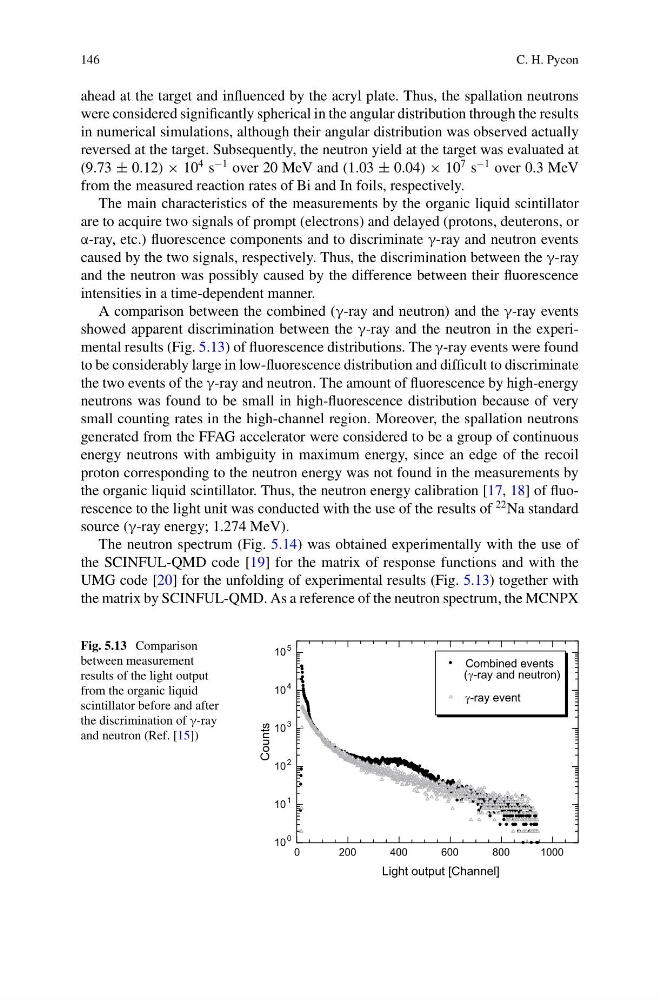
A comparison between the combined (γ-ray and neutron) and the γ-ray events
showed apparent discrimination between the γ-ray and the neutron in the experimental results (Fig. 5.13) of fluorescence distributions. The γ-ray events were found
to be considerably large in low-fluorescence distribution and difficult to discriminate
the two events of the γ-ray and neutron. The amount of fluorescence by high-energy
neutrons was found to be small in high-fluorescence distribution because of very
small counting rates in the high-channel region. Moreover, the spallation neutrons
generated from the FFAG accelerator were considered to be a group of continuous
energy neutrons with ambiguity in maximum energy, since an edge of the recoil
proton corresponding to the neutron energy was not found in the measurements by
the organic liquid scintillator. Thus, the neutron energy calibration [17, 18] of fluorescence to the light unit was conducted with the use of the results of
22 Na standard
source (γ-ray energy; 1.274 MeV).
The neutron spectrum (Fig. 5.14) was obtained experimentally with the use of
the SCINFUL-QMD code [19] for the matrix of response functions and with the
UMG code [20] for the unfolding of experimental results (Fig. 5.13) together with
the matrix by SCINFUL-QMD. As a reference of the neutron spectrum, the MCNPX
Fig. 5.13 Comparison
between measurement
results of the light output
from the organic liquid
scintillator before and after
the discrimination of γ-ray
and neutron (Ref. [15])
0
200
400
600
800
1000
10
0
10
1
10
2
10
3
10
4
10
5
Light output [Channel]
Counts
Combined events
( -ray and neutron)
-ray event
C. H. Pyeon
ahead at the target and influenced by the acryl plate. Thus, the spallation neutrons
were considered significantly spherical in the angular distribution through the results
in numerical simulations, although their angular distribution was observed actually
reversed at the target. Subsequently, the neutron yield at the target was evaluated at
(9.73 ± 0.12) × 10
4 s
−1 over 20 MeV and (1.03 ± 0.04) × 10
7 s
−1 over 0.3 MeV
from the measured reaction rates of Bi and In foils, respectively.
The main characteristics of the measurements by the organic liquid scintillator
are to acquire two signals of prompt (electrons) and delayed (protons, deuterons, or
α-ray, etc.) fluorescence components and to discriminate γ-ray and neutron events
caused by the two signals, respectively. Thus, the discrimination between the γ-ray
and the neutron was possibly caused by the difference between their fluorescence
intensities in a time-dependent manner.
A comparison between the combined (γ-ray and neutron) and the γ-ray events
showed apparent discrimination between the γ-ray and the neutron in the experimental results (Fig. 5.13) of fluorescence distributions. The γ-ray events were found
to be considerably large in low-fluorescence distribution and difficult to discriminate
the two events of the γ-ray and neutron. The amount of fluorescence by high-energy
neutrons was found to be small in high-fluorescence distribution because of very
small counting rates in the high-channel region. Moreover, the spallation neutrons
generated from the FFAG accelerator were considered to be a group of continuous
energy neutrons with ambiguity in maximum energy, since an edge of the recoil
proton corresponding to the neutron energy was not found in the measurements by
the organic liquid scintillator. Thus, the neutron energy calibration [17, 18] of fluorescence to the light unit was conducted with the use of the results of
22 Na standard
source (γ-ray energy; 1.274 MeV).
The neutron spectrum (Fig. 5.14) was obtained experimentally with the use of
the SCINFUL-QMD code [19] for the matrix of response functions and with the
UMG code [20] for the unfolding of experimental results (Fig. 5.13) together with
the matrix by SCINFUL-QMD. As a reference of the neutron spectrum, the MCNPX
Fig. 5.13 Comparison
between measurement
results of the light output
from the organic liquid
scintillator before and after
the discrimination of γ-ray
and neutron (Ref. [15])
0
200
400
600
800
1000
10
0
10
1
10
2
10
3
10
4
10
5
Light output [Channel]
Counts
Combined events
( -ray and neutron)
-ray event