

5 Neutron Spectrum
147
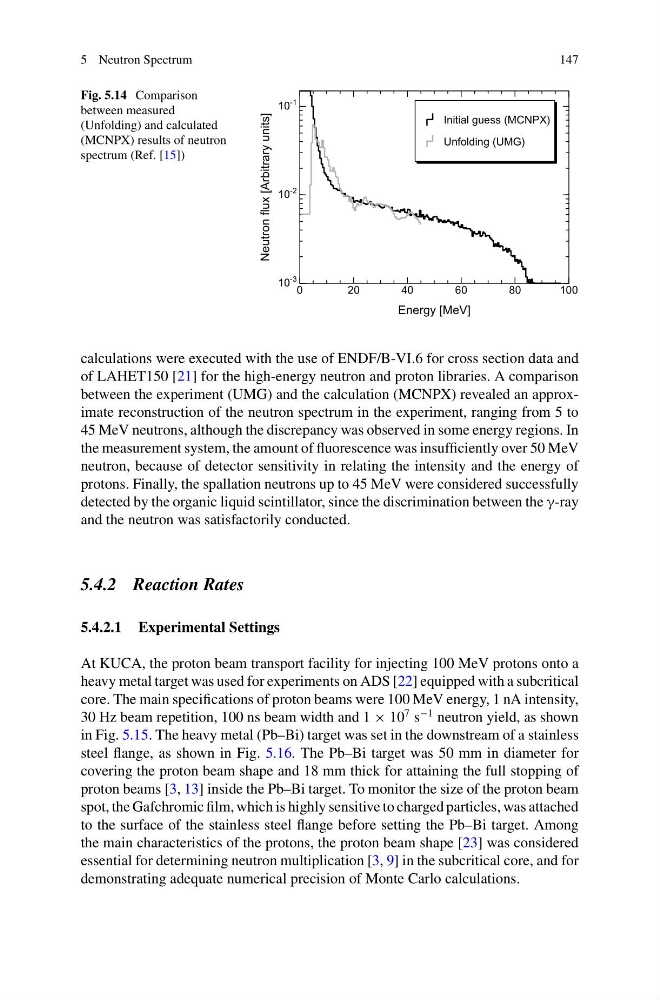
Fig. 5.14 Comparison
between measured
(Unfolding) and calculated
(MCNPX) results of neutron
spectrum (Ref. [15])
0
20
40
60
80
100
10
-3
10
-2
10
-1
Energy [MeV]
Neutron flux [Arbitrary units]
Initial guess (MCNPX)
Unfolding (UMG)
calculations were executed with the use of ENDF/B-VI.6 for cross section data and
of LAHET150 [21] for the high-energy neutron and proton libraries. A comparison
between the experiment (UMG) and the calculation (MCNPX) revealed an approximate reconstruction of the neutron spectrum in the experiment, ranging from 5 to
45 MeV neutrons, although the discrepancy was observed in some energy regions. In
the measurement system, the amount of fluorescence was insufficiently over 50 MeV
neutron, because of detector sensitivity in relating the intensity and the energy of
protons. Finally, the spallation neutrons up to 45 MeV were considered successfully
detected by the organic liquid scintillator, since the discrimination between the γ-ray
and the neutron was satisfactorily conducted.
5.4.2 Reaction Rates
5.4.2.1 Experimental Settings
At KUCA, the proton beam transport facility for injecting 100 MeV protons onto a
heavy metal target was used for experiments on ADS [22] equipped with a subcritical
core. The main specifications of proton beams were 100 MeV energy, 1 nA intensity,
30 Hz beam repetition, 100 ns beam width and 1 × 10
7 s
−1 neutron yield, as shown
in Fig. 5.15. The heavy metal (Pb–Bi) target was set in the downstream of a stainless
steel flange, as shown in Fig. 5.16. The Pb–Bi target was 50 mm in diameter for
covering the proton beam shape and 18 mm thick for attaining the full stopping of
proton beams [3, 13] inside the Pb–Bi target. To monitor the size of the proton beam
spot, the Gafchromic film, which is highly sensitive to charged particles, was attached
to the surface of the stainless steel flange before setting the Pb–Bi target. Among
the main characteristics of the protons, the proton beam shape [23] was considered
essential for determining neutron multiplication [3, 9] in the subcritical core, and for
demonstrating adequate numerical precision of Monte Carlo calculations.
147
Fig. 5.14 Comparison
between measured
(Unfolding) and calculated
(MCNPX) results of neutron
spectrum (Ref. [15])
0
20
40
60
80
100
10
-3
10
-2
10
-1
Energy [MeV]
Neutron flux [Arbitrary units]
Initial guess (MCNPX)
Unfolding (UMG)
calculations were executed with the use of ENDF/B-VI.6 for cross section data and
of LAHET150 [21] for the high-energy neutron and proton libraries. A comparison
between the experiment (UMG) and the calculation (MCNPX) revealed an approximate reconstruction of the neutron spectrum in the experiment, ranging from 5 to
45 MeV neutrons, although the discrepancy was observed in some energy regions. In
the measurement system, the amount of fluorescence was insufficiently over 50 MeV
neutron, because of detector sensitivity in relating the intensity and the energy of
protons. Finally, the spallation neutrons up to 45 MeV were considered successfully
detected by the organic liquid scintillator, since the discrimination between the γ-ray
and the neutron was satisfactorily conducted.
5.4.2 Reaction Rates
5.4.2.1 Experimental Settings
At KUCA, the proton beam transport facility for injecting 100 MeV protons onto a
heavy metal target was used for experiments on ADS [22] equipped with a subcritical
core. The main specifications of proton beams were 100 MeV energy, 1 nA intensity,
30 Hz beam repetition, 100 ns beam width and 1 × 10
7 s
−1 neutron yield, as shown
in Fig. 5.15. The heavy metal (Pb–Bi) target was set in the downstream of a stainless
steel flange, as shown in Fig. 5.16. The Pb–Bi target was 50 mm in diameter for
covering the proton beam shape and 18 mm thick for attaining the full stopping of
proton beams [3, 13] inside the Pb–Bi target. To monitor the size of the proton beam
spot, the Gafchromic film, which is highly sensitive to charged particles, was attached
to the surface of the stainless steel flange before setting the Pb–Bi target. Among
the main characteristics of the protons, the proton beam shape [23] was considered
essential for determining neutron multiplication [3, 9] in the subcritical core, and for
demonstrating adequate numerical precision of Monte Carlo calculations.