

5 Neutron Spectrum
145
The comparison between measured and calculated results of the reaction rates at 90
degrees is listed in Table 5.10. The highest reaction rate was observed at the center
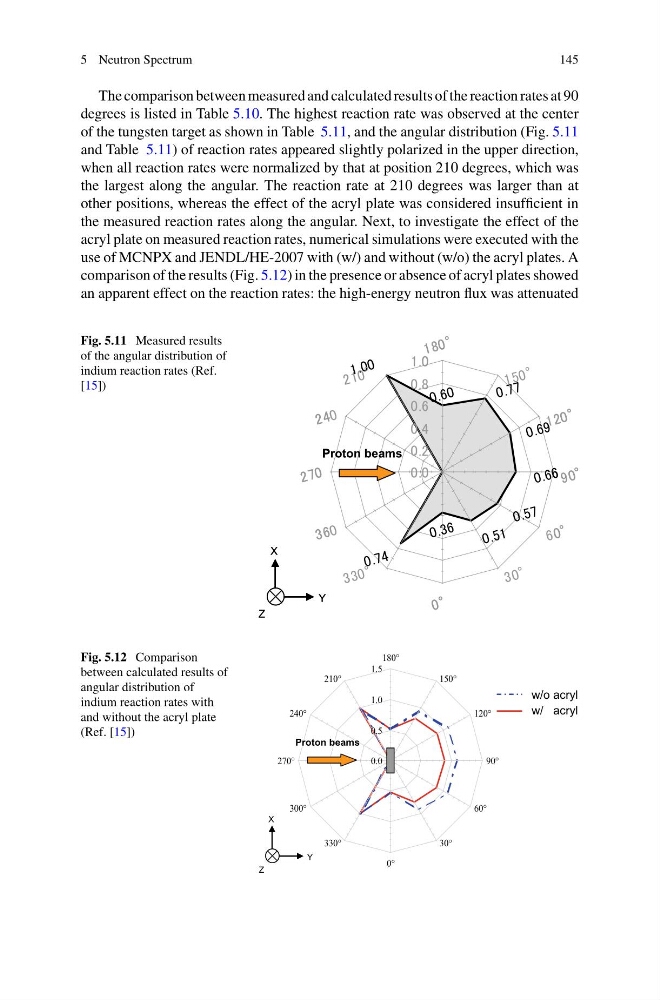
of the tungsten target as shown in Table 5.11, and the angular distribution (Fig. 5.11
and Table 5.11) of reaction rates appeared slightly polarized in the upper direction,
when all reaction rates were normalized by that at position 210 degrees, which was
the largest along the angular. The reaction rate at 210 degrees was larger than at
other positions, whereas the effect of the acryl plate was considered insufficient in
the measured reaction rates along the angular. Next, to investigate the effect of the
acryl plate on measured reaction rates, numerical simulations were executed with the
use of MCNPX and JENDL/HE-2007 with (w/) and without (w/o) the acryl plates. A
comparison of the results (Fig. 5.12) in the presence or absence of acryl plates showed
an apparent effect on the reaction rates: the high-energy neutron flux was attenuated
Fig. 5.11 Measured results
of the angular distribution of
indium reaction rates (Ref.
[15])
Fig. 5.12 Comparison
between calculated results of
angular distribution of
indium reaction rates with
and without the acryl plate
(Ref. [15])
0.0
0.5
1.0
1.5
180°
150°
120°
90°
60°
30°
0°
330°
300°
270°
240°
210°
Proton beams
Y
X
Z
w/o acryl
w/ acryl
145
The comparison between measured and calculated results of the reaction rates at 90
degrees is listed in Table 5.10. The highest reaction rate was observed at the center
of the tungsten target as shown in Table 5.11, and the angular distribution (Fig. 5.11
and Table 5.11) of reaction rates appeared slightly polarized in the upper direction,
when all reaction rates were normalized by that at position 210 degrees, which was
the largest along the angular. The reaction rate at 210 degrees was larger than at
other positions, whereas the effect of the acryl plate was considered insufficient in
the measured reaction rates along the angular. Next, to investigate the effect of the
acryl plate on measured reaction rates, numerical simulations were executed with the
use of MCNPX and JENDL/HE-2007 with (w/) and without (w/o) the acryl plates. A
comparison of the results (Fig. 5.12) in the presence or absence of acryl plates showed
an apparent effect on the reaction rates: the high-energy neutron flux was attenuated
Fig. 5.11 Measured results
of the angular distribution of
indium reaction rates (Ref.
[15])
Fig. 5.12 Comparison
between calculated results of
angular distribution of
indium reaction rates with
and without the acryl plate
(Ref. [15])
0.0
0.5
1.0
1.5
180°
150°
120°
90°
60°
30°
0°
330°
300°
270°
240°
210°
Proton beams
Y
X
Z
w/o acryl
w/ acryl