

The D. vulgaris SeCys–W–FDH, on the other hand, is better suited for CO 2
reduction, with a k cat
CO
2 % 315 s
−1 (K
CO 2
m
% 420 lM; k
CO 2 % 0.75 Â 10
6 M
−1 s
−1 )
[132]. Even though the CO 2 specificity of this enzyme is considerably lower (100
times) than that for formate (k cat
HCOO−
% 1310 s
−1 ; K m
HCOO−
% 17 lM; k
HCOO
−
% 77.5 Â 10
6 M
−1 s
−1 [132]), this D. vulgaris W-FDH is at the base of several
very well succeeded proof-of-principle devices for semi-artificial photosynthesis
and production/storage of dihydrogen. A D. vulgaris W-FDH-containing cathode
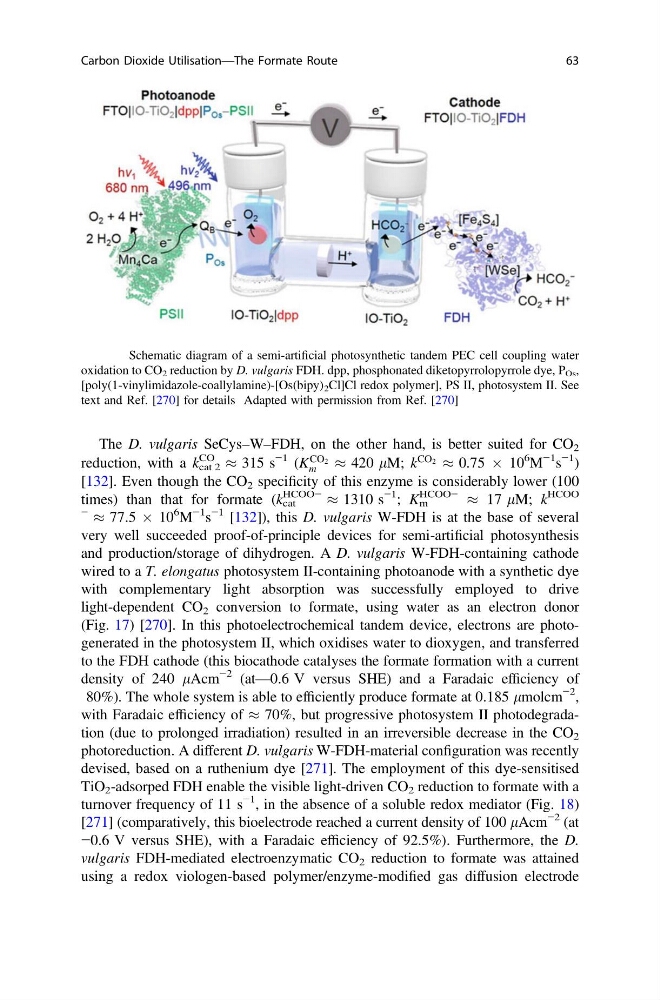
wired to a T. elongatus photosystem II-containing photoanode with a synthetic dye
with complementary light absorption was successfully employed to drive
light-dependent CO 2 conversion to formate, using water as an electron donor
(Fig. 17) [270]. In this photoelectrochemical tandem device, electrons are photogenerated in the photosystem II, which oxidises water to dioxygen, and transferred
to the FDH cathode (this biocathode catalyses the formate formation with a current
density of 240 lAcm
−2 (at—0.6 V versus SHE) and a Faradaic efficiency of
80%). The whole system is able to efficiently produce formate at 0.185 lmolcm
−2 ,
with Faradaic efficiency of % 70%, but progressive photosystem II photodegradation (due to prolonged irradiation) resulted in an irreversible decrease in the CO 2
photoreduction. A different D. vulgaris W-FDH-material configuration was recently
devised, based on a ruthenium dye [271]. The employment of this dye-sensitised
TiO 2 -adsorped FDH enable the visible light-driven CO 2 reduction to formate with a
turnover frequency of 11 s
−1 , in the absence of a soluble redox mediator (Fig. 18)
[271] (comparatively, this bioelectrode reached a current density of 100 lAcm
−2 (at
−0.6 V versus SHE), with a Faradaic efficiency of 92.5%). Furthermore, the D.
vulgaris FDH-mediated electroenzymatic CO 2 reduction to formate was attained
using a redox viologen-based polymer/enzyme-modified gas diffusion electrode
Fig. 17 Schematic diagram of a semi-artificial photosynthetic tandem PEC cell coupling water
oxidation to CO 2 reduction by D. vulgaris FDH. dpp, phosphonated diketopyrrolopyrrole dye, P Os ,
[poly(1-vinylimidazole-coallylamine)-[Os(bipy) 2 Cl]Cl redox polymer], PS II, photosystem II. See
text and Ref. [270] for details Adapted with permission from Ref. [270]
Carbon Dioxide Utilisation—The Formate Route
63
reduction, with a k cat
CO
2 % 315 s
−1 (K
CO 2
m
% 420 lM; k
CO 2 % 0.75 Â 10
6 M
−1 s
−1 )
[132]. Even though the CO 2 specificity of this enzyme is considerably lower (100
times) than that for formate (k cat
HCOO−
% 1310 s
−1 ; K m
HCOO−
% 17 lM; k
HCOO
−
% 77.5 Â 10
6 M
−1 s
−1 [132]), this D. vulgaris W-FDH is at the base of several
very well succeeded proof-of-principle devices for semi-artificial photosynthesis
and production/storage of dihydrogen. A D. vulgaris W-FDH-containing cathode
wired to a T. elongatus photosystem II-containing photoanode with a synthetic dye
with complementary light absorption was successfully employed to drive
light-dependent CO 2 conversion to formate, using water as an electron donor
(Fig. 17) [270]. In this photoelectrochemical tandem device, electrons are photogenerated in the photosystem II, which oxidises water to dioxygen, and transferred
to the FDH cathode (this biocathode catalyses the formate formation with a current
density of 240 lAcm
−2 (at—0.6 V versus SHE) and a Faradaic efficiency of
80%). The whole system is able to efficiently produce formate at 0.185 lmolcm
−2 ,
with Faradaic efficiency of % 70%, but progressive photosystem II photodegradation (due to prolonged irradiation) resulted in an irreversible decrease in the CO 2
photoreduction. A different D. vulgaris W-FDH-material configuration was recently
devised, based on a ruthenium dye [271]. The employment of this dye-sensitised
TiO 2 -adsorped FDH enable the visible light-driven CO 2 reduction to formate with a
turnover frequency of 11 s
−1 , in the absence of a soluble redox mediator (Fig. 18)
[271] (comparatively, this bioelectrode reached a current density of 100 lAcm
−2 (at
−0.6 V versus SHE), with a Faradaic efficiency of 92.5%). Furthermore, the D.
vulgaris FDH-mediated electroenzymatic CO 2 reduction to formate was attained
using a redox viologen-based polymer/enzyme-modified gas diffusion electrode
Fig. 17 Schematic diagram of a semi-artificial photosynthetic tandem PEC cell coupling water
oxidation to CO 2 reduction by D. vulgaris FDH. dpp, phosphonated diketopyrrolopyrrole dye, P Os ,
[poly(1-vinylimidazole-coallylamine)-[Os(bipy) 2 Cl]Cl redox polymer], PS II, photosystem II. See
text and Ref. [270] for details Adapted with permission from Ref. [270]
Carbon Dioxide Utilisation—The Formate Route
63