

quinols, cytoplasmatic and periplasmatic cytochromes, ferredoxins, NAD(P) or
coenzyme F 420 [94–101]. For those enzymes like the dihydrogen-dependent
CO 2 reductase (see above), the electrons are directly provided by the
co-substrate oxidation (dihydrogen in this case) that occurs in the enzyme
second active site. As a consequence of the physical separation of the oxidation
and reduction half-reactions (that occur at different enzyme centres), all these
enzymes operate via a ping-pong kinetic mechanism, as observed
experimentally.
HCOO
À
þ Mo=W
6 þ
CO 2 þ H
þ
þ Mo=W
4 þ
ð5aÞ
Mo=W
4 þ
þ Physiol: Partner
oxidised
Mo=W
6 þ
þ Physiol: Partner
reduced
ð5bÞ
CO 2 þ H
þ
þ Mo=W
4 þ
HCOO
À
þ Mo=W
6 þ
ð5cÞ
Mo=W
6 þ
þ Physiol: Partner
reduced
Mo=W
4 þ
þ Physiol: Partner
oxidised
ð5dÞ
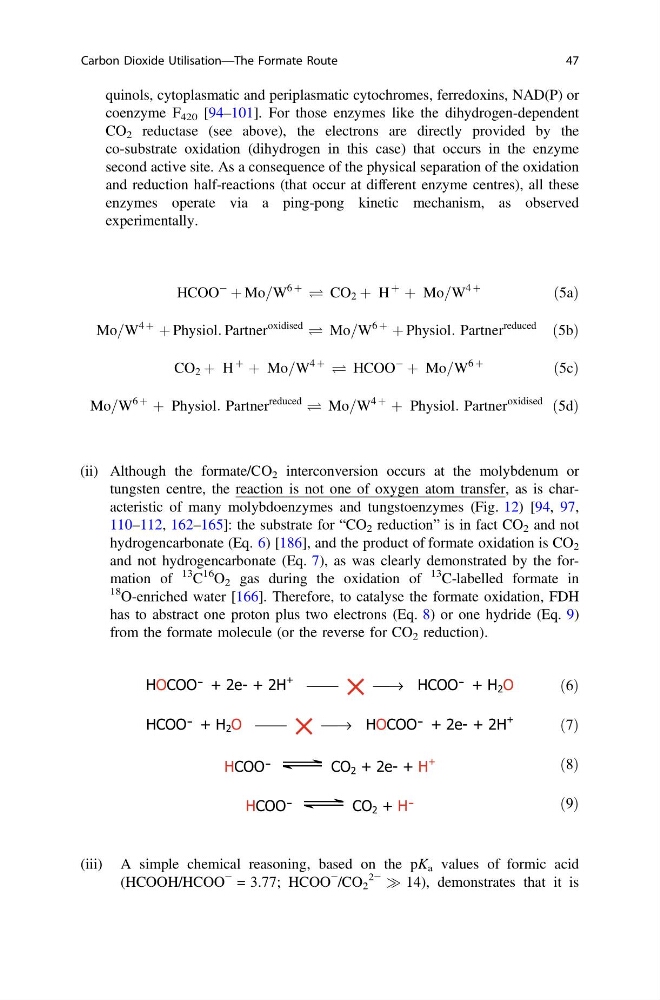
(ii) Although the formate/CO 2 interconversion occurs at the molybdenum or
tungsten centre, the reaction is not one of oxygen atom transfer, as is characteristic of many molybdoenzymes and tungstoenzymes (Fig. 12) [94, 97,
110–112, 162–165]: the substrate for “CO 2 reduction” is in fact CO 2 and not
hydrogencarbonate (Eq. 6) [186], and the product of formate oxidation is CO 2
and not hydrogencarbonate (Eq. 7), as was clearly demonstrated by the formation of
13 C
16 O 2 gas during the oxidation of
13 C-labelled formate in
18 O-enriched water [166]. Therefore, to catalyse the formate oxidation, FDH
has to abstract one proton plus two electrons (Eq. 8) or one hydride (Eq. 9)
from the formate molecule (or the reverse for CO 2 reduction).
ð6Þ
ð7Þ
ð8Þ
ð9Þ
(iii) A simple chemical reasoning, based on the pK a values of formic acid
(HCOOH/HCOO
− = 3.77; HCOO
−
/CO 2
2−
) 14), demonstrates that it is
Carbon Dioxide Utilisation—The Formate Route
47
coenzyme F 420 [94–101]. For those enzymes like the dihydrogen-dependent
CO 2 reductase (see above), the electrons are directly provided by the
co-substrate oxidation (dihydrogen in this case) that occurs in the enzyme
second active site. As a consequence of the physical separation of the oxidation
and reduction half-reactions (that occur at different enzyme centres), all these
enzymes operate via a ping-pong kinetic mechanism, as observed
experimentally.
HCOO
À
þ Mo=W
6 þ
CO 2 þ H
þ
þ Mo=W
4 þ
ð5aÞ
Mo=W
4 þ
þ Physiol: Partner
oxidised
Mo=W
6 þ
þ Physiol: Partner
reduced
ð5bÞ
CO 2 þ H
þ
þ Mo=W
4 þ
HCOO
À
þ Mo=W
6 þ
ð5cÞ
Mo=W
6 þ
þ Physiol: Partner
reduced
Mo=W
4 þ
þ Physiol: Partner
oxidised
ð5dÞ
(ii) Although the formate/CO 2 interconversion occurs at the molybdenum or
tungsten centre, the reaction is not one of oxygen atom transfer, as is characteristic of many molybdoenzymes and tungstoenzymes (Fig. 12) [94, 97,
110–112, 162–165]: the substrate for “CO 2 reduction” is in fact CO 2 and not
hydrogencarbonate (Eq. 6) [186], and the product of formate oxidation is CO 2
and not hydrogencarbonate (Eq. 7), as was clearly demonstrated by the formation of
13 C
16 O 2 gas during the oxidation of
13 C-labelled formate in
18 O-enriched water [166]. Therefore, to catalyse the formate oxidation, FDH
has to abstract one proton plus two electrons (Eq. 8) or one hydride (Eq. 9)
from the formate molecule (or the reverse for CO 2 reduction).
ð6Þ
ð7Þ
ð8Þ
ð9Þ
(iii) A simple chemical reasoning, based on the pK a values of formic acid
(HCOOH/HCOO
− = 3.77; HCOO
−
/CO 2
2−
) 14), demonstrates that it is
Carbon Dioxide Utilisation—The Formate Route
47