

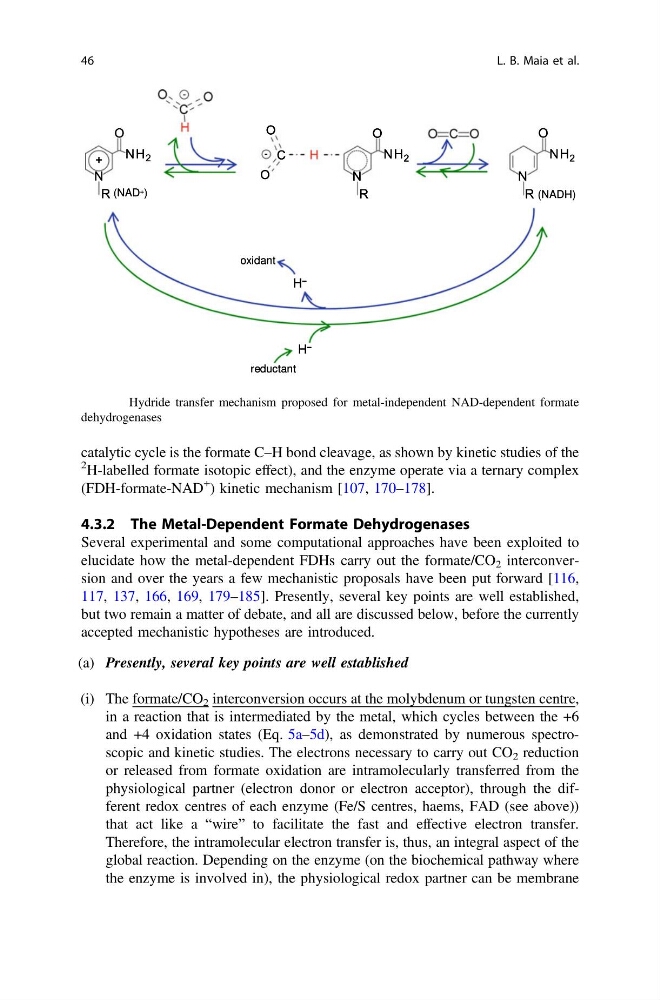
catalytic cycle is the formate C–H bond cleavage, as shown by kinetic studies of the
2 H-labelled formate isotopic effect), and the enzyme operate via a ternary complex
(FDH-formate-NAD
+
) kinetic mechanism [107, 170–178].
4.3.2 The Metal-Dependent Formate Dehydrogenases
Several experimental and some computational approaches have been exploited to
elucidate how the metal-dependent FDHs carry out the formate/CO 2 interconversion and over the years a few mechanistic proposals have been put forward [116,
117, 137, 166, 169, 179–185]. Presently, several key points are well established,
but two remain a matter of debate, and all are discussed below, before the currently
accepted mechanistic hypotheses are introduced.
(a) Presently, several key points are well established
(i) The formate/CO 2 interconversion occurs at the molybdenum or tungsten centre,
in a reaction that is intermediated by the metal, which cycles between the +6
and +4 oxidation states (Eq. 5a–5d), as demonstrated by numerous spectroscopic and kinetic studies. The electrons necessary to carry out CO 2 reduction
or released from formate oxidation are intramolecularly transferred from the
physiological partner (electron donor or electron acceptor), through the different redox centres of each enzyme (Fe/S centres, haems, FAD (see above))
that act like a “wire” to facilitate the fast and effective electron transfer.
Therefore, the intramolecular electron transfer is, thus, an integral aspect of the
global reaction. Depending on the enzyme (on the biochemical pathway where
the enzyme is involved in), the physiological redox partner can be membrane
Fig. 11 Hydride transfer mechanism proposed for metal-independent NAD-dependent formate
dehydrogenases
46
L. B. Maia et al.
2 H-labelled formate isotopic effect), and the enzyme operate via a ternary complex
(FDH-formate-NAD
+
) kinetic mechanism [107, 170–178].
4.3.2 The Metal-Dependent Formate Dehydrogenases
Several experimental and some computational approaches have been exploited to
elucidate how the metal-dependent FDHs carry out the formate/CO 2 interconversion and over the years a few mechanistic proposals have been put forward [116,
117, 137, 166, 169, 179–185]. Presently, several key points are well established,
but two remain a matter of debate, and all are discussed below, before the currently
accepted mechanistic hypotheses are introduced.
(a) Presently, several key points are well established
(i) The formate/CO 2 interconversion occurs at the molybdenum or tungsten centre,
in a reaction that is intermediated by the metal, which cycles between the +6
and +4 oxidation states (Eq. 5a–5d), as demonstrated by numerous spectroscopic and kinetic studies. The electrons necessary to carry out CO 2 reduction
or released from formate oxidation are intramolecularly transferred from the
physiological partner (electron donor or electron acceptor), through the different redox centres of each enzyme (Fe/S centres, haems, FAD (see above))
that act like a “wire” to facilitate the fast and effective electron transfer.
Therefore, the intramolecular electron transfer is, thus, an integral aspect of the
global reaction. Depending on the enzyme (on the biochemical pathway where
the enzyme is involved in), the physiological redox partner can be membrane
Fig. 11 Hydride transfer mechanism proposed for metal-independent NAD-dependent formate
dehydrogenases
46
L. B. Maia et al.