

incorporation of a biotinylated dirhodium complex within engineered streptavidin
variants and using EDA as a transfer agent, the resulting biohybrids were found to
catalyze the carbene insertion into styrene, leading to the corresponding cyclopropane as well as the insertion of the carbene moiety of trifluoroethylphenyl
diazoacetate into allylic C–H bonds of cyclohexadiene. Chemical and genetic
optimizations allowed to modulate the catalytic activity of the ArMs which could be
expressed in the periplasm of E. Coli cells. The most efficient artificial enzyme
in vivo was obtained by assembling the dirhodium complex with the SAV K121C
mutant expressed in the periplasm of E. coli and catalyzed the cyclopropanation of
styrene with up to 20 turnovers (Fig. 26) [135].
The directed evolution of Cyt P450 BM3 was also employed by several groups
including Arnold’s who was the first to enhance the activity and the selectivity of
cytochrome P450 BM3 for the catalysis of cyclopropanation reactions [136]. Directed
evolution was also applied to Mb by Fasan et al. to produce artificial hemoproteins
that could catalyze cyclopropanation reactions. The H64V-V68A double mutant
catalyzed the benchmark reaction with 99% yield and 99.9% ee. Additionally, this
mutant was found to catalyze the functionalization of the C–H of indoles by EDA,
with 85% conversion and a TON of 106 [137]. It is noteworthy that this reaction
could even be performed in whole cells, with 99% conversion and a TON of 82
[138, 139]. Brustad and coworkers used orthogonal expression techniques of
hemoproteins to introduce mutations in the heme-binding pocket to allow the direct
“in cellulo” incorporation of metal complexes of Deuteroporphyrin IX as cofactors
into the apoprotein. Incorporation of Fe(Me)-Deuteroporphyrin IX and Ir(Me)Deuteroporphyrin IX in the WIVS-FM*T268A variant, derived Cyt P450 BM3, led to
artificial hemoproteins that catalyzed the cyclopropanation of styrene by EDA [140,
N
E. Coli containing
P411-IA
N
NHTs
N
N
N
N
Ts
S
O
O N N N
+
R
R
NHTs
P411 CHA variant
Yield (%) ee (%)
R= OMe
66
>99
R=Me
34
>99
R=H
15
>99
R
R
N
Ts
Yield (%) ee (%)
R=Me
55
>99
R=H
70
>99
P411BM3-CIS-T438S-I263F
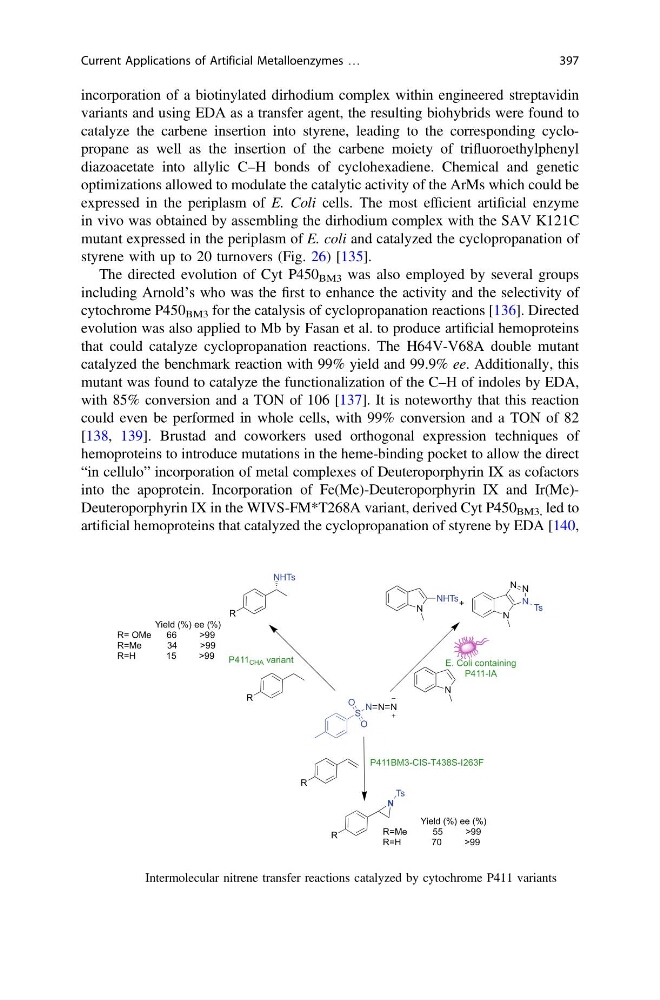
Scheme 8 Intermolecular nitrene transfer reactions catalyzed by cytochrome P411 variants
Current Applications of Artificial Metalloenzymes …
397
variants and using EDA as a transfer agent, the resulting biohybrids were found to
catalyze the carbene insertion into styrene, leading to the corresponding cyclopropane as well as the insertion of the carbene moiety of trifluoroethylphenyl
diazoacetate into allylic C–H bonds of cyclohexadiene. Chemical and genetic
optimizations allowed to modulate the catalytic activity of the ArMs which could be
expressed in the periplasm of E. Coli cells. The most efficient artificial enzyme
in vivo was obtained by assembling the dirhodium complex with the SAV K121C
mutant expressed in the periplasm of E. coli and catalyzed the cyclopropanation of
styrene with up to 20 turnovers (Fig. 26) [135].
The directed evolution of Cyt P450 BM3 was also employed by several groups
including Arnold’s who was the first to enhance the activity and the selectivity of
cytochrome P450 BM3 for the catalysis of cyclopropanation reactions [136]. Directed
evolution was also applied to Mb by Fasan et al. to produce artificial hemoproteins
that could catalyze cyclopropanation reactions. The H64V-V68A double mutant
catalyzed the benchmark reaction with 99% yield and 99.9% ee. Additionally, this
mutant was found to catalyze the functionalization of the C–H of indoles by EDA,
with 85% conversion and a TON of 106 [137]. It is noteworthy that this reaction
could even be performed in whole cells, with 99% conversion and a TON of 82
[138, 139]. Brustad and coworkers used orthogonal expression techniques of
hemoproteins to introduce mutations in the heme-binding pocket to allow the direct
“in cellulo” incorporation of metal complexes of Deuteroporphyrin IX as cofactors
into the apoprotein. Incorporation of Fe(Me)-Deuteroporphyrin IX and Ir(Me)Deuteroporphyrin IX in the WIVS-FM*T268A variant, derived Cyt P450 BM3, led to
artificial hemoproteins that catalyzed the cyclopropanation of styrene by EDA [140,
N
E. Coli containing
P411-IA
N
NHTs
N
N
N
N
Ts
S
O
O N N N
+
R
R
NHTs
P411 CHA variant
Yield (%) ee (%)
R= OMe
66
>99
R=Me
34
>99
R=H
15
>99
R
R
N
Ts
Yield (%) ee (%)
R=Me
55
>99
R=H
70
>99
P411BM3-CIS-T438S-I263F
Scheme 8 Intermolecular nitrene transfer reactions catalyzed by cytochrome P411 variants
Current Applications of Artificial Metalloenzymes …
397