

141]. Hayashi and coworkers found out that Mb reconstituted (rMb) with iron(II)porphycene was able to catalyze the cyclopropanation of styrene by EDA, and was
26-fold more efficient than native Mb [142, 143]. Substituting the native Fe ion of
Mb by either Co, Cu, Mn, Ru, Rh, Pd, Ag, or Ir allowed Hartwig and coworkers to
generate new hemoproteins that catalyzed the intramolecular carbene insertion of a
diazoester into a C–H bond to form a dihydrobenzofuran product as well as the
enantio- and diastereoselective cyclopropanation of unactivated olefins [144].
CYP119 mutants containing iridium methyl unit were found able to catalyze
intramolecular carbene insertion [145, 146] and directed evolution, focusing on
amino acids close to the active site, allowed to select four mutants, C317G, T213G,
L69V, V254L, that were able to catalyze the reaction with 94% ee and a TOF of
43 min
−1 at best. Arnold and coworkers showed that engineered cytochrome P450s,
catalyzed the insertion of fluoroalkyl carbene intermediates into a-amino C(sp
3 )–H
bonds [147] and the reaction be performed on a preparative scale, but in vivo
catalysis was not documented.
3.2.6 Diels–Alder Reaction
Because natural Diels–Alderases are rare and the Diels–Alder cycloaddition reaction is of major importance for chemical syntheses, many research teams have been
tackling the elaboration of new artificial metalloenzymes that would catalyze the
Diels–Alder reaction under ecofriendly conditions. Cu
II was shown to be the most
efficient water-compatible transition metal for the Lewis acid catalysis of this
cycloaddition [148–150] and therefore most artificial metallo-Diels-Alderases have
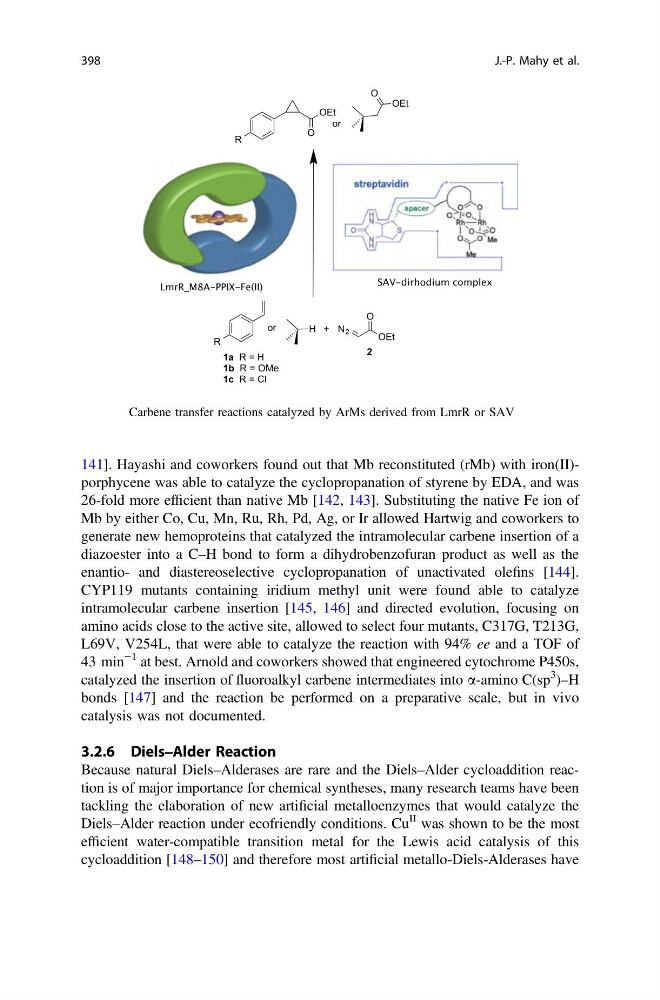
Fig. 26 Carbene transfer reactions catalyzed by ArMs derived from LmrR or SAV
398
J.-P. Mahy et al.
26-fold more efficient than native Mb [142, 143]. Substituting the native Fe ion of
Mb by either Co, Cu, Mn, Ru, Rh, Pd, Ag, or Ir allowed Hartwig and coworkers to
generate new hemoproteins that catalyzed the intramolecular carbene insertion of a
diazoester into a C–H bond to form a dihydrobenzofuran product as well as the
enantio- and diastereoselective cyclopropanation of unactivated olefins [144].
CYP119 mutants containing iridium methyl unit were found able to catalyze
intramolecular carbene insertion [145, 146] and directed evolution, focusing on
amino acids close to the active site, allowed to select four mutants, C317G, T213G,
L69V, V254L, that were able to catalyze the reaction with 94% ee and a TOF of
43 min
−1 at best. Arnold and coworkers showed that engineered cytochrome P450s,
catalyzed the insertion of fluoroalkyl carbene intermediates into a-amino C(sp
3 )–H
bonds [147] and the reaction be performed on a preparative scale, but in vivo
catalysis was not documented.
3.2.6 Diels–Alder Reaction
Because natural Diels–Alderases are rare and the Diels–Alder cycloaddition reaction is of major importance for chemical syntheses, many research teams have been
tackling the elaboration of new artificial metalloenzymes that would catalyze the
Diels–Alder reaction under ecofriendly conditions. Cu
II was shown to be the most
efficient water-compatible transition metal for the Lewis acid catalysis of this
cycloaddition [148–150] and therefore most artificial metallo-Diels-Alderases have
Fig. 26 Carbene transfer reactions catalyzed by ArMs derived from LmrR or SAV
398
J.-P. Mahy et al.