

natural nitrene to a C=C bond leading to an aziridine intermediate in the biosynthesis of benzastatin [120]. Inspired by Bez E, efforts were dedicated to the
development of artificial enzymes capable of catalyzing nitrene and carbene transfer
reactions in water and particularly in vivo.
Nitrene transfer reactions were initiated with iron porphyrins and then Cyt P450
by Breslow and Gellman [121–123] and Mansuy [124] in the early 1980s. 25 years
later, Fasan and coworkers showed that cytochrome P450 BM3 and some of its
variants were able to catalyze intramolecular C–H amination [125, 126]. Hartwig
and coworkers replaced the iron of the heme of a Cyt P450 from a thermophilic
organism, CYP119, by iridium and obtained the most active and the most
chemoselective artificial enzyme for intramolecular C–H aminations, which they
further improved the yield and selectivity by mutation [127]. 2018 Nobel Prize
laureate F. Arnold [128] and coworkers showed that Cyt P450 engineered into a
cytochrome P411 that contained a serine axial ligand to the heme iron in place of
the WT cysteine ligand was able to catalyze, in the presence of NADPH as
reductant, the intermolecular transfer of nitrene moieties into benzylic C–H bonds
under anaerobic conditions (Scheme 8) [129]. Application of directed evolution to
the protein afforded mutant P411 CHA that catalyzed the benzylic tosylamidation of
4-ethylanisole by tosyl azide (TsN 3 ) to form the benzylic N-tosylamide with up to
1,300 turnovers, 66% yield, and excellent enantioselectivity (99% ee) even at the
preparative scale and in vivo in whole E. coli cells. Further investigations in whole
E. coli cells led to other variants that catalyzed the to sylamidation of indoles, such
as 1-methylindole [130]. The most efficient variant, namely P411-IA, provided the
desired indole amidation products with up to 8400 turnovers and 90% yield, with a
chemoselectivity of 110:12:1 in favor of nitrene transfer over reduction or triazole
formation. Finally, the variant of P411BM3-CIS-T438S having a single active site
mutation, I263F, was the most active in the aziridination of a series of styrene
derivatives, including less electron-rich substrates with up to 600 TTN, 70% yield,
and 99% ee (Scheme 8) [131].
Roelfes and coworkers prepared an ArM by incorporation of heme into LmrR
and showed that this enzyme as well as its mutants were able to catalyze carbene
transfer reactions by ethyl diazoacetate 2 (EDA) into the double bond of styrene
derivatives [132–134]. Ward and coworkers brought this activity to whole cells by
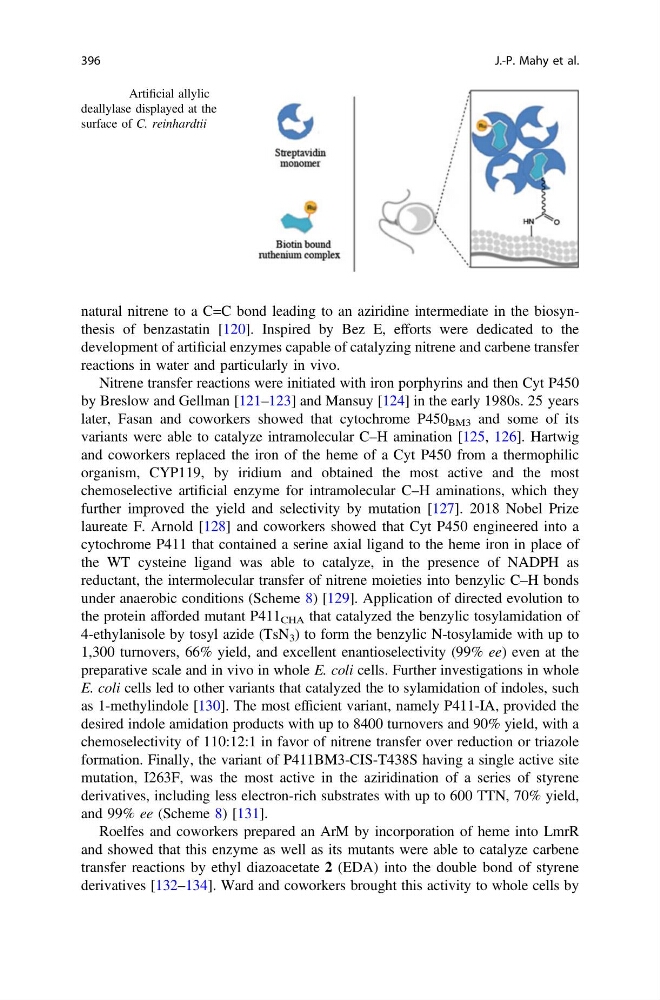
Fig. 25 Artificial allylic
deallylase displayed at the
surface of C. reinhardtii
396
J.-P. Mahy et al.
development of artificial enzymes capable of catalyzing nitrene and carbene transfer
reactions in water and particularly in vivo.
Nitrene transfer reactions were initiated with iron porphyrins and then Cyt P450
by Breslow and Gellman [121–123] and Mansuy [124] in the early 1980s. 25 years
later, Fasan and coworkers showed that cytochrome P450 BM3 and some of its
variants were able to catalyze intramolecular C–H amination [125, 126]. Hartwig
and coworkers replaced the iron of the heme of a Cyt P450 from a thermophilic
organism, CYP119, by iridium and obtained the most active and the most
chemoselective artificial enzyme for intramolecular C–H aminations, which they
further improved the yield and selectivity by mutation [127]. 2018 Nobel Prize
laureate F. Arnold [128] and coworkers showed that Cyt P450 engineered into a
cytochrome P411 that contained a serine axial ligand to the heme iron in place of
the WT cysteine ligand was able to catalyze, in the presence of NADPH as
reductant, the intermolecular transfer of nitrene moieties into benzylic C–H bonds
under anaerobic conditions (Scheme 8) [129]. Application of directed evolution to
the protein afforded mutant P411 CHA that catalyzed the benzylic tosylamidation of
4-ethylanisole by tosyl azide (TsN 3 ) to form the benzylic N-tosylamide with up to
1,300 turnovers, 66% yield, and excellent enantioselectivity (99% ee) even at the
preparative scale and in vivo in whole E. coli cells. Further investigations in whole
E. coli cells led to other variants that catalyzed the to sylamidation of indoles, such
as 1-methylindole [130]. The most efficient variant, namely P411-IA, provided the
desired indole amidation products with up to 8400 turnovers and 90% yield, with a
chemoselectivity of 110:12:1 in favor of nitrene transfer over reduction or triazole
formation. Finally, the variant of P411BM3-CIS-T438S having a single active site
mutation, I263F, was the most active in the aziridination of a series of styrene
derivatives, including less electron-rich substrates with up to 600 TTN, 70% yield,
and 99% ee (Scheme 8) [131].
Roelfes and coworkers prepared an ArM by incorporation of heme into LmrR
and showed that this enzyme as well as its mutants were able to catalyze carbene
transfer reactions by ethyl diazoacetate 2 (EDA) into the double bond of styrene
derivatives [132–134]. Ward and coworkers brought this activity to whole cells by
Fig. 25 Artificial allylic
deallylase displayed at the
surface of C. reinhardtii
396
J.-P. Mahy et al.