

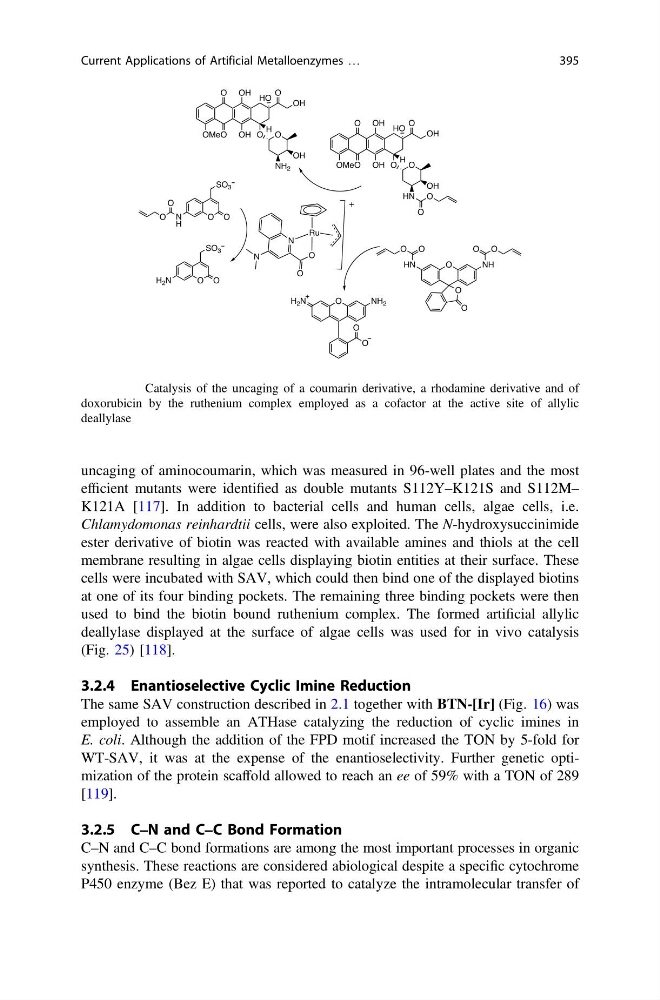
uncaging of aminocoumarin, which was measured in 96-well plates and the most
efficient mutants were identified as double mutants S112Y–K121S and S112M–
K121A [117]. In addition to bacterial cells and human cells, algae cells, i.e.
Chlamydomonas reinhardtii cells, were also exploited. The N-hydroxysuccinimide
ester derivative of biotin was reacted with available amines and thiols at the cell
membrane resulting in algae cells displaying biotin entities at their surface. These
cells were incubated with SAV, which could then bind one of the displayed biotins
at one of its four binding pockets. The remaining three binding pockets were then
used to bind the biotin bound ruthenium complex. The formed artificial allylic
deallylase displayed at the surface of algae cells was used for in vivo catalysis
(Fig. 25) [118].
3.2.4 Enantioselective Cyclic Imine Reduction
The same SAV construction described in 2.1 together with BTN-[Ir] (Fig. 16) was
employed to assemble an ATHase catalyzing the reduction of cyclic imines in
E. coli. Although the addition of the FPD motif increased the TON by 5-fold for
WT-SAV, it was at the expense of the enantioselectivity. Further genetic optimization of the protein scaffold allowed to reach an ee of 59% with a TON of 289
[119].
3.2.5 C–N and C–C Bond Formation
C–N and C–C bond formations are among the most important processes in organic
synthesis. These reactions are considered abiological despite a specific cytochrome
P450 enzyme (Bez E) that was reported to catalyze the intramolecular transfer of
Scheme 7 Catalysis of the uncaging of a coumarin derivative, a rhodamine derivative and of
doxorubicin by the ruthenium complex employed as a cofactor at the active site of allylic
deallylase
Current Applications of Artificial Metalloenzymes …
395
efficient mutants were identified as double mutants S112Y–K121S and S112M–
K121A [117]. In addition to bacterial cells and human cells, algae cells, i.e.
Chlamydomonas reinhardtii cells, were also exploited. The N-hydroxysuccinimide
ester derivative of biotin was reacted with available amines and thiols at the cell
membrane resulting in algae cells displaying biotin entities at their surface. These
cells were incubated with SAV, which could then bind one of the displayed biotins
at one of its four binding pockets. The remaining three binding pockets were then
used to bind the biotin bound ruthenium complex. The formed artificial allylic
deallylase displayed at the surface of algae cells was used for in vivo catalysis
(Fig. 25) [118].
3.2.4 Enantioselective Cyclic Imine Reduction
The same SAV construction described in 2.1 together with BTN-[Ir] (Fig. 16) was
employed to assemble an ATHase catalyzing the reduction of cyclic imines in
E. coli. Although the addition of the FPD motif increased the TON by 5-fold for
WT-SAV, it was at the expense of the enantioselectivity. Further genetic optimization of the protein scaffold allowed to reach an ee of 59% with a TON of 289
[119].
3.2.5 C–N and C–C Bond Formation
C–N and C–C bond formations are among the most important processes in organic
synthesis. These reactions are considered abiological despite a specific cytochrome
P450 enzyme (Bez E) that was reported to catalyze the intramolecular transfer of
Scheme 7 Catalysis of the uncaging of a coumarin derivative, a rhodamine derivative and of
doxorubicin by the ruthenium complex employed as a cofactor at the active site of allylic
deallylase
Current Applications of Artificial Metalloenzymes …
395