

on the outer membrane of the bacterial cells. The covalent anchoring of the
half-sandwich Rh(cod) (Fig. 19) to NB4 at the surface of the cells formed an
artificial enzyme. The generated biohybrid bugs were evaluated for the catalysis of
the polymerization of PA. This cellular system provided poly(phenylacetylene)
with 80% of trans content and with 39 Â 10
6 TON per cell.
3.2.3 Deallylation
Bioorthogonal uncaging of amines by cleavage of allyl carbamate protecting group
catalyzed by organometallic ruthenium complexes has been shown to function under
biologically relevant conditions and even inside living cells. Several organometallic
ruthenium complexes were assayed and [(Cp)(Me 2 NQ)(allyl)Ru]PF 6 (Cp = η
5
-
cyclopentadienyl, Me 2 NQ = 4-(N,N-dimethylamino)-2-quinolinecarboxyl) showed
the highest TON in the deprotection of N-(allyloxycarbonyl)aminocoumarin of bis[N(allyloxycarbonyl)]rhodamine 110 and of N-(allyloxycarbonyl)doxorubicin
(Scheme 7) [115].
The ruthenium complex was thereafter covalently bound to biotin and assembled
to SAV to form an artificial allylic deallylase. Cell-penetrating benzopentasulfides
(B5S) were bound to biotin and the four streptavidin binding pockets of the artificial
enzyme were shared between biotin bound ruthenium complex and biotin bound
B5S. Such artificial enzymes could accumulate in the cytoplasm of HeLa Kyoto
cells, wherein they catalyzed the uncaging of rhodamine 110 from bis[N-(allyloxycarbonyl)]rhodamine 110. In another approach that allowed the artificial enzyme
to cross the cellular membrane, B5S were covalently bound to streptavidin leaving
its four binding pockets available for biotin bound ruthenium complex. The artificial enzyme also accumulated in the cytoplasm and it could be fully exploited as
its four binding pockets were available for catalysis [116].
Bacterial cells were also used as a platform for allylic deallylase activity. SAV
was expressed at the surface of cells as described earlier relying on OmpA then
incubated with the biotin bound ruthenium complex to form the artificial allylic
deallylase. Directed evolution was used to further improve the activity in the
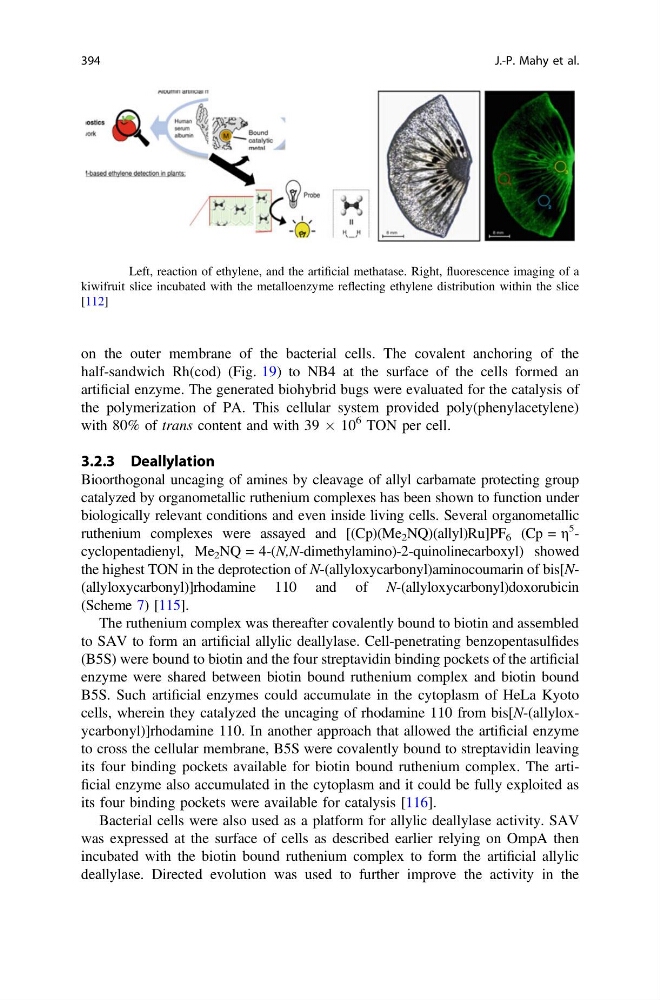
Fig. 24 Left, reaction of ethylene, and the artificial methatase. Right, fluorescence imaging of a
kiwifruit slice incubated with the metalloenzyme reflecting ethylene distribution within the slice
[112]
394
J.-P. Mahy et al.
half-sandwich Rh(cod) (Fig. 19) to NB4 at the surface of the cells formed an
artificial enzyme. The generated biohybrid bugs were evaluated for the catalysis of
the polymerization of PA. This cellular system provided poly(phenylacetylene)
with 80% of trans content and with 39 Â 10
6 TON per cell.
3.2.3 Deallylation
Bioorthogonal uncaging of amines by cleavage of allyl carbamate protecting group
catalyzed by organometallic ruthenium complexes has been shown to function under
biologically relevant conditions and even inside living cells. Several organometallic
ruthenium complexes were assayed and [(Cp)(Me 2 NQ)(allyl)Ru]PF 6 (Cp = η
5
-
cyclopentadienyl, Me 2 NQ = 4-(N,N-dimethylamino)-2-quinolinecarboxyl) showed
the highest TON in the deprotection of N-(allyloxycarbonyl)aminocoumarin of bis[N(allyloxycarbonyl)]rhodamine 110 and of N-(allyloxycarbonyl)doxorubicin
(Scheme 7) [115].
The ruthenium complex was thereafter covalently bound to biotin and assembled
to SAV to form an artificial allylic deallylase. Cell-penetrating benzopentasulfides
(B5S) were bound to biotin and the four streptavidin binding pockets of the artificial
enzyme were shared between biotin bound ruthenium complex and biotin bound
B5S. Such artificial enzymes could accumulate in the cytoplasm of HeLa Kyoto
cells, wherein they catalyzed the uncaging of rhodamine 110 from bis[N-(allyloxycarbonyl)]rhodamine 110. In another approach that allowed the artificial enzyme
to cross the cellular membrane, B5S were covalently bound to streptavidin leaving
its four binding pockets available for biotin bound ruthenium complex. The artificial enzyme also accumulated in the cytoplasm and it could be fully exploited as
its four binding pockets were available for catalysis [116].
Bacterial cells were also used as a platform for allylic deallylase activity. SAV
was expressed at the surface of cells as described earlier relying on OmpA then
incubated with the biotin bound ruthenium complex to form the artificial allylic
deallylase. Directed evolution was used to further improve the activity in the
Fig. 24 Left, reaction of ethylene, and the artificial methatase. Right, fluorescence imaging of a
kiwifruit slice incubated with the metalloenzyme reflecting ethylene distribution within the slice
[112]
394
J.-P. Mahy et al.