

FhuA-[Rh] was able to catalyze the polymerization of PA in 52% yield to afford a
polymer with an M n of 5,500 and dispersity of 2.9. Most interestingly, the trans:cis
ratio equaled 75:25, meaning that embedding of the rhodium complex within the
protein environment provided by FhuA reversed the stereoselectivity of the
reaction.
2.3.2 Ring-Opening Metathesis Polymerization (ROMP)
of Olefins
The first biohybrid to catalyze a ROMP reaction was introduced by Schwaneberg
and Okuda in 2013 [94]. The synthesis of this ArM is based on the covalent
anchoring of a Hoveyda-Grubbs metathesis catalyst [95, 96] to a variant of the
E. coli transmembrane protein FhuA (ferric hydroxamate uptake protein component
A). This protein conveniently displays a b-barrel folding made of 22 anti-parallel
b-sheets creating a wide cavity suitable for hosting the metal catalyst and the
substrate. Prior to ArM assembling, FhuA was engineered to create an anchoring
point for the metal complex via a cysteine at position 545 and optimize its
accessibility; TEV cleavage sites were also introduced in two loops to facilitate
mass analysis of the ArM. The ruthenium benzylidene complex HG3 (Fig. 22)
designed from a previously published water-soluble Grubbs catalyst [96] was
conjugated to FhuA in its unfolded form by Michael addition of the single cysteine
to the maleimide group of HG3. Refolding of FhuA-HG3 was then achieved by
dialysis in the presence of polyethylene – polyethyleneglycol (PE-PEG).
The catalytic activity of the ArM was tested in the ROMP reaction of a
water-soluble 7-oxanorbornene derivative (Scheme 3). The partially folded ArM
FhuA-HG3 afforded a polymer with 77% yield and a cis:trans ratio of 60:40 while
the fully folded FhuA-HG3 gave rise to a lower conversion (37%).
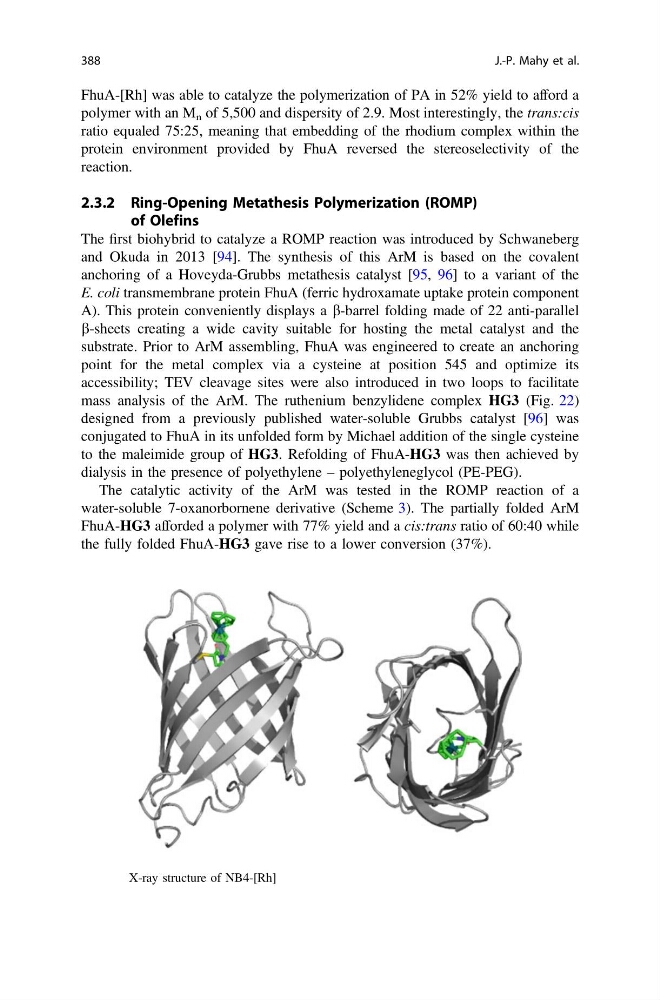
Fig. 21 X-ray structure of NB4-[Rh]
388
J.-P. Mahy et al.
polymer with an M n of 5,500 and dispersity of 2.9. Most interestingly, the trans:cis
ratio equaled 75:25, meaning that embedding of the rhodium complex within the
protein environment provided by FhuA reversed the stereoselectivity of the
reaction.
2.3.2 Ring-Opening Metathesis Polymerization (ROMP)
of Olefins
The first biohybrid to catalyze a ROMP reaction was introduced by Schwaneberg
and Okuda in 2013 [94]. The synthesis of this ArM is based on the covalent
anchoring of a Hoveyda-Grubbs metathesis catalyst [95, 96] to a variant of the
E. coli transmembrane protein FhuA (ferric hydroxamate uptake protein component
A). This protein conveniently displays a b-barrel folding made of 22 anti-parallel
b-sheets creating a wide cavity suitable for hosting the metal catalyst and the
substrate. Prior to ArM assembling, FhuA was engineered to create an anchoring
point for the metal complex via a cysteine at position 545 and optimize its
accessibility; TEV cleavage sites were also introduced in two loops to facilitate
mass analysis of the ArM. The ruthenium benzylidene complex HG3 (Fig. 22)
designed from a previously published water-soluble Grubbs catalyst [96] was
conjugated to FhuA in its unfolded form by Michael addition of the single cysteine
to the maleimide group of HG3. Refolding of FhuA-HG3 was then achieved by
dialysis in the presence of polyethylene – polyethyleneglycol (PE-PEG).
The catalytic activity of the ArM was tested in the ROMP reaction of a
water-soluble 7-oxanorbornene derivative (Scheme 3). The partially folded ArM
FhuA-HG3 afforded a polymer with 77% yield and a cis:trans ratio of 60:40 while
the fully folded FhuA-HG3 gave rise to a lower conversion (37%).
Fig. 21 X-ray structure of NB4-[Rh]
388
J.-P. Mahy et al.