

for hosting the metal-binding site and the substrate [92]. The half-sandwich Rh(cod)
complex carrying a maleimide group (Fig. 19) was synthesized and conjugated to
the Q96C mutant of NB. The anchoring point was chosen so as to be located at the
entrance of the cavity. Polymerization of PA proceeded under mild conditions to
afford a polymer with an M n of 42.6 Â 10
3 and dispersity of 2.6. The most
interesting finding was the stereochemistry of the generated polymer since the
trans:cis ratio equaled 53:47, to be compared to the precursor complex that gave
almost exclusively the cis configuration as previously reported for other Rh(I)
catalysts [89]. The trans:cis ratio even increased to 30:70 when the reaction was
performed at 2 °C. NB was further engineered to enlarge the cavity by mutating
positions distant by 6 Å from the Rh center. Mutant NB4 (H76L/Q96C/H158L)
afforded the highest trans:cis ratio (82:12). X-ray crystallography of NB4-[Rh]
assorted by molecular dynamics simulation suggested that the metal center in NB4[Rh] displays a defined orientation probably explaining the high stereoselectivity of
the reaction (Fig. 21).
Another ArM was built up by covalent anchoring of the same rhodium(cod)
complex to an engineered form of Fhu A [93]. [Note: Description of FhuA and its
engineered form ΔCVF
TEV will be given below]. The amphipathic solvent MPD
was shown to efficiently stabilize the resulting biohybrid in its fully folded form.
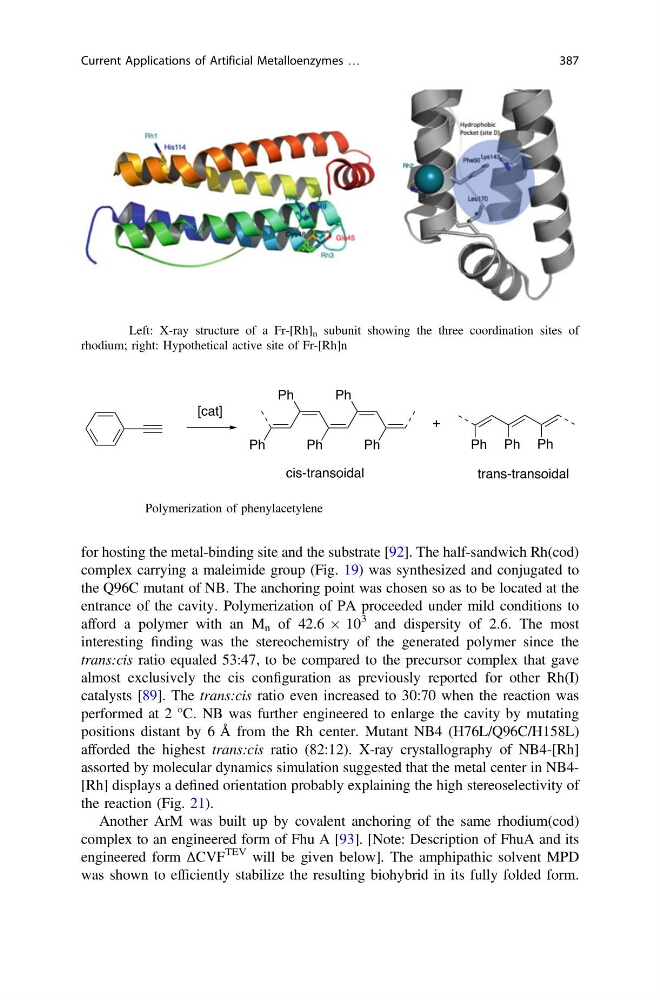
Fig. 20 Left: X-ray structure of a Fr-[Rh] n subunit showing the three coordination sites of
rhodium; right: Hypothetical active site of Fr-[Rh]n
Scheme 2 Polymerization of phenylacetylene
Current Applications of Artificial Metalloenzymes …
387
complex carrying a maleimide group (Fig. 19) was synthesized and conjugated to
the Q96C mutant of NB. The anchoring point was chosen so as to be located at the
entrance of the cavity. Polymerization of PA proceeded under mild conditions to
afford a polymer with an M n of 42.6 Â 10
3 and dispersity of 2.6. The most
interesting finding was the stereochemistry of the generated polymer since the
trans:cis ratio equaled 53:47, to be compared to the precursor complex that gave
almost exclusively the cis configuration as previously reported for other Rh(I)
catalysts [89]. The trans:cis ratio even increased to 30:70 when the reaction was
performed at 2 °C. NB was further engineered to enlarge the cavity by mutating
positions distant by 6 Å from the Rh center. Mutant NB4 (H76L/Q96C/H158L)
afforded the highest trans:cis ratio (82:12). X-ray crystallography of NB4-[Rh]
assorted by molecular dynamics simulation suggested that the metal center in NB4[Rh] displays a defined orientation probably explaining the high stereoselectivity of
the reaction (Fig. 21).
Another ArM was built up by covalent anchoring of the same rhodium(cod)
complex to an engineered form of Fhu A [93]. [Note: Description of FhuA and its
engineered form ΔCVF
TEV will be given below]. The amphipathic solvent MPD
was shown to efficiently stabilize the resulting biohybrid in its fully folded form.
Fig. 20 Left: X-ray structure of a Fr-[Rh] n subunit showing the three coordination sites of
rhodium; right: Hypothetical active site of Fr-[Rh]n
Scheme 2 Polymerization of phenylacetylene
Current Applications of Artificial Metalloenzymes …
387