

2.3 Artificial Metalloenzymes for Polymerization Catalysis
2.3.1 Polymerization of Phenylacetylene
Polyacetylenes are a group of conjugated polymers with unique electrical, (nonlinear) optical, optoelectronic, magnetic, chiroptical, (enantio)permselective, and
photolithographic properties. Prior to the design of ArMs catalyzing the polymerization of phenylacetylene (PA), it had been shown that PA could be polymerized in
water in the presence of various rhodium complexes, for instance [Rh(L)Cl] 2 (with
L = nbd; cod) and that the resulting polymers displayed up to 100% cis configuration depending on the rhodium catalyst [89].
The first ArM to catalyze a polymerization reaction was built up by dative
anchoring of Rh(nbd) entities to horse apo-Fr as protein scaffold [90]. Apo-ferritin
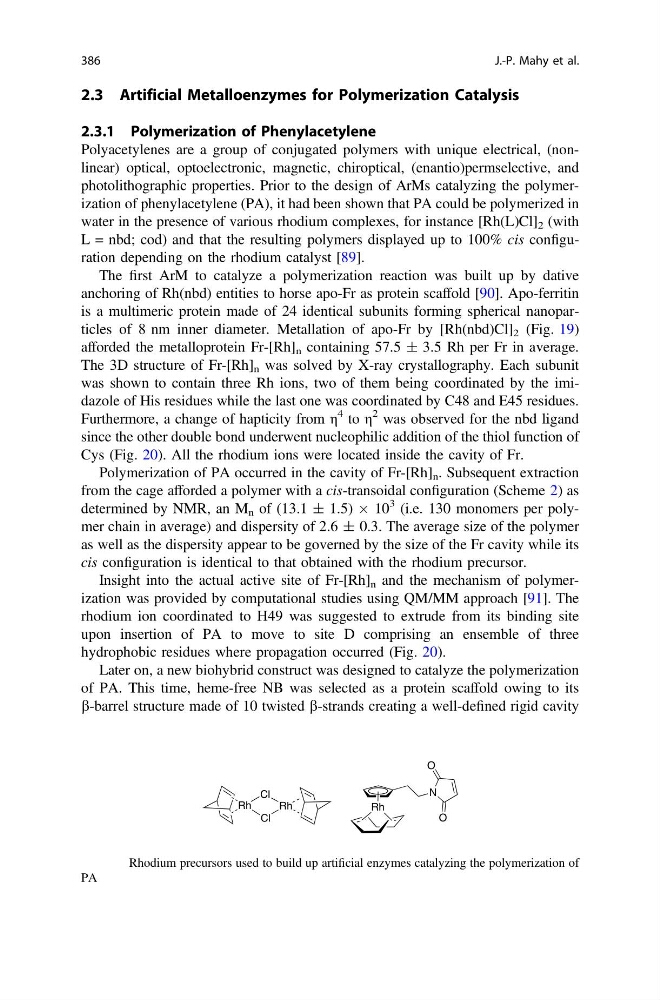
is a multimeric protein made of 24 identical subunits forming spherical nanoparticles of 8 nm inner diameter. Metallation of apo-Fr by [Rh(nbd)Cl] 2 (Fig. 19)
afforded the metalloprotein Fr-[Rh] n containing 57.5 ± 3.5 Rh per Fr in average.
The 3D structure of Fr-[Rh] n was solved by X-ray crystallography. Each subunit
was shown to contain three Rh ions, two of them being coordinated by the imidazole of His residues while the last one was coordinated by C48 and E45 residues.
Furthermore, a change of hapticity from η
4 to η
2 was observed for the nbd ligand
since the other double bond underwent nucleophilic addition of the thiol function of
Cys (Fig. 20). All the rhodium ions were located inside the cavity of Fr.
Polymerization of PA occurred in the cavity of Fr-[Rh] n . Subsequent extraction
from the cage afforded a polymer with a cis-transoidal configuration (Scheme 2) as
determined by NMR, an M n of (13.1 ± 1.5) Â 10
3 (i.e. 130 monomers per polymer chain in average) and dispersity of 2.6 ± 0.3. The average size of the polymer
as well as the dispersity appear to be governed by the size of the Fr cavity while its
cis configuration is identical to that obtained with the rhodium precursor.
Insight into the actual active site of Fr-[Rh] n and the mechanism of polymerization was provided by computational studies using QM/MM approach [91]. The
rhodium ion coordinated to H49 was suggested to extrude from its binding site
upon insertion of PA to move to site D comprising an ensemble of three
hydrophobic residues where propagation occurred (Fig. 20).
Later on, a new biohybrid construct was designed to catalyze the polymerization
of PA. This time, heme-free NB was selected as a protein scaffold owing to its
b-barrel structure made of 10 twisted b-strands creating a well-defined rigid cavity
Fig. 19 Rhodium precursors used to build up artificial enzymes catalyzing the polymerization of
PA
386
J.-P. Mahy et al.
2.3.1 Polymerization of Phenylacetylene
Polyacetylenes are a group of conjugated polymers with unique electrical, (nonlinear) optical, optoelectronic, magnetic, chiroptical, (enantio)permselective, and
photolithographic properties. Prior to the design of ArMs catalyzing the polymerization of phenylacetylene (PA), it had been shown that PA could be polymerized in
water in the presence of various rhodium complexes, for instance [Rh(L)Cl] 2 (with
L = nbd; cod) and that the resulting polymers displayed up to 100% cis configuration depending on the rhodium catalyst [89].
The first ArM to catalyze a polymerization reaction was built up by dative
anchoring of Rh(nbd) entities to horse apo-Fr as protein scaffold [90]. Apo-ferritin
is a multimeric protein made of 24 identical subunits forming spherical nanoparticles of 8 nm inner diameter. Metallation of apo-Fr by [Rh(nbd)Cl] 2 (Fig. 19)
afforded the metalloprotein Fr-[Rh] n containing 57.5 ± 3.5 Rh per Fr in average.
The 3D structure of Fr-[Rh] n was solved by X-ray crystallography. Each subunit
was shown to contain three Rh ions, two of them being coordinated by the imidazole of His residues while the last one was coordinated by C48 and E45 residues.
Furthermore, a change of hapticity from η
4 to η
2 was observed for the nbd ligand
since the other double bond underwent nucleophilic addition of the thiol function of
Cys (Fig. 20). All the rhodium ions were located inside the cavity of Fr.
Polymerization of PA occurred in the cavity of Fr-[Rh] n . Subsequent extraction
from the cage afforded a polymer with a cis-transoidal configuration (Scheme 2) as
determined by NMR, an M n of (13.1 ± 1.5) Â 10
3 (i.e. 130 monomers per polymer chain in average) and dispersity of 2.6 ± 0.3. The average size of the polymer
as well as the dispersity appear to be governed by the size of the Fr cavity while its
cis configuration is identical to that obtained with the rhodium precursor.
Insight into the actual active site of Fr-[Rh] n and the mechanism of polymerization was provided by computational studies using QM/MM approach [91]. The
rhodium ion coordinated to H49 was suggested to extrude from its binding site
upon insertion of PA to move to site D comprising an ensemble of three
hydrophobic residues where propagation occurred (Fig. 20).
Later on, a new biohybrid construct was designed to catalyze the polymerization
of PA. This time, heme-free NB was selected as a protein scaffold owing to its
b-barrel structure made of 10 twisted b-strands creating a well-defined rigid cavity
Fig. 19 Rhodium precursors used to build up artificial enzymes catalyzing the polymerization of
PA
386
J.-P. Mahy et al.