

mutant affording an ee of 50% for (S)-salsolidine with 75% conversion. Another
mutant displayed an 8-fold increase in k cat compared to the cofactor alone.
Recently, to overcome the previously noticed dependence of SAV-to-Ir ratio on
the enantioselectivity owing to the tetrameric nature of SAV, a single chain dimeric
streptavidin (scdSAV) was engineered followed by genetic optimization of positions 112 and 121 [86]. Two monovalent scdSAVs (scdSAVmv1 and scdSAVmv2)
were also produced to study the influence of the second cofactor on the catalytic
properties of the ArM. X-ray structural analysis showed that the iridium cofactor
adopts two different conformations in scdSAV, one being more solvent-exposed
than the other. Conversely, the Ir cofactor adopts only one conformation once
bound to its binding pocket. Under optimized conditions, an ArM affording a high
TON and high ee were identified. Most importantly, ATH experiment could be
extended to the preparative scale without detrimental effects on the conversion and
ee. This breakthrough lets us anticipate biotechnological developments of artificial
imine hydrogenases in the near future.
Carbonic Anhydrase as Protein Scaffold
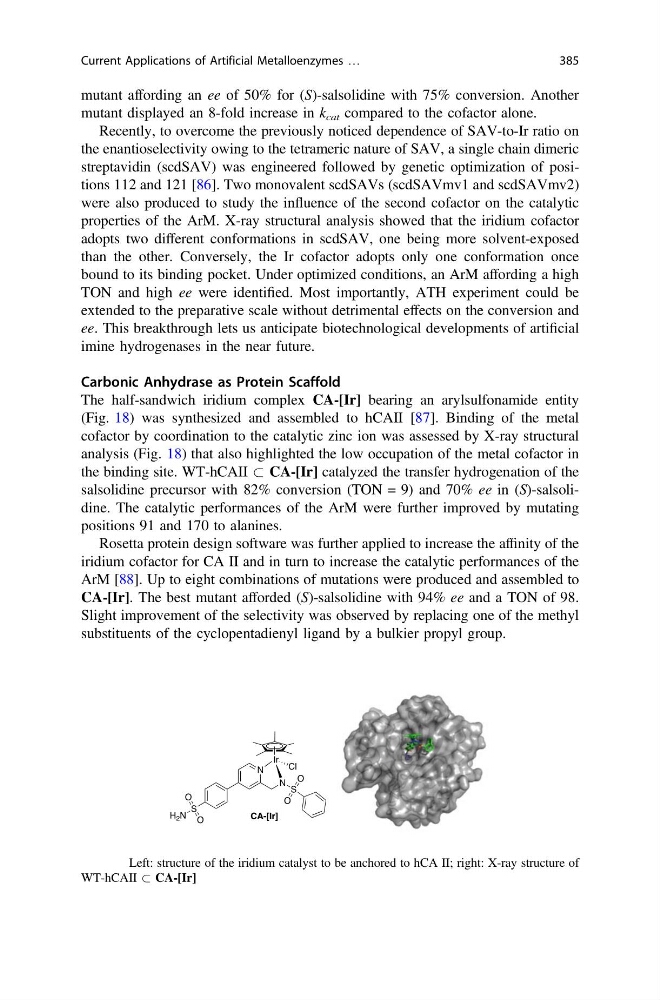
The half-sandwich iridium complex CA-[Ir] bearing an arylsulfonamide entity
(Fig. 18) was synthesized and assembled to hCAII [87]. Binding of the metal
cofactor by coordination to the catalytic zinc ion was assessed by X-ray structural
analysis (Fig. 18) that also highlighted the low occupation of the metal cofactor in
the binding site. WT-hCAII & CA-[Ir] catalyzed the transfer hydrogenation of the
salsolidine precursor with 82% conversion (TON = 9) and 70% ee in (S)-salsolidine. The catalytic performances of the ArM were further improved by mutating
positions 91 and 170 to alanines.
Rosetta protein design software was further applied to increase the affinity of the
iridium cofactor for CA II and in turn to increase the catalytic performances of the
ArM [88]. Up to eight combinations of mutations were produced and assembled to
CA-[Ir]. The best mutant afforded (S)-salsolidine with 94% ee and a TON of 98.
Slight improvement of the selectivity was observed by replacing one of the methyl
substituents of the cyclopentadienyl ligand by a bulkier propyl group.
Fig. 18 Left: structure of the iridium catalyst to be anchored to hCA II; right: X-ray structure of
WT-hCAII & CA-[Ir]
Current Applications of Artificial Metalloenzymes …
385
mutant displayed an 8-fold increase in k cat compared to the cofactor alone.
Recently, to overcome the previously noticed dependence of SAV-to-Ir ratio on
the enantioselectivity owing to the tetrameric nature of SAV, a single chain dimeric
streptavidin (scdSAV) was engineered followed by genetic optimization of positions 112 and 121 [86]. Two monovalent scdSAVs (scdSAVmv1 and scdSAVmv2)
were also produced to study the influence of the second cofactor on the catalytic
properties of the ArM. X-ray structural analysis showed that the iridium cofactor
adopts two different conformations in scdSAV, one being more solvent-exposed
than the other. Conversely, the Ir cofactor adopts only one conformation once
bound to its binding pocket. Under optimized conditions, an ArM affording a high
TON and high ee were identified. Most importantly, ATH experiment could be
extended to the preparative scale without detrimental effects on the conversion and
ee. This breakthrough lets us anticipate biotechnological developments of artificial
imine hydrogenases in the near future.
Carbonic Anhydrase as Protein Scaffold
The half-sandwich iridium complex CA-[Ir] bearing an arylsulfonamide entity
(Fig. 18) was synthesized and assembled to hCAII [87]. Binding of the metal
cofactor by coordination to the catalytic zinc ion was assessed by X-ray structural
analysis (Fig. 18) that also highlighted the low occupation of the metal cofactor in
the binding site. WT-hCAII & CA-[Ir] catalyzed the transfer hydrogenation of the
salsolidine precursor with 82% conversion (TON = 9) and 70% ee in (S)-salsolidine. The catalytic performances of the ArM were further improved by mutating
positions 91 and 170 to alanines.
Rosetta protein design software was further applied to increase the affinity of the
iridium cofactor for CA II and in turn to increase the catalytic performances of the
ArM [88]. Up to eight combinations of mutations were produced and assembled to
CA-[Ir]. The best mutant afforded (S)-salsolidine with 94% ee and a TON of 98.
Slight improvement of the selectivity was observed by replacing one of the methyl
substituents of the cyclopentadienyl ligand by a bulkier propyl group.
Fig. 18 Left: structure of the iridium catalyst to be anchored to hCA II; right: X-ray structure of
WT-hCAII & CA-[Ir]
Current Applications of Artificial Metalloenzymes …
385