

The same team next investigated the influence of the linker arm length on the
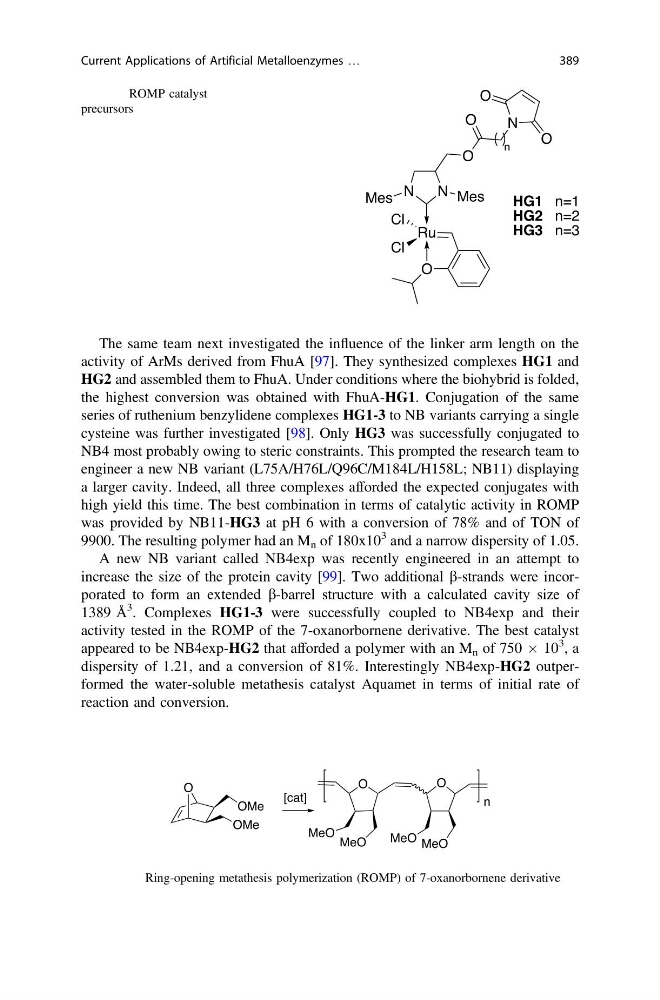
activity of ArMs derived from FhuA [97]. They synthesized complexes HG1 and
HG2 and assembled them to FhuA. Under conditions where the biohybrid is folded,
the highest conversion was obtained with FhuA-HG1. Conjugation of the same
series of ruthenium benzylidene complexes HG1-3 to NB variants carrying a single
cysteine was further investigated [98]. Only HG3 was successfully conjugated to
NB4 most probably owing to steric constraints. This prompted the research team to
engineer a new NB variant (L75A/H76L/Q96C/M184L/H158L; NB11) displaying
a larger cavity. Indeed, all three complexes afforded the expected conjugates with
high yield this time. The best combination in terms of catalytic activity in ROMP
was provided by NB11-HG3 at pH 6 with a conversion of 78% and of TON of
9900. The resulting polymer had an M n of 180x10
3 and a narrow dispersity of 1.05.
A new NB variant called NB4exp was recently engineered in an attempt to
increase the size of the protein cavity [99]. Two additional b-strands were incorporated to form an extended b-barrel structure with a calculated cavity size of
1389 Å
3 . Complexes HG1-3 were successfully coupled to NB4exp and their
activity tested in the ROMP of the 7-oxanorbornene derivative. The best catalyst
appeared to be NB4exp-HG2 that afforded a polymer with an M n of 750 Â 10
3 , a
dispersity of 1.21, and a conversion of 81%. Interestingly NB4exp-HG2 outperformed the water-soluble metathesis catalyst Aquamet in terms of initial rate of
reaction and conversion.
Fig. 22 ROMP catalyst
precursors
Scheme 3 Ring-opening metathesis polymerization (ROMP) of 7-oxanorbornene derivative
Current Applications of Artificial Metalloenzymes …
389
activity of ArMs derived from FhuA [97]. They synthesized complexes HG1 and
HG2 and assembled them to FhuA. Under conditions where the biohybrid is folded,
the highest conversion was obtained with FhuA-HG1. Conjugation of the same
series of ruthenium benzylidene complexes HG1-3 to NB variants carrying a single
cysteine was further investigated [98]. Only HG3 was successfully conjugated to
NB4 most probably owing to steric constraints. This prompted the research team to
engineer a new NB variant (L75A/H76L/Q96C/M184L/H158L; NB11) displaying
a larger cavity. Indeed, all three complexes afforded the expected conjugates with
high yield this time. The best combination in terms of catalytic activity in ROMP
was provided by NB11-HG3 at pH 6 with a conversion of 78% and of TON of
9900. The resulting polymer had an M n of 180x10
3 and a narrow dispersity of 1.05.
A new NB variant called NB4exp was recently engineered in an attempt to
increase the size of the protein cavity [99]. Two additional b-strands were incorporated to form an extended b-barrel structure with a calculated cavity size of
1389 Å
3 . Complexes HG1-3 were successfully coupled to NB4exp and their
activity tested in the ROMP of the 7-oxanorbornene derivative. The best catalyst
appeared to be NB4exp-HG2 that afforded a polymer with an M n of 750 Â 10
3 , a
dispersity of 1.21, and a conversion of 81%. Interestingly NB4exp-HG2 outperformed the water-soluble metathesis catalyst Aquamet in terms of initial rate of
reaction and conversion.
Fig. 22 ROMP catalyst
precursors
Scheme 3 Ring-opening metathesis polymerization (ROMP) of 7-oxanorbornene derivative
Current Applications of Artificial Metalloenzymes …
389