

Streptavidin as Protein Scaffold
The first ArM catalyzing the ATH of the salsolidine precursor was designed from
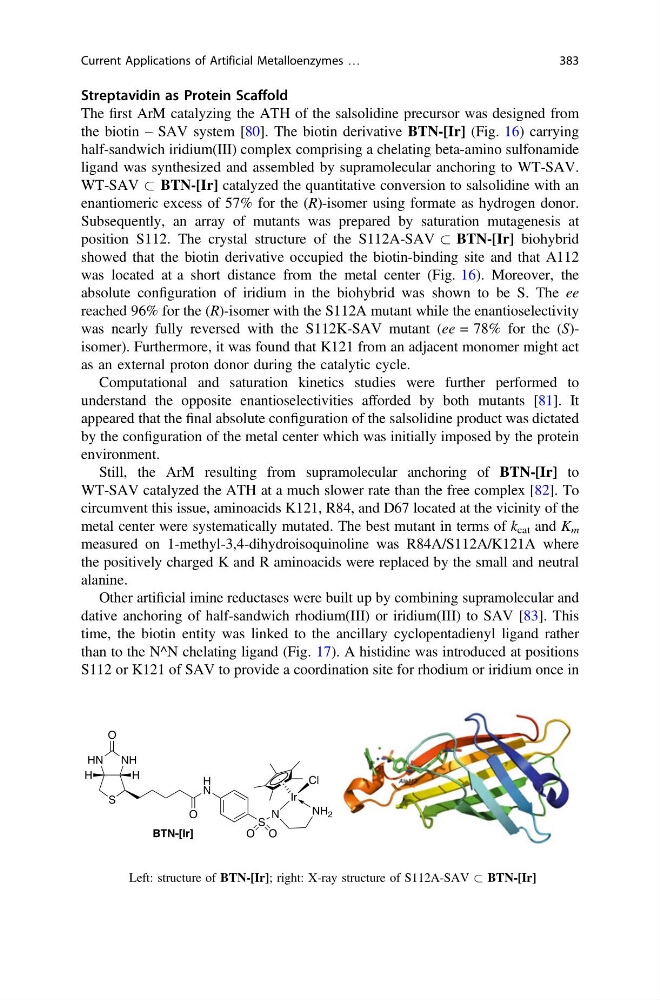
the biotin – SAV system [80]. The biotin derivative BTN-[Ir] (Fig. 16) carrying
half-sandwich iridium(III) complex comprising a chelating beta-amino sulfonamide
ligand was synthesized and assembled by supramolecular anchoring to WT-SAV.
WT-SAV & BTN-[Ir] catalyzed the quantitative conversion to salsolidine with an
enantiomeric excess of 57% for the (R)-isomer using formate as hydrogen donor.
Subsequently, an array of mutants was prepared by saturation mutagenesis at
position S112. The crystal structure of the S112A-SAV & BTN-[Ir] biohybrid
showed that the biotin derivative occupied the biotin-binding site and that A112
was located at a short distance from the metal center (Fig. 16). Moreover, the
absolute configuration of iridium in the biohybrid was shown to be S. The ee
reached 96% for the (R)-isomer with the S112A mutant while the enantioselectivity
was nearly fully reversed with the S112K-SAV mutant (ee = 78% for the (S)isomer). Furthermore, it was found that K121 from an adjacent monomer might act
as an external proton donor during the catalytic cycle.
Computational and saturation kinetics studies were further performed to
understand the opposite enantioselectivities afforded by both mutants [81]. It
appeared that the final absolute configuration of the salsolidine product was dictated
by the configuration of the metal center which was initially imposed by the protein
environment.
Still, the ArM resulting from supramolecular anchoring of BTN-[Ir] to
WT-SAV catalyzed the ATH at a much slower rate than the free complex [82]. To
circumvent this issue, aminoacids K121, R84, and D67 located at the vicinity of the
metal center were systematically mutated. The best mutant in terms of k cat and K m
measured on 1-methyl-3,4-dihydroisoquinoline was R84A/S112A/K121A where
the positively charged K and R aminoacids were replaced by the small and neutral
alanine.
Other artificial imine reductases were built up by combining supramolecular and
dative anchoring of half-sandwich rhodium(III) or iridium(III) to SAV [83]. This
time, the biotin entity was linked to the ancillary cyclopentadienyl ligand rather
than to the N^N chelating ligand (Fig. 17). A histidine was introduced at positions
S112 or K121 of SAV to provide a coordination site for rhodium or iridium once in
Fig. 16 Left: structure of BTN-[Ir]; right: X-ray structure of S112A-SAV & BTN-[Ir]
Current Applications of Artificial Metalloenzymes …
383
The first ArM catalyzing the ATH of the salsolidine precursor was designed from
the biotin – SAV system [80]. The biotin derivative BTN-[Ir] (Fig. 16) carrying
half-sandwich iridium(III) complex comprising a chelating beta-amino sulfonamide
ligand was synthesized and assembled by supramolecular anchoring to WT-SAV.
WT-SAV & BTN-[Ir] catalyzed the quantitative conversion to salsolidine with an
enantiomeric excess of 57% for the (R)-isomer using formate as hydrogen donor.
Subsequently, an array of mutants was prepared by saturation mutagenesis at
position S112. The crystal structure of the S112A-SAV & BTN-[Ir] biohybrid
showed that the biotin derivative occupied the biotin-binding site and that A112
was located at a short distance from the metal center (Fig. 16). Moreover, the
absolute configuration of iridium in the biohybrid was shown to be S. The ee
reached 96% for the (R)-isomer with the S112A mutant while the enantioselectivity
was nearly fully reversed with the S112K-SAV mutant (ee = 78% for the (S)isomer). Furthermore, it was found that K121 from an adjacent monomer might act
as an external proton donor during the catalytic cycle.
Computational and saturation kinetics studies were further performed to
understand the opposite enantioselectivities afforded by both mutants [81]. It
appeared that the final absolute configuration of the salsolidine product was dictated
by the configuration of the metal center which was initially imposed by the protein
environment.
Still, the ArM resulting from supramolecular anchoring of BTN-[Ir] to
WT-SAV catalyzed the ATH at a much slower rate than the free complex [82]. To
circumvent this issue, aminoacids K121, R84, and D67 located at the vicinity of the
metal center were systematically mutated. The best mutant in terms of k cat and K m
measured on 1-methyl-3,4-dihydroisoquinoline was R84A/S112A/K121A where
the positively charged K and R aminoacids were replaced by the small and neutral
alanine.
Other artificial imine reductases were built up by combining supramolecular and
dative anchoring of half-sandwich rhodium(III) or iridium(III) to SAV [83]. This
time, the biotin entity was linked to the ancillary cyclopentadienyl ligand rather
than to the N^N chelating ligand (Fig. 17). A histidine was introduced at positions
S112 or K121 of SAV to provide a coordination site for rhodium or iridium once in
Fig. 16 Left: structure of BTN-[Ir]; right: X-ray structure of S112A-SAV & BTN-[Ir]
Current Applications of Artificial Metalloenzymes …
383