

difference of catalytic activity between the free complex and LmrR-[Rh] was tentatively explained by the assumption that only LmrR-[Rh] was able to transfer a
hydride to CO 2 likely due to favorable second and outer-sphere interactions with
the substrate.
2.2.3 Enantioselective Cyclic Imine Reduction
Enantiopure amines are key compounds, found in numerous pharmaceuticals and
agrochemicals to name a few applications. A strategy to access these compounds
relies on enantioselective reduction of imines catalyzed by imine reductases [77].
However, natural imine reductases are still scarce, leaving room for the development of artificial imine reductases.
Nearly all the examples reported in the literature so far deal with the production
of salsolidine by asymmetric transfer hydrogenation (ATH) of its imine precursor
(Scheme 1). Salsolidine is a tetrahydroisoquinoline alkaloid produced by plants of
the genus Salsola. The (R)-enantiomer of salsolidine has been found as a potent
inhibitor of monoamine oxidase A [78]. Plant extracts were also shown to display
significant choline esterase inhibition [79].
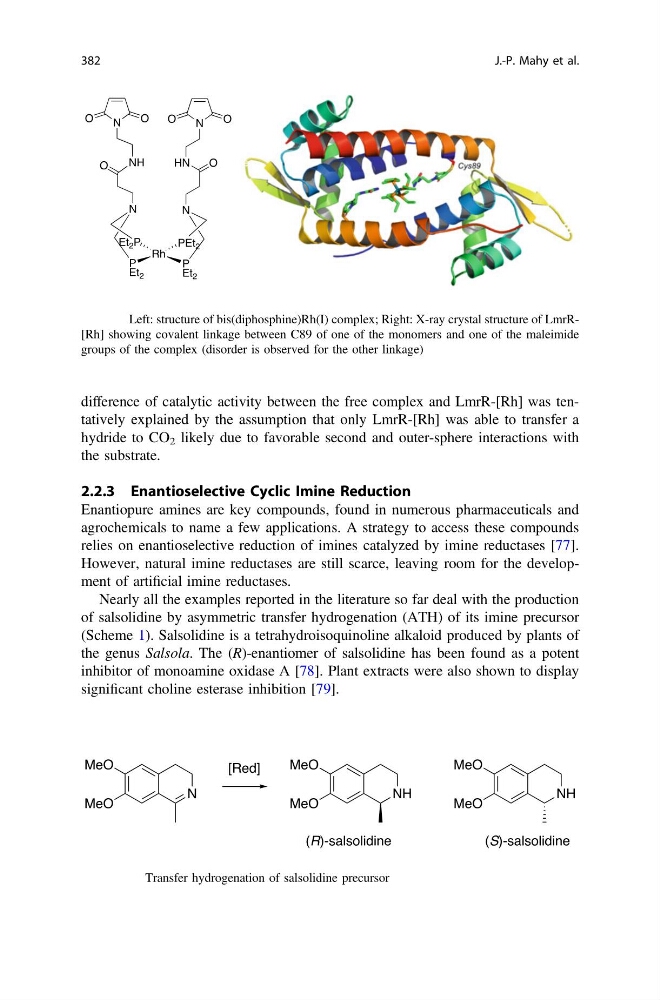
Fig. 15 Left: structure of bis(diphosphine)Rh(I) complex; Right: X-ray crystal structure of LmrR[Rh] showing covalent linkage between C89 of one of the monomers and one of the maleimide
groups of the complex (disorder is observed for the other linkage)
Scheme 1 Transfer hydrogenation of salsolidine precursor
382
J.-P. Mahy et al.
hydride to CO 2 likely due to favorable second and outer-sphere interactions with
the substrate.
2.2.3 Enantioselective Cyclic Imine Reduction
Enantiopure amines are key compounds, found in numerous pharmaceuticals and
agrochemicals to name a few applications. A strategy to access these compounds
relies on enantioselective reduction of imines catalyzed by imine reductases [77].
However, natural imine reductases are still scarce, leaving room for the development of artificial imine reductases.
Nearly all the examples reported in the literature so far deal with the production
of salsolidine by asymmetric transfer hydrogenation (ATH) of its imine precursor
(Scheme 1). Salsolidine is a tetrahydroisoquinoline alkaloid produced by plants of
the genus Salsola. The (R)-enantiomer of salsolidine has been found as a potent
inhibitor of monoamine oxidase A [78]. Plant extracts were also shown to display
significant choline esterase inhibition [79].
Fig. 15 Left: structure of bis(diphosphine)Rh(I) complex; Right: X-ray crystal structure of LmrR[Rh] showing covalent linkage between C89 of one of the monomers and one of the maleimide
groups of the complex (disorder is observed for the other linkage)
Scheme 1 Transfer hydrogenation of salsolidine precursor
382
J.-P. Mahy et al.