

produced CO/H 2 molar ratios were significantly larger than those obtained with the
free nickel complex. Also, the ArM built up from WT Az was more selective than
the double mutant, likely owing to the partially buried position of H83.
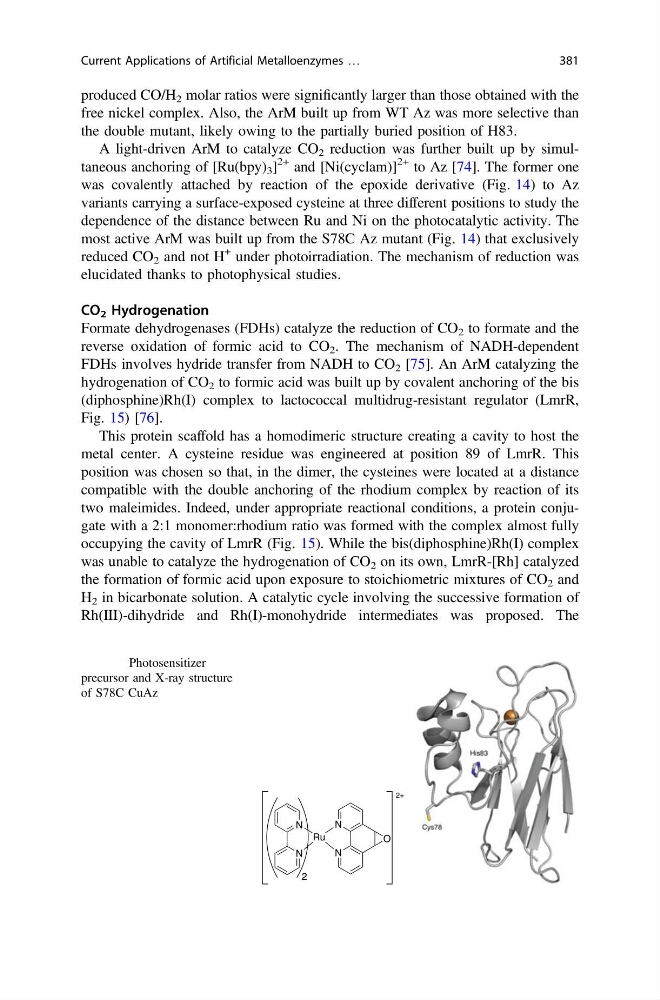
A light-driven ArM to catalyze CO 2 reduction was further built up by simultaneous anchoring of [Ru(bpy) 3 ]
2+ and [Ni(cyclam)]
2+ to Az [74]. The former one
was covalently attached by reaction of the epoxide derivative (Fig. 14) to Az
variants carrying a surface-exposed cysteine at three different positions to study the
dependence of the distance between Ru and Ni on the photocatalytic activity. The
most active ArM was built up from the S78C Az mutant (Fig. 14) that exclusively
reduced CO 2 and not H
+ under photoirradiation. The mechanism of reduction was
elucidated thanks to photophysical studies.
CO 2 Hydrogenation
Formate dehydrogenases (FDHs) catalyze the reduction of CO 2 to formate and the
reverse oxidation of formic acid to CO 2 . The mechanism of NADH-dependent
FDHs involves hydride transfer from NADH to CO 2 [75]. An ArM catalyzing the
hydrogenation of CO 2 to formic acid was built up by covalent anchoring of the bis
(diphosphine)Rh(I) complex to lactococcal multidrug-resistant regulator (LmrR,
Fig. 15) [76].
This protein scaffold has a homodimeric structure creating a cavity to host the
metal center. A cysteine residue was engineered at position 89 of LmrR. This
position was chosen so that, in the dimer, the cysteines were located at a distance
compatible with the double anchoring of the rhodium complex by reaction of its
two maleimides. Indeed, under appropriate reactional conditions, a protein conjugate with a 2:1 monomer:rhodium ratio was formed with the complex almost fully
occupying the cavity of LmrR (Fig. 15). While the bis(diphosphine)Rh(I) complex
was unable to catalyze the hydrogenation of CO 2 on its own, LmrR-[Rh] catalyzed
the formation of formic acid upon exposure to stoichiometric mixtures of CO 2 and
H 2 in bicarbonate solution. A catalytic cycle involving the successive formation of
Rh(III)-dihydride and Rh(I)-monohydride intermediates was proposed. The
Fig. 14 Photosensitizer
precursor and X-ray structure
of S78C CuAz
Current Applications of Artificial Metalloenzymes …
381
free nickel complex. Also, the ArM built up from WT Az was more selective than
the double mutant, likely owing to the partially buried position of H83.
A light-driven ArM to catalyze CO 2 reduction was further built up by simultaneous anchoring of [Ru(bpy) 3 ]
2+ and [Ni(cyclam)]
2+ to Az [74]. The former one
was covalently attached by reaction of the epoxide derivative (Fig. 14) to Az
variants carrying a surface-exposed cysteine at three different positions to study the
dependence of the distance between Ru and Ni on the photocatalytic activity. The
most active ArM was built up from the S78C Az mutant (Fig. 14) that exclusively
reduced CO 2 and not H
+ under photoirradiation. The mechanism of reduction was
elucidated thanks to photophysical studies.
CO 2 Hydrogenation
Formate dehydrogenases (FDHs) catalyze the reduction of CO 2 to formate and the
reverse oxidation of formic acid to CO 2 . The mechanism of NADH-dependent
FDHs involves hydride transfer from NADH to CO 2 [75]. An ArM catalyzing the
hydrogenation of CO 2 to formic acid was built up by covalent anchoring of the bis
(diphosphine)Rh(I) complex to lactococcal multidrug-resistant regulator (LmrR,
Fig. 15) [76].
This protein scaffold has a homodimeric structure creating a cavity to host the
metal center. A cysteine residue was engineered at position 89 of LmrR. This
position was chosen so that, in the dimer, the cysteines were located at a distance
compatible with the double anchoring of the rhodium complex by reaction of its
two maleimides. Indeed, under appropriate reactional conditions, a protein conjugate with a 2:1 monomer:rhodium ratio was formed with the complex almost fully
occupying the cavity of LmrR (Fig. 15). While the bis(diphosphine)Rh(I) complex
was unable to catalyze the hydrogenation of CO 2 on its own, LmrR-[Rh] catalyzed
the formation of formic acid upon exposure to stoichiometric mixtures of CO 2 and
H 2 in bicarbonate solution. A catalytic cycle involving the successive formation of
Rh(III)-dihydride and Rh(I)-monohydride intermediates was proposed. The
Fig. 14 Photosensitizer
precursor and X-ray structure
of S78C CuAz
Current Applications of Artificial Metalloenzymes …
381