

metal complex in light-driven H 2 production (TON = 120 after 8 h at pH 7).
However, mutation of the coordinating M7 by alanine or aspartate led to more
efficient hybrid catalysts with TONs of 310 and 270, respectively. Photocatalytic
production of H 2 was also effective under aerobic conditions, which opens attractive avenues in the future development of environmentally benign artificial
hydrogenases.
2.2.2 Carbon Dioxide Hydrogenation and Reduction
Carbon dioxide emissions owing to fossil fuel consumption are a real environmental threat because of the associated greenhouse effect. On the other hand,
conversion of CO 2 into added-value chemicals such as CO or HCOOH may contribute to counteract this threat [71].
CO 2 Reduction
In nature, the interconversion between CO 2 and CO is catalyzed by [NiFe] carbon
monoxide dehydrogenase (CODH) via a two-electron, proton-coupled process [72].
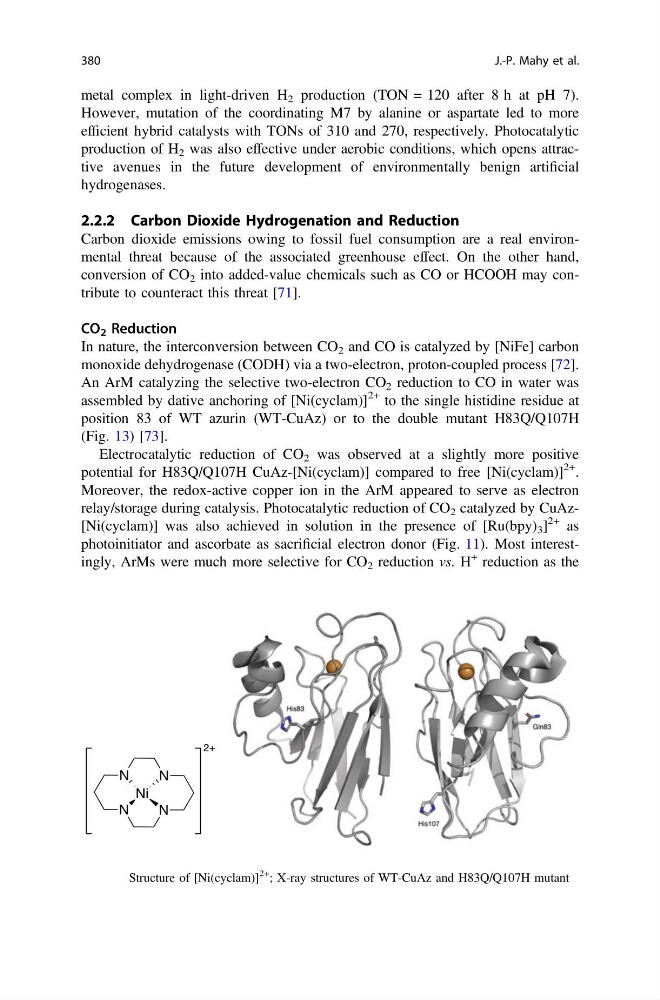
An ArM catalyzing the selective two-electron CO 2 reduction to CO in water was
assembled by dative anchoring of [Ni(cyclam)]
2+ to the single histidine residue at
position 83 of WT azurin (WT-CuAz) or to the double mutant H83Q/Q107H
(Fig. 13) [73].
Electrocatalytic reduction of CO 2 was observed at a slightly more positive
potential for H83Q/Q107H CuAz-[Ni(cyclam)] compared to free [Ni(cyclam)]
2+ .
Moreover, the redox-active copper ion in the ArM appeared to serve as electron
relay/storage during catalysis. Photocatalytic reduction of CO 2 catalyzed by CuAz[Ni(cyclam)] was also achieved in solution in the presence of [Ru(bpy) 3 ]
2+ as
photoinitiator and ascorbate as sacrificial electron donor (Fig. 11). Most interestingly, ArMs were much more selective for CO 2 reduction vs. H
+ reduction as the
Fig. 13 Structure of [Ni(cyclam)]
2+ ; X-ray structures of WT-CuAz and H83Q/Q107H mutant
380
J.-P. Mahy et al.
However, mutation of the coordinating M7 by alanine or aspartate led to more
efficient hybrid catalysts with TONs of 310 and 270, respectively. Photocatalytic
production of H 2 was also effective under aerobic conditions, which opens attractive avenues in the future development of environmentally benign artificial
hydrogenases.
2.2.2 Carbon Dioxide Hydrogenation and Reduction
Carbon dioxide emissions owing to fossil fuel consumption are a real environmental threat because of the associated greenhouse effect. On the other hand,
conversion of CO 2 into added-value chemicals such as CO or HCOOH may contribute to counteract this threat [71].
CO 2 Reduction
In nature, the interconversion between CO 2 and CO is catalyzed by [NiFe] carbon
monoxide dehydrogenase (CODH) via a two-electron, proton-coupled process [72].
An ArM catalyzing the selective two-electron CO 2 reduction to CO in water was
assembled by dative anchoring of [Ni(cyclam)]
2+ to the single histidine residue at
position 83 of WT azurin (WT-CuAz) or to the double mutant H83Q/Q107H
(Fig. 13) [73].
Electrocatalytic reduction of CO 2 was observed at a slightly more positive
potential for H83Q/Q107H CuAz-[Ni(cyclam)] compared to free [Ni(cyclam)]
2+ .
Moreover, the redox-active copper ion in the ArM appeared to serve as electron
relay/storage during catalysis. Photocatalytic reduction of CO 2 catalyzed by CuAz[Ni(cyclam)] was also achieved in solution in the presence of [Ru(bpy) 3 ]
2+ as
photoinitiator and ascorbate as sacrificial electron donor (Fig. 11). Most interestingly, ArMs were much more selective for CO 2 reduction vs. H
+ reduction as the
Fig. 13 Structure of [Ni(cyclam)]
2+ ; X-ray structures of WT-CuAz and H83Q/Q107H mutant
380
J.-P. Mahy et al.