

Apo-ferritin (Fr) was also used to host diiron hexacarbonyl dithiolate clusters
inside its cavity that naturally presents numerous metal-binding sites [67]. Loading
of FeFe2 within the cavity of apo-Fr was readily achieved at neutral pH without
alteration of its structure. Light-driven reduction of H
+ afforded H 2 with a TON of
31 after 3 h at pH 5 to be compared with free FeFe2 that gave a TON of 3.6 in the
same conditions. It was shown that, since the photosensitizer remained outside the
cavity, electron tunneling through the Fr shell necessarily followed a multistep
pathway.
The N-hydroxysuccinimide ester derivative of FeFe3 was conjugated to calf
thymus histone H1 whose C-terminal domain contains numerous lysine residues
and is intrinsically disordered [68]. Conjugation induced a significant conformational change with formation of a-helices. A change in the size and density of the
nanoparticles was also observed. This biohybrid was able to catalyze the
light-driven production of H 2 with a TON of 359 after 6 h at pH 5.0 to be compared
with a TON of 54 for the precursor.
Nevertheless, all the artificial hydrogenases containing a diiron hexacarbonyl
dithiolate active site suffer from progressive degradation upon illumination even if the
protein scaffold provides some kind of protection resulting in increased catalyst
lifetime. This is why Ghirlanda’s team proposed to exploit the hydrogen reduction
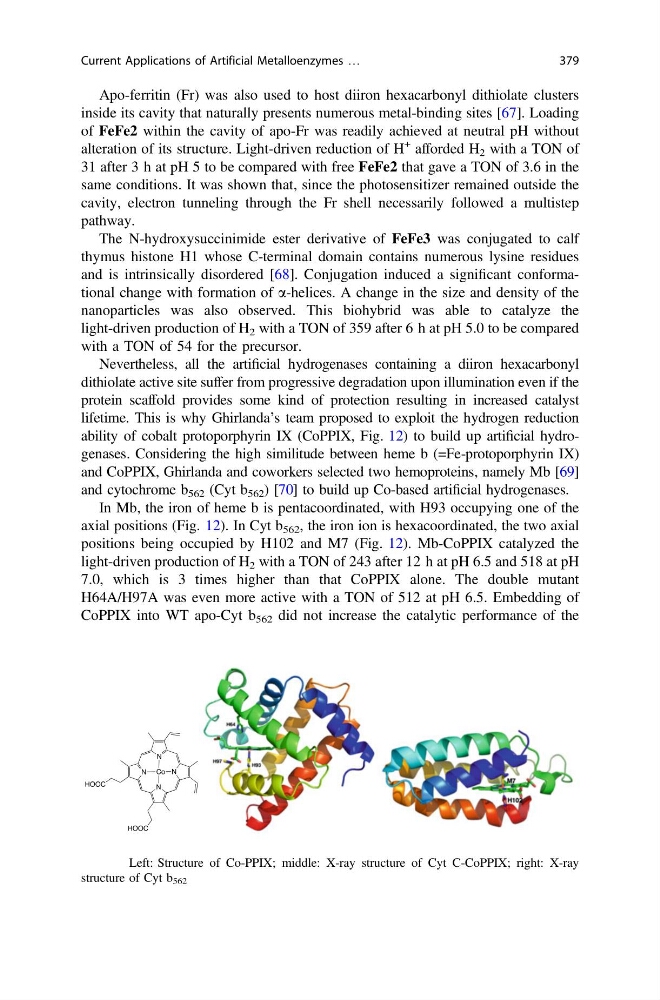
ability of cobalt protoporphyrin IX (CoPPIX, Fig. 12) to build up artificial hydrogenases. Considering the high similitude between heme b (=Fe-protoporphyrin IX)
and CoPPIX, Ghirlanda and coworkers selected two hemoproteins, namely Mb [69]
and cytochrome b 562 (Cyt b 562 ) [70] to build up Co-based artificial hydrogenases.
In Mb, the iron of heme b is pentacoordinated, with H93 occupying one of the
axial positions (Fig. 12). In Cyt b 562 , the iron ion is hexacoordinated, the two axial
positions being occupied by H102 and M7 (Fig. 12). Mb-CoPPIX catalyzed the
light-driven production of H 2 with a TON of 243 after 12 h at pH 6.5 and 518 at pH
7.0, which is 3 times higher than that CoPPIX alone. The double mutant
H64A/H97A was even more active with a TON of 512 at pH 6.5. Embedding of
CoPPIX into WT apo-Cyt b 562 did not increase the catalytic performance of the
Fig. 12 Left: Structure of Co-PPIX; middle: X-ray structure of Cyt C-CoPPIX; right: X-ray
structure of Cyt b 562
Current Applications of Artificial Metalloenzymes …
379
inside its cavity that naturally presents numerous metal-binding sites [67]. Loading
of FeFe2 within the cavity of apo-Fr was readily achieved at neutral pH without
alteration of its structure. Light-driven reduction of H
+ afforded H 2 with a TON of
31 after 3 h at pH 5 to be compared with free FeFe2 that gave a TON of 3.6 in the
same conditions. It was shown that, since the photosensitizer remained outside the
cavity, electron tunneling through the Fr shell necessarily followed a multistep
pathway.
The N-hydroxysuccinimide ester derivative of FeFe3 was conjugated to calf
thymus histone H1 whose C-terminal domain contains numerous lysine residues
and is intrinsically disordered [68]. Conjugation induced a significant conformational change with formation of a-helices. A change in the size and density of the
nanoparticles was also observed. This biohybrid was able to catalyze the
light-driven production of H 2 with a TON of 359 after 6 h at pH 5.0 to be compared
with a TON of 54 for the precursor.
Nevertheless, all the artificial hydrogenases containing a diiron hexacarbonyl
dithiolate active site suffer from progressive degradation upon illumination even if the
protein scaffold provides some kind of protection resulting in increased catalyst
lifetime. This is why Ghirlanda’s team proposed to exploit the hydrogen reduction
ability of cobalt protoporphyrin IX (CoPPIX, Fig. 12) to build up artificial hydrogenases. Considering the high similitude between heme b (=Fe-protoporphyrin IX)
and CoPPIX, Ghirlanda and coworkers selected two hemoproteins, namely Mb [69]
and cytochrome b 562 (Cyt b 562 ) [70] to build up Co-based artificial hydrogenases.
In Mb, the iron of heme b is pentacoordinated, with H93 occupying one of the
axial positions (Fig. 12). In Cyt b 562 , the iron ion is hexacoordinated, the two axial
positions being occupied by H102 and M7 (Fig. 12). Mb-CoPPIX catalyzed the
light-driven production of H 2 with a TON of 243 after 12 h at pH 6.5 and 518 at pH
7.0, which is 3 times higher than that CoPPIX alone. The double mutant
H64A/H97A was even more active with a TON of 512 at pH 6.5. Embedding of
CoPPIX into WT apo-Cyt b 562 did not increase the catalytic performance of the
Fig. 12 Left: Structure of Co-PPIX; middle: X-ray structure of Cyt C-CoPPIX; right: X-ray
structure of Cyt b 562
Current Applications of Artificial Metalloenzymes …
379