

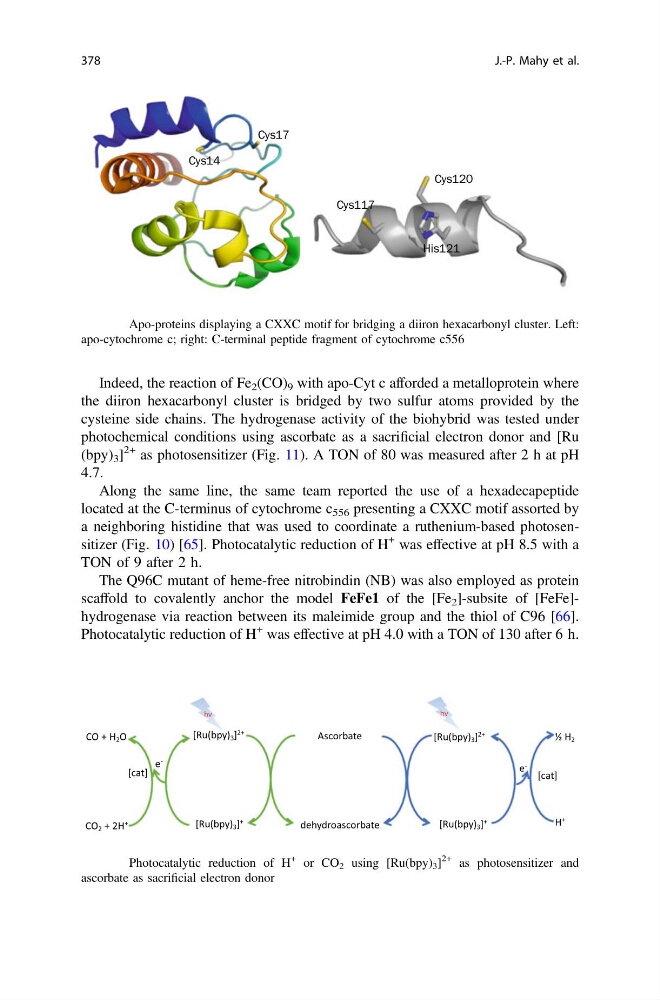
Indeed, the reaction of Fe 2 (CO) 9 with apo-Cyt c afforded a metalloprotein where
the diiron hexacarbonyl cluster is bridged by two sulfur atoms provided by the
cysteine side chains. The hydrogenase activity of the biohybrid was tested under
photochemical conditions using ascorbate as a sacrificial electron donor and [Ru
(bpy) 3 ]
2+ as photosensitizer (Fig. 11). A TON of 80 was measured after 2 h at pH
4.7.
Along the same line, the same team reported the use of a hexadecapeptide
located at the C-terminus of cytochrome c 556 presenting a CXXC motif assorted by
a neighboring histidine that was used to coordinate a ruthenium-based photosensitizer (Fig. 10) [65]. Photocatalytic reduction of H
+ was effective at pH 8.5 with a
TON of 9 after 2 h.
The Q96C mutant of heme-free nitrobindin (NB) was also employed as protein
scaffold to covalently anchor the model FeFe1 of the [Fe 2 ]-subsite of [FeFe]hydrogenase via reaction between its maleimide group and the thiol of C96 [66].
Photocatalytic reduction of H
+ was effective at pH 4.0 with a TON of 130 after 6 h.
Cys117
Cys120
His121
Cys14
Cys17
Fig. 10 Apo-proteins displaying a CXXC motif for bridging a diiron hexacarbonyl cluster. Left:
apo-cytochrome c; right: C-terminal peptide fragment of cytochrome c556
Ascorbate
dehydroascorbate
[Ru(bpy) 3 ]
2+
[Ru(bpy) 3 ]
+
H
+
½ H 2
e
-
[cat]
hv
[Ru(bpy) 3 ]
+
[Ru(bpy) 3 ]
2+
hv
CO 2 + 2H
+
CO + H 2 O
e
-
[cat]
Fig. 11 Photocatalytic reduction of H
+ or CO 2 using [Ru(bpy) 3 ]
2+ as photosensitizer and
ascorbate as sacrificial electron donor
378
J.-P. Mahy et al.
the diiron hexacarbonyl cluster is bridged by two sulfur atoms provided by the
cysteine side chains. The hydrogenase activity of the biohybrid was tested under
photochemical conditions using ascorbate as a sacrificial electron donor and [Ru
(bpy) 3 ]
2+ as photosensitizer (Fig. 11). A TON of 80 was measured after 2 h at pH
4.7.
Along the same line, the same team reported the use of a hexadecapeptide
located at the C-terminus of cytochrome c 556 presenting a CXXC motif assorted by
a neighboring histidine that was used to coordinate a ruthenium-based photosensitizer (Fig. 10) [65]. Photocatalytic reduction of H
+ was effective at pH 8.5 with a
TON of 9 after 2 h.
The Q96C mutant of heme-free nitrobindin (NB) was also employed as protein
scaffold to covalently anchor the model FeFe1 of the [Fe 2 ]-subsite of [FeFe]hydrogenase via reaction between its maleimide group and the thiol of C96 [66].
Photocatalytic reduction of H
+ was effective at pH 4.0 with a TON of 130 after 6 h.
Cys117
Cys120
His121
Cys14
Cys17
Fig. 10 Apo-proteins displaying a CXXC motif for bridging a diiron hexacarbonyl cluster. Left:
apo-cytochrome c; right: C-terminal peptide fragment of cytochrome c556
Ascorbate
dehydroascorbate
[Ru(bpy) 3 ]
2+
[Ru(bpy) 3 ]
+
H
+
½ H 2
e
-
[cat]
hv
[Ru(bpy) 3 ]
+
[Ru(bpy) 3 ]
2+
hv
CO 2 + 2H
+
CO + H 2 O
e
-
[cat]
Fig. 11 Photocatalytic reduction of H
+ or CO 2 using [Ru(bpy) 3 ]
2+ as photosensitizer and
ascorbate as sacrificial electron donor
378
J.-P. Mahy et al.