

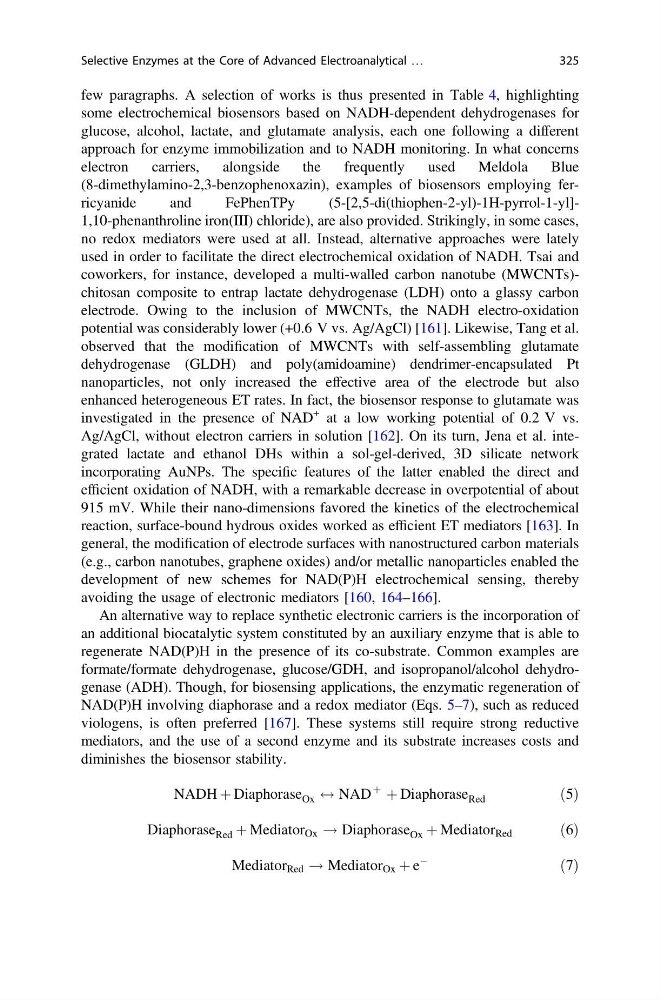
few paragraphs. A selection of works is thus presented in Table 4, highlighting
some electrochemical biosensors based on NADH-dependent dehydrogenases for
glucose, alcohol, lactate, and glutamate analysis, each one following a different
approach for enzyme immobilization and to NADH monitoring. In what concerns
electron
carriers,
alongside
the
frequently
used
Meldola
Blue
(8-dimethylamino-2,3-benzophenoxazin), examples of biosensors employing ferricyanide
and
FePhenTPy
(5-[2,5-di(thiophen-2-yl)-1H-pyrrol-1-yl]1,10-phenanthroline iron(III) chloride), are also provided. Strikingly, in some cases,
no redox mediators were used at all. Instead, alternative approaches were lately
used in order to facilitate the direct electrochemical oxidation of NADH. Tsai and
coworkers, for instance, developed a multi-walled carbon nanotube (MWCNTs)chitosan composite to entrap lactate dehydrogenase (LDH) onto a glassy carbon
electrode. Owing to the inclusion of MWCNTs, the NADH electro-oxidation
potential was considerably lower (+0.6 V vs. Ag/AgCl) [161]. Likewise, Tang et al.
observed that the modification of MWCNTs with self-assembling glutamate
dehydrogenase (GLDH) and poly(amidoamine) dendrimer-encapsulated Pt
nanoparticles, not only increased the effective area of the electrode but also
enhanced heterogeneous ET rates. In fact, the biosensor response to glutamate was
investigated in the presence of NAD
+ at a low working potential of 0.2 V vs.
Ag/AgCl, without electron carriers in solution [162]. On its turn, Jena et al. integrated lactate and ethanol DHs within a sol-gel-derived, 3D silicate network
incorporating AuNPs. The specific features of the latter enabled the direct and
efficient oxidation of NADH, with a remarkable decrease in overpotential of about
915 mV. While their nano-dimensions favored the kinetics of the electrochemical
reaction, surface-bound hydrous oxides worked as efficient ET mediators [163]. In
general, the modification of electrode surfaces with nanostructured carbon materials
(e.g., carbon nanotubes, graphene oxides) and/or metallic nanoparticles enabled the
development of new schemes for NAD(P)H electrochemical sensing, thereby
avoiding the usage of electronic mediators [160, 164–166].
An alternative way to replace synthetic electronic carriers is the incorporation of
an additional biocatalytic system constituted by an auxiliary enzyme that is able to
regenerate NAD(P)H in the presence of its co-substrate. Common examples are
formate/formate dehydrogenase, glucose/GDH, and isopropanol/alcohol dehydrogenase (ADH). Though, for biosensing applications, the enzymatic regeneration of
NAD(P)H involving diaphorase and a redox mediator (Eqs. 5–7), such as reduced
viologens, is often preferred [167]. These systems still require strong reductive
mediators, and the use of a second enzyme and its substrate increases costs and
diminishes the biosensor stability.
NADH þ Diaphorase Ox $ NAD
þ
þ Diaphorase Red
ð5Þ
Diaphorase Red þ Mediator Ox ! Diaphorase Ox þ Mediator Red
ð6Þ
Mediator Red ! Mediator Ox þ e
À
ð7Þ
Selective Enzymes at the Core of Advanced Electroanalytical …
325
some electrochemical biosensors based on NADH-dependent dehydrogenases for
glucose, alcohol, lactate, and glutamate analysis, each one following a different
approach for enzyme immobilization and to NADH monitoring. In what concerns
electron
carriers,
alongside
the
frequently
used
Meldola
Blue
(8-dimethylamino-2,3-benzophenoxazin), examples of biosensors employing ferricyanide
and
FePhenTPy
(5-[2,5-di(thiophen-2-yl)-1H-pyrrol-1-yl]1,10-phenanthroline iron(III) chloride), are also provided. Strikingly, in some cases,
no redox mediators were used at all. Instead, alternative approaches were lately
used in order to facilitate the direct electrochemical oxidation of NADH. Tsai and
coworkers, for instance, developed a multi-walled carbon nanotube (MWCNTs)chitosan composite to entrap lactate dehydrogenase (LDH) onto a glassy carbon
electrode. Owing to the inclusion of MWCNTs, the NADH electro-oxidation
potential was considerably lower (+0.6 V vs. Ag/AgCl) [161]. Likewise, Tang et al.
observed that the modification of MWCNTs with self-assembling glutamate
dehydrogenase (GLDH) and poly(amidoamine) dendrimer-encapsulated Pt
nanoparticles, not only increased the effective area of the electrode but also
enhanced heterogeneous ET rates. In fact, the biosensor response to glutamate was
investigated in the presence of NAD
+ at a low working potential of 0.2 V vs.
Ag/AgCl, without electron carriers in solution [162]. On its turn, Jena et al. integrated lactate and ethanol DHs within a sol-gel-derived, 3D silicate network
incorporating AuNPs. The specific features of the latter enabled the direct and
efficient oxidation of NADH, with a remarkable decrease in overpotential of about
915 mV. While their nano-dimensions favored the kinetics of the electrochemical
reaction, surface-bound hydrous oxides worked as efficient ET mediators [163]. In
general, the modification of electrode surfaces with nanostructured carbon materials
(e.g., carbon nanotubes, graphene oxides) and/or metallic nanoparticles enabled the
development of new schemes for NAD(P)H electrochemical sensing, thereby
avoiding the usage of electronic mediators [160, 164–166].
An alternative way to replace synthetic electronic carriers is the incorporation of
an additional biocatalytic system constituted by an auxiliary enzyme that is able to
regenerate NAD(P)H in the presence of its co-substrate. Common examples are
formate/formate dehydrogenase, glucose/GDH, and isopropanol/alcohol dehydrogenase (ADH). Though, for biosensing applications, the enzymatic regeneration of
NAD(P)H involving diaphorase and a redox mediator (Eqs. 5–7), such as reduced
viologens, is often preferred [167]. These systems still require strong reductive
mediators, and the use of a second enzyme and its substrate increases costs and
diminishes the biosensor stability.
NADH þ Diaphorase Ox $ NAD
þ
þ Diaphorase Red
ð5Þ
Diaphorase Red þ Mediator Ox ! Diaphorase Ox þ Mediator Red
ð6Þ
Mediator Red ! Mediator Ox þ e
À
ð7Þ
Selective Enzymes at the Core of Advanced Electroanalytical …
325