

masking the truly analytic signals and making impractical the NAD(P)
+ reduction in
biosensing applications without previous sample deaeration. Besides, the dimers’
formation from reaction products also affects the electrochemical reaction. For these
reasons, the design of amperometric biosensors based on NAD(P)H-dependent DHs
have been mainly focused on the anodic oxidation of the cofactor’s reduced form
[153, 155].
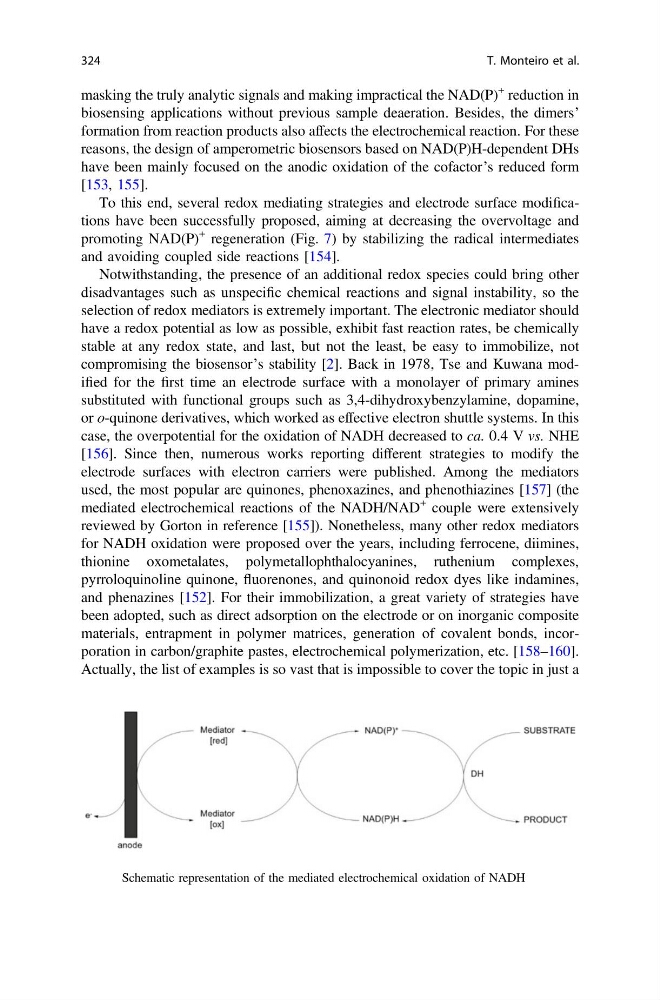
To this end, several redox mediating strategies and electrode surface modifications have been successfully proposed, aiming at decreasing the overvoltage and
promoting NAD(P)
+ regeneration (Fig. 7) by stabilizing the radical intermediates
and avoiding coupled side reactions [154].
Notwithstanding, the presence of an additional redox species could bring other
disadvantages such as unspecific chemical reactions and signal instability, so the
selection of redox mediators is extremely important. The electronic mediator should
have a redox potential as low as possible, exhibit fast reaction rates, be chemically
stable at any redox state, and last, but not the least, be easy to immobilize, not
compromising the biosensor’s stability [2]. Back in 1978, Tse and Kuwana modified for the first time an electrode surface with a monolayer of primary amines
substituted with functional groups such as 3,4-dihydroxybenzylamine, dopamine,
or o-quinone derivatives, which worked as effective electron shuttle systems. In this
case, the overpotential for the oxidation of NADH decreased to ca. 0.4 V vs. NHE
[156]. Since then, numerous works reporting different strategies to modify the
electrode surfaces with electron carriers were published. Among the mediators
used, the most popular are quinones, phenoxazines, and phenothiazines [157] (the
mediated electrochemical reactions of the NADH/NAD
+ couple were extensively
reviewed by Gorton in reference [155]). Nonetheless, many other redox mediators
for NADH oxidation were proposed over the years, including ferrocene, diimines,
thionine oxometalates, polymetallophthalocyanines, ruthenium complexes,
pyrroloquinoline quinone, fluorenones, and quinonoid redox dyes like indamines,
and phenazines [152]. For their immobilization, a great variety of strategies have
been adopted, such as direct adsorption on the electrode or on inorganic composite
materials, entrapment in polymer matrices, generation of covalent bonds, incorporation in carbon/graphite pastes, electrochemical polymerization, etc. [158–160].
Actually, the list of examples is so vast that is impossible to cover the topic in just a
Fig. 7 Schematic representation of the mediated electrochemical oxidation of NADH
324
T. Monteiro et al.
+ reduction in
biosensing applications without previous sample deaeration. Besides, the dimers’
formation from reaction products also affects the electrochemical reaction. For these
reasons, the design of amperometric biosensors based on NAD(P)H-dependent DHs
have been mainly focused on the anodic oxidation of the cofactor’s reduced form
[153, 155].
To this end, several redox mediating strategies and electrode surface modifications have been successfully proposed, aiming at decreasing the overvoltage and
promoting NAD(P)
+ regeneration (Fig. 7) by stabilizing the radical intermediates
and avoiding coupled side reactions [154].
Notwithstanding, the presence of an additional redox species could bring other
disadvantages such as unspecific chemical reactions and signal instability, so the
selection of redox mediators is extremely important. The electronic mediator should
have a redox potential as low as possible, exhibit fast reaction rates, be chemically
stable at any redox state, and last, but not the least, be easy to immobilize, not
compromising the biosensor’s stability [2]. Back in 1978, Tse and Kuwana modified for the first time an electrode surface with a monolayer of primary amines
substituted with functional groups such as 3,4-dihydroxybenzylamine, dopamine,
or o-quinone derivatives, which worked as effective electron shuttle systems. In this
case, the overpotential for the oxidation of NADH decreased to ca. 0.4 V vs. NHE
[156]. Since then, numerous works reporting different strategies to modify the
electrode surfaces with electron carriers were published. Among the mediators
used, the most popular are quinones, phenoxazines, and phenothiazines [157] (the
mediated electrochemical reactions of the NADH/NAD
+ couple were extensively
reviewed by Gorton in reference [155]). Nonetheless, many other redox mediators
for NADH oxidation were proposed over the years, including ferrocene, diimines,
thionine oxometalates, polymetallophthalocyanines, ruthenium complexes,
pyrroloquinoline quinone, fluorenones, and quinonoid redox dyes like indamines,
and phenazines [152]. For their immobilization, a great variety of strategies have
been adopted, such as direct adsorption on the electrode or on inorganic composite
materials, entrapment in polymer matrices, generation of covalent bonds, incorporation in carbon/graphite pastes, electrochemical polymerization, etc. [158–160].
Actually, the list of examples is so vast that is impossible to cover the topic in just a
Fig. 7 Schematic representation of the mediated electrochemical oxidation of NADH
324
T. Monteiro et al.