

reported for GOx [55, 56], ChOx [57], ChOD [58], XOD [59] on modified electrodes. However, special care must be taken when considering the evaluation of
such devices. For example, for GOx the idea of direct electron communication with
the electrode has been recently revised by Wilson [60] and Bartlett [8], who concluded that there is no real evidence to sustain such claims in the majority of the
literature. It was demonstrated that the commonly observed redox peaks around -
400 mV (vs. Ag/AgCl reference) are mostly due to free, adsorbed flavin on carbon
electrodes which are present either as an impurity from non-purified commercial
enzyme preparations or as the result of cofactor dissociation due to protein
denaturation [8]. The catalytic responses towards glucose and seen in the presence
of O 2 are due to the consumption of the latter by adsorbed, enzymatically active, but
electrochemically inactive enzyme at the electrode’s surface, making these devices
belong to the first rather than third generation [2, 8, 61].
2.2 Multicopper Oxidases
Multicopper oxidase enzymes are a diverse group that couple the one-electron
oxidation of a variety of substrates with the four-electron reduction of O 2 to water,
without the release of activated oxygen species [105]. This family of enzymes
includes laccase, ascorbate oxidase, copper oxidases, ferroxidases, mammalian
ceruloplasmin, and bilirubin oxidase [105, 106]. The catalytic site of multicopper
oxidases is comprised of four copper atoms that are classified according to their
spectroscopic and magnetic properties: type 1 “blue copper” (T1), type 2 “normal
copper” (T2), and type 3 binuclear copper (T3) (Table 1) [105–107]. The
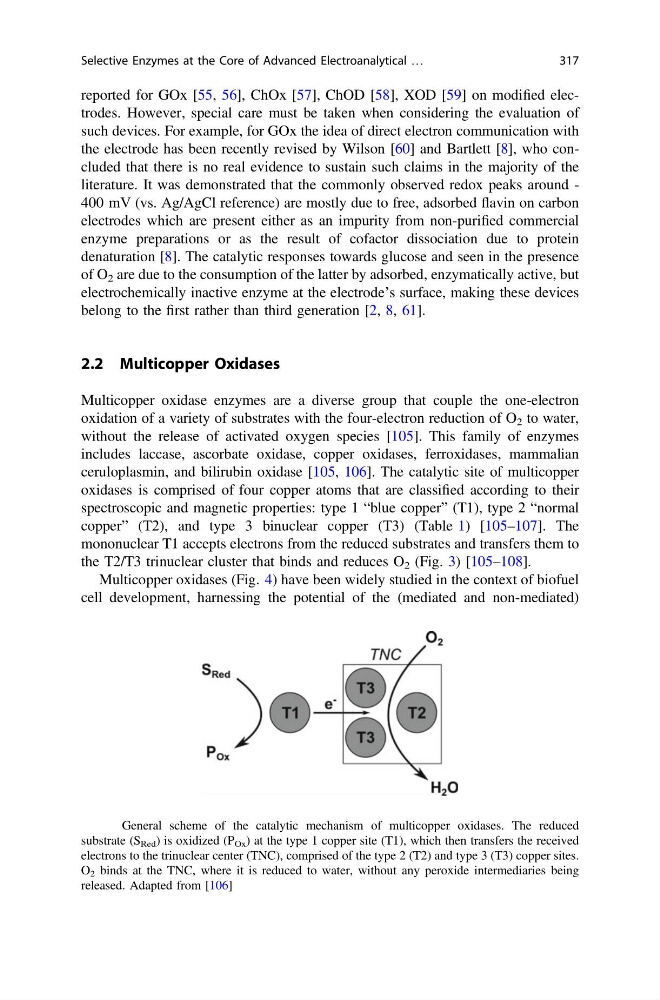
mononuclear T1 accepts electrons from the reduced substrates and transfers them to
the T2/T3 trinuclear cluster that binds and reduces O 2 (Fig. 3) [105–108].
Multicopper oxidases (Fig. 4) have been widely studied in the context of biofuel
cell development, harnessing the potential of the (mediated and non-mediated)
Fig. 3 General scheme of the catalytic mechanism of multicopper oxidases. The reduced
substrate (S Red ) is oxidized (P Ox ) at the type 1 copper site (T1), which then transfers the received
electrons to the trinuclear center (TNC), comprised of the type 2 (T2) and type 3 (T3) copper sites.
O 2 binds at the TNC, where it is reduced to water, without any peroxide intermediaries being
released. Adapted from [106]
Selective Enzymes at the Core of Advanced Electroanalytical …
317
such devices. For example, for GOx the idea of direct electron communication with
the electrode has been recently revised by Wilson [60] and Bartlett [8], who concluded that there is no real evidence to sustain such claims in the majority of the
literature. It was demonstrated that the commonly observed redox peaks around -
400 mV (vs. Ag/AgCl reference) are mostly due to free, adsorbed flavin on carbon
electrodes which are present either as an impurity from non-purified commercial
enzyme preparations or as the result of cofactor dissociation due to protein
denaturation [8]. The catalytic responses towards glucose and seen in the presence
of O 2 are due to the consumption of the latter by adsorbed, enzymatically active, but
electrochemically inactive enzyme at the electrode’s surface, making these devices
belong to the first rather than third generation [2, 8, 61].
2.2 Multicopper Oxidases
Multicopper oxidase enzymes are a diverse group that couple the one-electron
oxidation of a variety of substrates with the four-electron reduction of O 2 to water,
without the release of activated oxygen species [105]. This family of enzymes
includes laccase, ascorbate oxidase, copper oxidases, ferroxidases, mammalian
ceruloplasmin, and bilirubin oxidase [105, 106]. The catalytic site of multicopper
oxidases is comprised of four copper atoms that are classified according to their
spectroscopic and magnetic properties: type 1 “blue copper” (T1), type 2 “normal
copper” (T2), and type 3 binuclear copper (T3) (Table 1) [105–107]. The
mononuclear T1 accepts electrons from the reduced substrates and transfers them to
the T2/T3 trinuclear cluster that binds and reduces O 2 (Fig. 3) [105–108].
Multicopper oxidases (Fig. 4) have been widely studied in the context of biofuel
cell development, harnessing the potential of the (mediated and non-mediated)
Fig. 3 General scheme of the catalytic mechanism of multicopper oxidases. The reduced
substrate (S Red ) is oxidized (P Ox ) at the type 1 copper site (T1), which then transfers the received
electrons to the trinuclear center (TNC), comprised of the type 2 (T2) and type 3 (T3) copper sites.
O 2 binds at the TNC, where it is reduced to water, without any peroxide intermediaries being
released. Adapted from [106]
Selective Enzymes at the Core of Advanced Electroanalytical …
317