

present in physiological samples (e.g., ascorbic and uric acid) [2, 13, 52]. In order to
decrease the necessary working potential, electron transfer (ET) mediators have been
widely applied, where a redox molecule at a constant concentration serves as an
electron shuttle (either free-diffusing or bound to an immobilization matrix) between
the flavin cofactor and the surface of the electrode. O 2 is thus replaced by a
non-physiological electron acceptor, which is recycled at the electrode, providing an
amperometric signal; these devices are classified as second generation biosensors.
[2, 13, 50, 53, 54]. The use of such redox mediators also poses technical difficulties
regarding selectivity, since they are non-specific catalysts and can react with other
electroactive species present in a sample. Also, toxicity issues arise, a common
feature in the majority of artificial mediators [2, 6, 54].
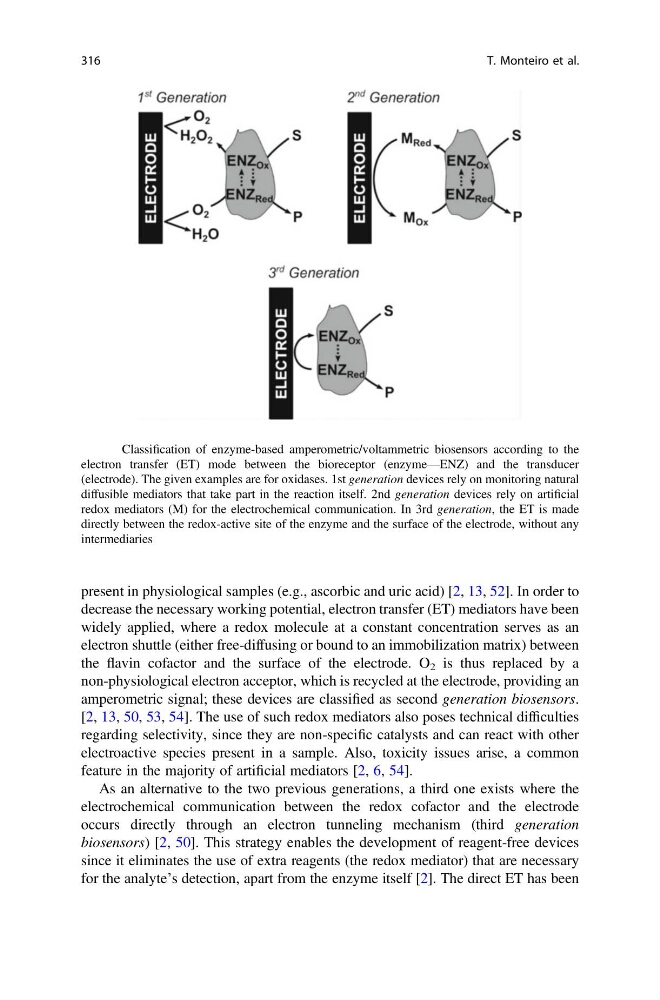
As an alternative to the two previous generations, a third one exists where the
electrochemical communication between the redox cofactor and the electrode
occurs directly through an electron tunneling mechanism (third generation
biosensors) [2, 50]. This strategy enables the development of reagent-free devices
since it eliminates the use of extra reagents (the redox mediator) that are necessary
for the analyte’s detection, apart from the enzyme itself [2]. The direct ET has been
Fig. 2 Classification of enzyme-based amperometric/voltammetric biosensors according to the
electron transfer (ET) mode between the bioreceptor (enzyme—ENZ) and the transducer
(electrode). The given examples are for oxidases. 1st generation devices rely on monitoring natural
diffusible mediators that take part in the reaction itself. 2nd generation devices rely on artificial
redox mediators (M) for the electrochemical communication. In 3rd generation, the ET is made
directly between the redox-active site of the enzyme and the surface of the electrode, without any
intermediaries
316
T. Monteiro et al.
decrease the necessary working potential, electron transfer (ET) mediators have been
widely applied, where a redox molecule at a constant concentration serves as an
electron shuttle (either free-diffusing or bound to an immobilization matrix) between
the flavin cofactor and the surface of the electrode. O 2 is thus replaced by a
non-physiological electron acceptor, which is recycled at the electrode, providing an
amperometric signal; these devices are classified as second generation biosensors.
[2, 13, 50, 53, 54]. The use of such redox mediators also poses technical difficulties
regarding selectivity, since they are non-specific catalysts and can react with other
electroactive species present in a sample. Also, toxicity issues arise, a common
feature in the majority of artificial mediators [2, 6, 54].
As an alternative to the two previous generations, a third one exists where the
electrochemical communication between the redox cofactor and the electrode
occurs directly through an electron tunneling mechanism (third generation
biosensors) [2, 50]. This strategy enables the development of reagent-free devices
since it eliminates the use of extra reagents (the redox mediator) that are necessary
for the analyte’s detection, apart from the enzyme itself [2]. The direct ET has been
Fig. 2 Classification of enzyme-based amperometric/voltammetric biosensors according to the
electron transfer (ET) mode between the bioreceptor (enzyme—ENZ) and the transducer
(electrode). The given examples are for oxidases. 1st generation devices rely on monitoring natural
diffusible mediators that take part in the reaction itself. 2nd generation devices rely on artificial
redox mediators (M) for the electrochemical communication. In 3rd generation, the ET is made
directly between the redox-active site of the enzyme and the surface of the electrode, without any
intermediaries
316
T. Monteiro et al.