

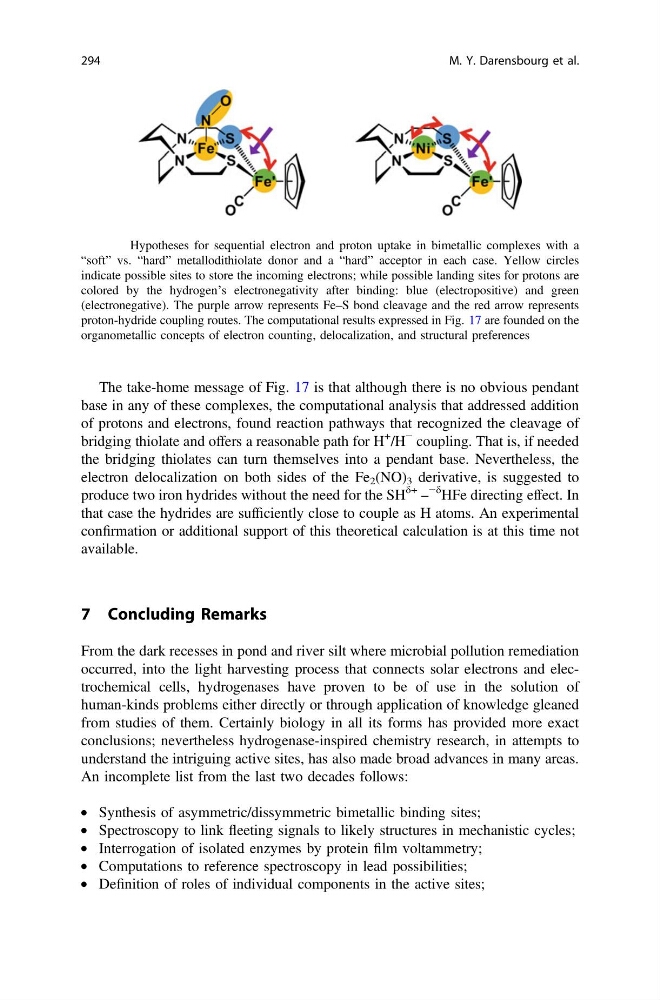
The take-home message of Fig. 17 is that although there is no obvious pendant
base in any of these complexes, the computational analysis that addressed addition
of protons and electrons, found reaction pathways that recognized the cleavage of
bridging thiolate and offers a reasonable path for H
+ /H
− coupling. That is, if needed
the bridging thiolates can turn themselves into a pendant base. Nevertheless, the
electron delocalization on both sides of the Fe 2 (NO) 3 derivative, is suggested to
produce two iron hydrides without the need for the SH
d+
–
−d HFe directing effect. In
that case the hydrides are sufficiently close to couple as H atoms. An experimental
confirmation or additional support of this theoretical calculation is at this time not
available.
7 Concluding Remarks
From the dark recesses in pond and river silt where microbial pollution remediation
occurred, into the light harvesting process that connects solar electrons and electrochemical cells, hydrogenases have proven to be of use in the solution of
human-kinds problems either directly or through application of knowledge gleaned
from studies of them. Certainly biology in all its forms has provided more exact
conclusions; nevertheless hydrogenase-inspired chemistry research, in attempts to
understand the intriguing active sites, has also made broad advances in many areas.
An incomplete list from the last two decades follows:
• Synthesis of asymmetric/dissymmetric bimetallic binding sites;
• Spectroscopy to link fleeting signals to likely structures in mechanistic cycles;
• Interrogation of isolated enzymes by protein film voltammetry;
• Computations to reference spectroscopy in lead possibilities;
• Definition of roles of individual components in the active sites;
Fig. 18 Hypotheses for sequential electron and proton uptake in bimetallic complexes with a
“soft” vs. “hard” metallodithiolate donor and a “hard” acceptor in each case. Yellow circles
indicate possible sites to store the incoming electrons; while possible landing sites for protons are
colored by the hydrogen’s electronegativity after binding: blue (electropositive) and green
(electronegative). The purple arrow represents Fe–S bond cleavage and the red arrow represents
proton-hydride coupling routes. The computational results expressed in Fig. 17 are founded on the
organometallic concepts of electron counting, delocalization, and structural preferences
294
M. Y. Darensbourg et al.
base in any of these complexes, the computational analysis that addressed addition
of protons and electrons, found reaction pathways that recognized the cleavage of
bridging thiolate and offers a reasonable path for H
+ /H
− coupling. That is, if needed
the bridging thiolates can turn themselves into a pendant base. Nevertheless, the
electron delocalization on both sides of the Fe 2 (NO) 3 derivative, is suggested to
produce two iron hydrides without the need for the SH
d+
–
−d HFe directing effect. In
that case the hydrides are sufficiently close to couple as H atoms. An experimental
confirmation or additional support of this theoretical calculation is at this time not
available.
7 Concluding Remarks
From the dark recesses in pond and river silt where microbial pollution remediation
occurred, into the light harvesting process that connects solar electrons and electrochemical cells, hydrogenases have proven to be of use in the solution of
human-kinds problems either directly or through application of knowledge gleaned
from studies of them. Certainly biology in all its forms has provided more exact
conclusions; nevertheless hydrogenase-inspired chemistry research, in attempts to
understand the intriguing active sites, has also made broad advances in many areas.
An incomplete list from the last two decades follows:
• Synthesis of asymmetric/dissymmetric bimetallic binding sites;
• Spectroscopy to link fleeting signals to likely structures in mechanistic cycles;
• Interrogation of isolated enzymes by protein film voltammetry;
• Computations to reference spectroscopy in lead possibilities;
• Definition of roles of individual components in the active sites;
Fig. 18 Hypotheses for sequential electron and proton uptake in bimetallic complexes with a
“soft” vs. “hard” metallodithiolate donor and a “hard” acceptor in each case. Yellow circles
indicate possible sites to store the incoming electrons; while possible landing sites for protons are
colored by the hydrogen’s electronegativity after binding: blue (electropositive) and green
(electronegative). The purple arrow represents Fe–S bond cleavage and the red arrow represents
proton-hydride coupling routes. The computational results expressed in Fig. 17 are founded on the
organometallic concepts of electron counting, delocalization, and structural preferences
294
M. Y. Darensbourg et al.