

The matrix shown in Fig. 17 of electrocatalysts for the HER reaction was
originally conceived for synthetic analogues of the [NiFe]-H 2 ase active site containing features that might be compared in a structure/function relationship. Each of
the complexes show electrocatalytic responses to added electrons and protons in
electrocatalysis and controlled potential solution studies.
The mechanisms differ in the position of those electrochemical responses and to
the strength of the acid, according to the availability of the electron buffering NO,
i.e., the presence of a redox active ligand. As shown in Fig. 17, the NiFe and FeFe
complexes are characterized as Hard and Soft, an analogy to acid/base designations,
however here Hard/Soft refers to the absence or presence of electron-delocalizing
NO ligands either on the metallodithiolate donor ligand or the iron acceptor. For
example, the [Fe(NO)]N 2 S 2 metallodithiolate ligand is classified as a “soft” donor
relative to NiN 2 S 2 , a hard donor reflecting the electron densities on the donor
thiolate sulfurs. Similarly the Fe(NO) 2 unit is a “soft” acceptor, while the (η
5
-C 5 H 5 )
Fe unit is “hard”. For the metallodithiolate donors, the reversible one-electron
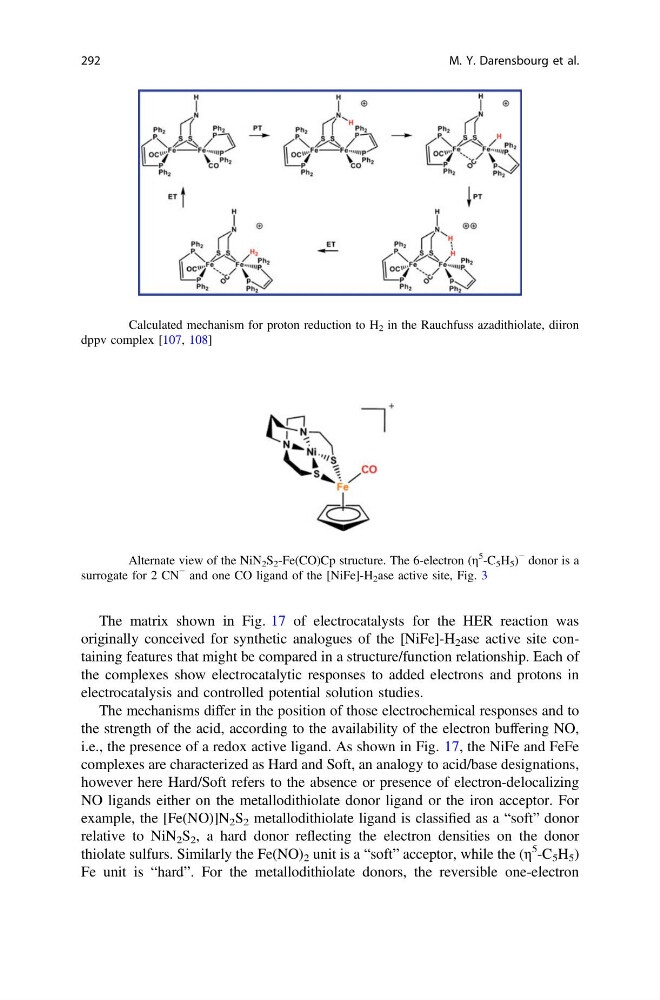
Fig. 15 Calculated mechanism for proton reduction to H 2 in the Rauchfuss azadithiolate, diiron
dppv complex [107, 108]
Fig. 16 Alternate view of the NiN 2 S 2 -Fe(CO)Cp structure. The 6-electron (η
5
-C 5 H 5 )
− donor is a
surrogate for 2 CN
− and one CO ligand of the [NiFe]-H 2 ase active site, Fig. 3
292
M. Y. Darensbourg et al.
originally conceived for synthetic analogues of the [NiFe]-H 2 ase active site containing features that might be compared in a structure/function relationship. Each of
the complexes show electrocatalytic responses to added electrons and protons in
electrocatalysis and controlled potential solution studies.
The mechanisms differ in the position of those electrochemical responses and to
the strength of the acid, according to the availability of the electron buffering NO,
i.e., the presence of a redox active ligand. As shown in Fig. 17, the NiFe and FeFe
complexes are characterized as Hard and Soft, an analogy to acid/base designations,
however here Hard/Soft refers to the absence or presence of electron-delocalizing
NO ligands either on the metallodithiolate donor ligand or the iron acceptor. For
example, the [Fe(NO)]N 2 S 2 metallodithiolate ligand is classified as a “soft” donor
relative to NiN 2 S 2 , a hard donor reflecting the electron densities on the donor
thiolate sulfurs. Similarly the Fe(NO) 2 unit is a “soft” acceptor, while the (η
5
-C 5 H 5 )
Fe unit is “hard”. For the metallodithiolate donors, the reversible one-electron
Fig. 15 Calculated mechanism for proton reduction to H 2 in the Rauchfuss azadithiolate, diiron
dppv complex [107, 108]
Fig. 16 Alternate view of the NiN 2 S 2 -Fe(CO)Cp structure. The 6-electron (η
5
-C 5 H 5 )
− donor is a
surrogate for 2 CN
− and one CO ligand of the [NiFe]-H 2 ase active site, Fig. 3
292
M. Y. Darensbourg et al.