

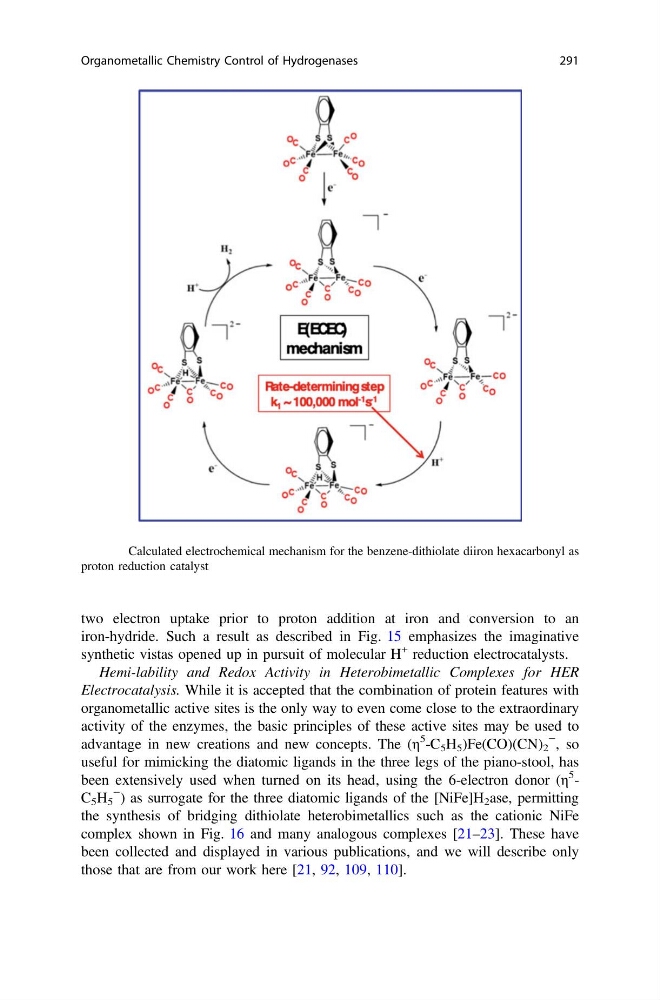
two electron uptake prior to proton addition at iron and conversion to an
iron-hydride. Such a result as described in Fig. 15 emphasizes the imaginative
synthetic vistas opened up in pursuit of molecular H
+ reduction electrocatalysts.
Hemi-lability and Redox Activity in Heterobimetallic Complexes for HER
Electrocatalysis. While it is accepted that the combination of protein features with
organometallic active sites is the only way to even come close to the extraordinary
activity of the enzymes, the basic principles of these active sites may be used to
advantage in new creations and new concepts. The (η
5 -C 5 H 5 )Fe(CO)(CN) 2
− , so
useful for mimicking the diatomic ligands in the three legs of the piano-stool, has
been extensively used when turned on its head, using the 6-electron donor (η
5 -
C 5 H 5
− ) as surrogate for the three diatomic ligands of the [NiFe]H 2 ase, permitting
the synthesis of bridging dithiolate heterobimetallics such as the cationic NiFe
complex shown in Fig. 16 and many analogous complexes [21–23]. These have
been collected and displayed in various publications, and we will describe only
those that are from our work here [21, 92, 109, 110].
Fig. 14 Calculated electrochemical mechanism for the benzene-dithiolate diiron hexacarbonyl as
proton reduction catalyst
Organometallic Chemistry Control of Hydrogenases
291
iron-hydride. Such a result as described in Fig. 15 emphasizes the imaginative
synthetic vistas opened up in pursuit of molecular H
+ reduction electrocatalysts.
Hemi-lability and Redox Activity in Heterobimetallic Complexes for HER
Electrocatalysis. While it is accepted that the combination of protein features with
organometallic active sites is the only way to even come close to the extraordinary
activity of the enzymes, the basic principles of these active sites may be used to
advantage in new creations and new concepts. The (η
5 -C 5 H 5 )Fe(CO)(CN) 2
− , so
useful for mimicking the diatomic ligands in the three legs of the piano-stool, has
been extensively used when turned on its head, using the 6-electron donor (η
5 -
C 5 H 5
− ) as surrogate for the three diatomic ligands of the [NiFe]H 2 ase, permitting
the synthesis of bridging dithiolate heterobimetallics such as the cationic NiFe
complex shown in Fig. 16 and many analogous complexes [21–23]. These have
been collected and displayed in various publications, and we will describe only
those that are from our work here [21, 92, 109, 110].
Fig. 14 Calculated electrochemical mechanism for the benzene-dithiolate diiron hexacarbonyl as
proton reduction catalyst
Organometallic Chemistry Control of Hydrogenases
291