

to isolation of “rotated structures” [102] as a transition state structure in the neutral
diiron complex became the stable form in the one-electron oxidized structure that
had the diminished Fe–Fe bond order. It showed effects of steric encumbrance at the
bridgehead of the S to S linker [103]. It formed the basis of hybrid enzymes
prepared from the dicyano aza-dithiolate, (µ-adt)[Fe(CN)(CO) 2 ] 2
2− that illustrated
artificial maturation of the [FeFe]-H2ase [47, 49].
Despite its lack of several critical features, e.g., the CN
− ligands, the
N-bridgehead as pendant base, or a stable mixed-valent “rotated” structure, the
classic (µ-pdt)[Fe(CO) 3 ] 2 has even been shown to be an electrocatalyst for proton
reduction [104]. An early computational mechanism for the uptake of electrons and
protons in the catalytic cycle of the HER catalyzed by (µ-pdt)[Fe(CO) 3 ] 2 was the
harbinger of a better electrocatalyst based on arene-dithiolates from the Arizona
laboratory of Lichtenberger, Glass, et al., Fig. 14 [105]. A shift of the µ
2 -bridging
dithiolate into a mono-thiolate bridge opens up the dimeric iron to provide considerable asymmetry and the potential for proton landing into the Fe–Fe bond
density. It simultaneously creates a base site on the sulfur in proximity to the
hydride. Addition of the second proton to the doubly reduced species likely occurs
on the mono-dentate thiolate. Even better performances of this system were seen
with modifications of the arene that permitted its incorporation into a water-soluble
polymer [106]. In that case, H 2 production occurs in neutral water with a catalytic
rate of 2.5 Â 10
5 s
−1 and a turnover number on the order of 40,000 under both
anaerobic and aerobic conditions with loadings as low as 2 ppm [106].
A phosphine-substituted version of (µ-pdt)[Fe(CO) 3 ] 2 , developed in the
Rauchfuss laboratory, offers other features, finding a stable rotated structure that
provides an open site on iron, it permits H
+
/H
− coupling (in the computational
mechanism), and it has as well the efficient amine base proton relay [107, 108].
Here we see the agility of the diphosphine ligand that was key to the success of the
Dubois’ catalyst in stabilizing the lower oxidation state and altered coordination
geometry of reduced nickel. In the diiron case, there is further stabilization offered
by the bridging CO and the “come and go” Fe–Fe bonding interaction assists in the
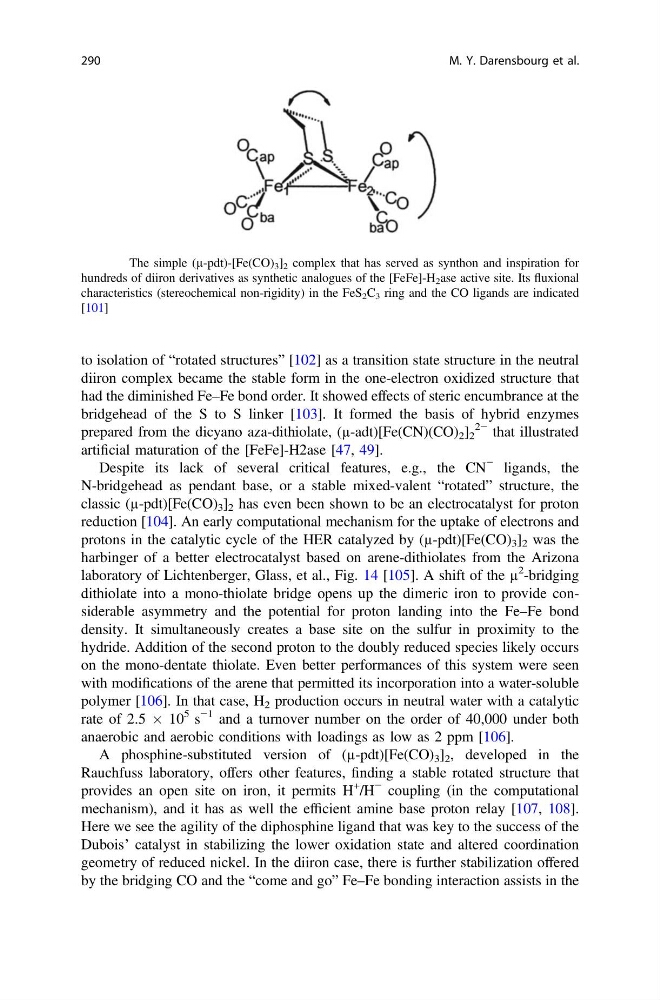
Fig. 13 The simple (µ-pdt)-[Fe(CO) 3 ] 2 complex that has served as synthon and inspiration for
hundreds of diiron derivatives as synthetic analogues of the [FeFe]-H 2 ase active site. Its fluxional
characteristics (stereochemical non-rigidity) in the FeS 2 C 3 ring and the CO ligands are indicated
[101]
290
M. Y. Darensbourg et al.
diiron complex became the stable form in the one-electron oxidized structure that
had the diminished Fe–Fe bond order. It showed effects of steric encumbrance at the
bridgehead of the S to S linker [103]. It formed the basis of hybrid enzymes
prepared from the dicyano aza-dithiolate, (µ-adt)[Fe(CN)(CO) 2 ] 2
2− that illustrated
artificial maturation of the [FeFe]-H2ase [47, 49].
Despite its lack of several critical features, e.g., the CN
− ligands, the
N-bridgehead as pendant base, or a stable mixed-valent “rotated” structure, the
classic (µ-pdt)[Fe(CO) 3 ] 2 has even been shown to be an electrocatalyst for proton
reduction [104]. An early computational mechanism for the uptake of electrons and
protons in the catalytic cycle of the HER catalyzed by (µ-pdt)[Fe(CO) 3 ] 2 was the
harbinger of a better electrocatalyst based on arene-dithiolates from the Arizona
laboratory of Lichtenberger, Glass, et al., Fig. 14 [105]. A shift of the µ
2 -bridging
dithiolate into a mono-thiolate bridge opens up the dimeric iron to provide considerable asymmetry and the potential for proton landing into the Fe–Fe bond
density. It simultaneously creates a base site on the sulfur in proximity to the
hydride. Addition of the second proton to the doubly reduced species likely occurs
on the mono-dentate thiolate. Even better performances of this system were seen
with modifications of the arene that permitted its incorporation into a water-soluble
polymer [106]. In that case, H 2 production occurs in neutral water with a catalytic
rate of 2.5 Â 10
5 s
−1 and a turnover number on the order of 40,000 under both
anaerobic and aerobic conditions with loadings as low as 2 ppm [106].
A phosphine-substituted version of (µ-pdt)[Fe(CO) 3 ] 2 , developed in the
Rauchfuss laboratory, offers other features, finding a stable rotated structure that
provides an open site on iron, it permits H
+
/H
− coupling (in the computational
mechanism), and it has as well the efficient amine base proton relay [107, 108].
Here we see the agility of the diphosphine ligand that was key to the success of the
Dubois’ catalyst in stabilizing the lower oxidation state and altered coordination
geometry of reduced nickel. In the diiron case, there is further stabilization offered
by the bridging CO and the “come and go” Fe–Fe bonding interaction assists in the
Fig. 13 The simple (µ-pdt)-[Fe(CO) 3 ] 2 complex that has served as synthon and inspiration for
hundreds of diiron derivatives as synthetic analogues of the [FeFe]-H 2 ase active site. Its fluxional
characteristics (stereochemical non-rigidity) in the FeS 2 C 3 ring and the CO ligands are indicated
[101]
290
M. Y. Darensbourg et al.