

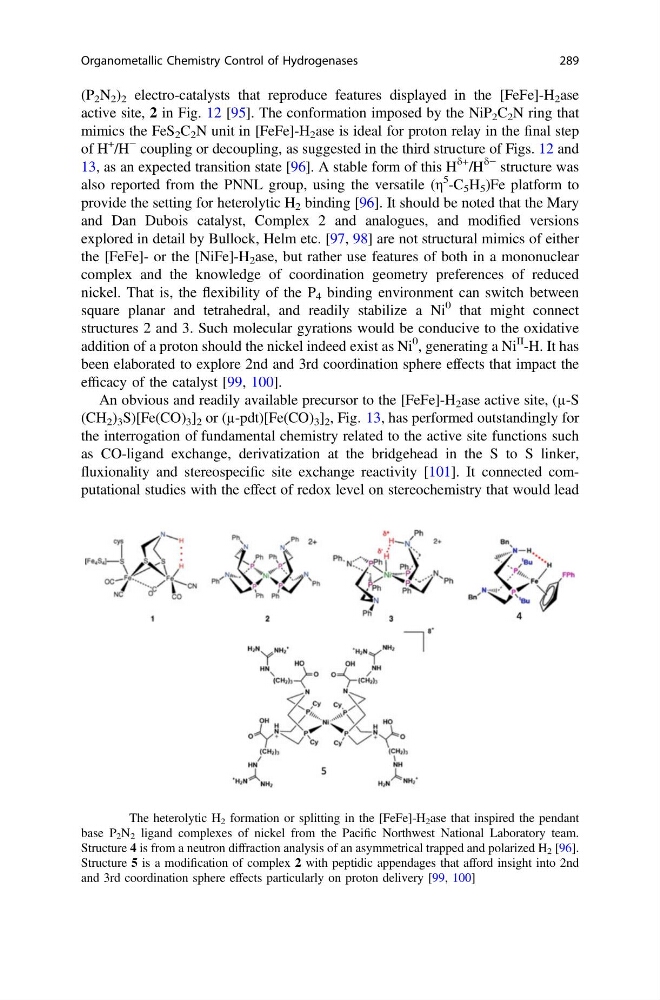
(P 2 N 2 ) 2 electro-catalysts that reproduce features displayed in the [FeFe]-H 2 ase
active site, 2 in Fig. 12 [95]. The conformation imposed by the NiP 2 C 2 N ring that
mimics the FeS 2 C 2 N unit in [FeFe]-H 2 ase is ideal for proton relay in the final step
of H
+ /H
− coupling or decoupling, as suggested in the third structure of Figs. 12 and
13, as an expected transition state [96]. A stable form of this H
d+ /H
d− structure was
also reported from the PNNL group, using the versatile (η
5 -C 5 H 5 )Fe platform to
provide the setting for heterolytic H 2 binding [96]. It should be noted that the Mary
and Dan Dubois catalyst, Complex 2 and analogues, and modified versions
explored in detail by Bullock, Helm etc. [97, 98] are not structural mimics of either
the [FeFe]- or the [NiFe]-H 2 ase, but rather use features of both in a mononuclear
complex and the knowledge of coordination geometry preferences of reduced
nickel. That is, the flexibility of the P 4 binding environment can switch between
square planar and tetrahedral, and readily stabilize a Ni
0 that might connect
structures 2 and 3. Such molecular gyrations would be conducive to the oxidative
addition of a proton should the nickel indeed exist as Ni
0 , generating a Ni
II -H. It has
been elaborated to explore 2nd and 3rd coordination sphere effects that impact the
efficacy of the catalyst [99, 100].
An obvious and readily available precursor to the [FeFe]-H 2 ase active site, (µ-S
(CH 2 ) 3 S)[Fe(CO) 3 ] 2 or (µ-pdt)[Fe(CO) 3 ] 2 , Fig. 13, has performed outstandingly for
the interrogation of fundamental chemistry related to the active site functions such
as CO-ligand exchange, derivatization at the bridgehead in the S to S linker,
fluxionality and stereospecific site exchange reactivity [101]. It connected computational studies with the effect of redox level on stereochemistry that would lead
Fig. 12 The heterolytic H 2 formation or splitting in the [FeFe]-H 2 ase that inspired the pendant
base P 2 N 2 ligand complexes of nickel from the Pacific Northwest National Laboratory team.
Structure 4 is from a neutron diffraction analysis of an asymmetrical trapped and polarized H 2 [96].
Structure 5 is a modification of complex 2 with peptidic appendages that afford insight into 2nd
and 3rd coordination sphere effects particularly on proton delivery [99, 100]
Organometallic Chemistry Control of Hydrogenases
289
active site, 2 in Fig. 12 [95]. The conformation imposed by the NiP 2 C 2 N ring that
mimics the FeS 2 C 2 N unit in [FeFe]-H 2 ase is ideal for proton relay in the final step
of H
+ /H
− coupling or decoupling, as suggested in the third structure of Figs. 12 and
13, as an expected transition state [96]. A stable form of this H
d+ /H
d− structure was
also reported from the PNNL group, using the versatile (η
5 -C 5 H 5 )Fe platform to
provide the setting for heterolytic H 2 binding [96]. It should be noted that the Mary
and Dan Dubois catalyst, Complex 2 and analogues, and modified versions
explored in detail by Bullock, Helm etc. [97, 98] are not structural mimics of either
the [FeFe]- or the [NiFe]-H 2 ase, but rather use features of both in a mononuclear
complex and the knowledge of coordination geometry preferences of reduced
nickel. That is, the flexibility of the P 4 binding environment can switch between
square planar and tetrahedral, and readily stabilize a Ni
0 that might connect
structures 2 and 3. Such molecular gyrations would be conducive to the oxidative
addition of a proton should the nickel indeed exist as Ni
0 , generating a Ni
II -H. It has
been elaborated to explore 2nd and 3rd coordination sphere effects that impact the
efficacy of the catalyst [99, 100].
An obvious and readily available precursor to the [FeFe]-H 2 ase active site, (µ-S
(CH 2 ) 3 S)[Fe(CO) 3 ] 2 or (µ-pdt)[Fe(CO) 3 ] 2 , Fig. 13, has performed outstandingly for
the interrogation of fundamental chemistry related to the active site functions such
as CO-ligand exchange, derivatization at the bridgehead in the S to S linker,
fluxionality and stereospecific site exchange reactivity [101]. It connected computational studies with the effect of redox level on stereochemistry that would lead
Fig. 12 The heterolytic H 2 formation or splitting in the [FeFe]-H 2 ase that inspired the pendant
base P 2 N 2 ligand complexes of nickel from the Pacific Northwest National Laboratory team.
Structure 4 is from a neutron diffraction analysis of an asymmetrical trapped and polarized H 2 [96].
Structure 5 is a modification of complex 2 with peptidic appendages that afford insight into 2nd
and 3rd coordination sphere effects particularly on proton delivery [99, 100]
Organometallic Chemistry Control of Hydrogenases
289