

sensitivity of the material, on the storage conditions of the ion-irradiated material
before etching, and on the etchant. The etching process is generally quantified by
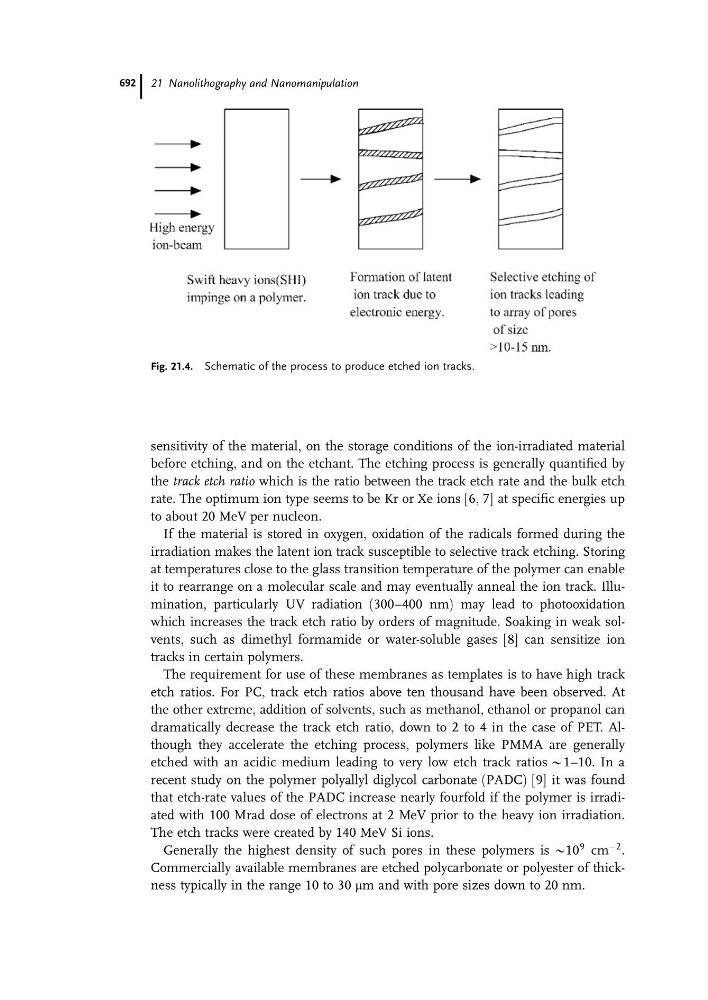
the track etch ratio which is the ratio between the track etch rate and the bulk etch
rate. The optimum ion type seems to be Kr or Xe ions [6, 7] at specific energies up
to about 20 MeV per nucleon.
If the material is stored in oxygen, oxidation of the radicals formed during the
irradiation makes the latent ion track susceptible to selective track etching. Storing
at temperatures close to the glass transition temperature of the polymer can enable
it to rearrange on a molecular scale and may eventually anneal the ion track. Illumination, particularly UV radiation (300–400 nm) may lead to photooxidation
which increases the track etch ratio by orders of magnitude. Soaking in weak solvents, such as dimethyl formamide or water-soluble gases [8] can sensitize ion
tracks in certain polymers.
The requirement for use of these membranes as templates is to have high track
etch ratios. For PC, track etch ratios above ten thousand have been observed. At
the other extreme, addition of solvents, such as methanol, ethanol or propanol can
dramatically decrease the track etch ratio, down to 2 to 4 in the case of PET. Although they accelerate the etching process, polymers like PMMA are generally
etched with an acidic medium leading to very low etch track ratios @1–10. In a
recent study on the polymer polyallyl diglycol carbonate (PADC) [9] it was found
that etch-rate values of the PADC increase nearly fourfold if the polymer is irradiated with 100 Mrad dose of electrons at 2 MeV prior to the heavy ion irradiation.
The etch tracks were created by 140 MeV Si ions.
Generally the highest density of such pores in these polymers is @10
9 cm
À2 .
Commercially available membranes are etched polycarbonate or polyester of thickness typically in the range 10 to 30 mm and with pore sizes down to 20 nm.
Fig. 21.4. Schematic of the process to produce etched ion tracks.
21 Nanolithography and Nanomanipulation
692