

21.2.2
Fabrication of Anodized Alumina Membrane
A highly ordered structure of nanopores in alumina membranes is made generally
by anodic oxidation of high purity (typically 5 N pure) aluminum foils. Typical pore
sizes are in the range 15–100 nm and the pore density can be as high as 10
10 –10
11
cm
À2 . The highly reproducible nature of the alumina membrane makes it a very
useful template for the formation of a number of different types of nanowire.
The alumina membrane can be etched out after growth and this gives rise to free
nanowires which can be used for a number of experiments and applications.
The growth of porous oxide on aluminum in various electrolytes under anodic
bias has been studied for some time [10]. When aluminum is anodized in certain
electrolytes, like phosphoric, sulfuric or oxalic acids, using a two-step process followed by etching, an array of close packed cells (pores) arranged in a near hexagonal pattern develops. Each cell contains a cylindrical pore and the axis of the cell is
perpendicular to the surface.
The anodization process uses high purity Al foils. Before anodization the aluminum foil is de-greased with acetone or trichloroethylene for some time followed by
a sodium carbonate wash at around 80
C and vacuum annealed (typically 10
À3 Pa)
at around 500
C for a few hours. This is followed by an electrochemical polish in
acidic solution (like perchloric acid and ethanol mixture or H 3 PO 4 , H 2 SO 4 and
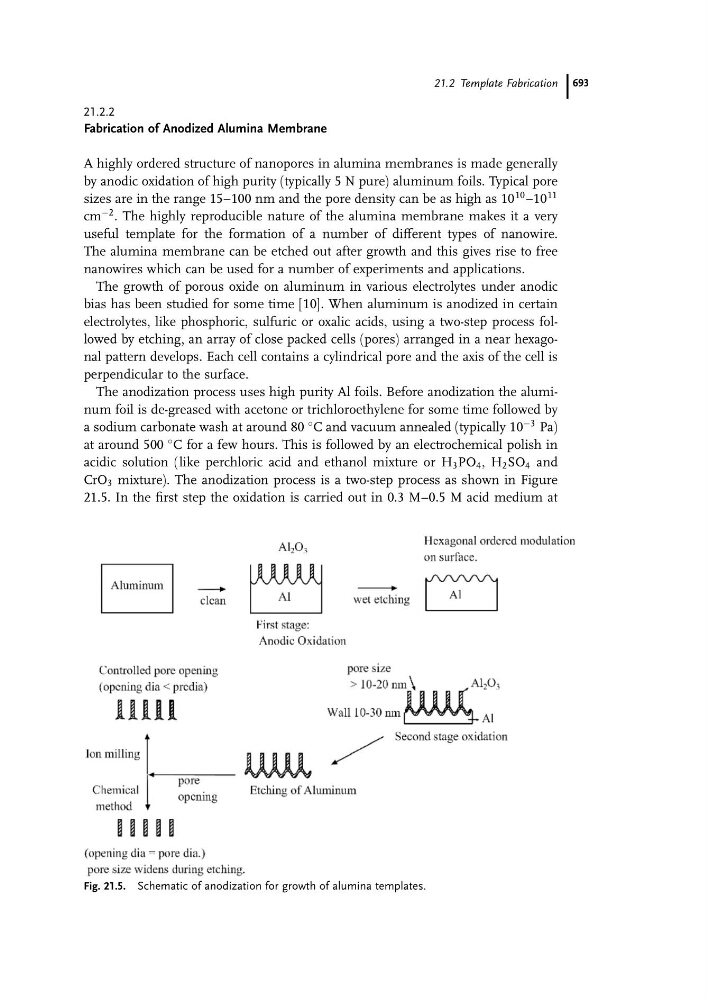
CrO 3 mixture). The anodization process is a two-step process as shown in Figure
21.5. In the first step the oxidation is carried out in 0.3 M–0.5 M acid medium at
Fig. 21.5. Schematic of anodization for growth of alumina templates.
21.2 Template Fabrication 693