

cases this allows fabrication of arrays. This is a chemical route where the nanowires are actually grown by electrodeposition, the sol–gel technique or from the
vapor phase. The advantage of this technique is that one can decouple the fabrication of nanowires and the templates and can have independent control of them.
The templates used for synthesis are either anodized alumina membranes (AM) or
etched track poly-carbonate or similar polymeric membranes (PM). There are other
templates for such deposition, however AM and PM are the most popular. Ease
of fabrication, handling and also commercial availability have made these membranes the mainstay of template growth. These templates can be procured from
commercial suppliers and can also be tailor-made to a specific use. The templates
contain cylindrical pores of diameter as small as 5–10 nm. In some cases the pores
form an ordered hexagonal array and the packing density of the pores can be as
large as 10
12 –10
13 m
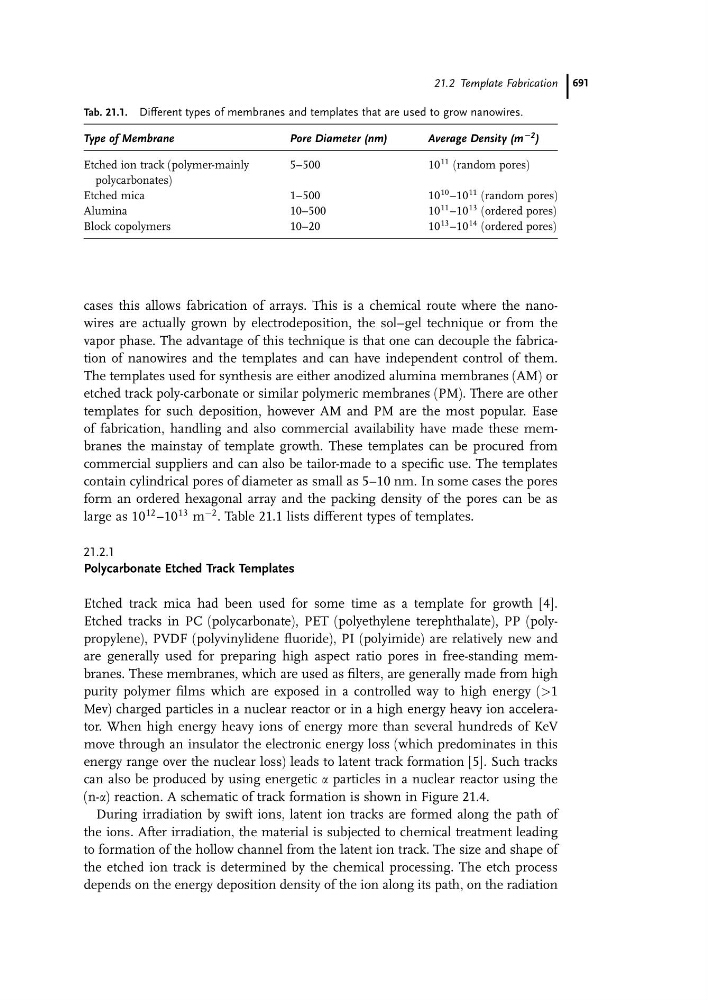
À2 . Table 21.1 lists different types of templates.
21.2.1
Polycarbonate Etched Track Templates
Etched track mica had been used for some time as a template for growth [4].
Etched tracks in PC (polycarbonate), PET (polyethylene terephthalate), PP (polypropylene), PVDF (polyvinylidene fluoride), PI (polyimide) are relatively new and
are generally used for preparing high aspect ratio pores in free-standing membranes. These membranes, which are used as filters, are generally made from high
purity polymer films which are exposed in a controlled way to high energy (>1
Mev) charged particles in a nuclear reactor or in a high energy heavy ion accelerator. When high energy heavy ions of energy more than several hundreds of KeV
move through an insulator the electronic energy loss (which predominates in this
energy range over the nuclear loss) leads to latent track formation [5]. Such tracks
can also be produced by using energetic a particles in a nuclear reactor using the
(n-a) reaction. A schematic of track formation is shown in Figure 21.4.
During irradiation by swift ions, latent ion tracks are formed along the path of
the ions. After irradiation, the material is subjected to chemical treatment leading
to formation of the hollow channel from the latent ion track. The size and shape of
the etched ion track is determined by the chemical processing. The etch process
depends on the energy deposition density of the ion along its path, on the radiation
Tab. 21.1. Different types of membranes and templates that are used to grow nanowires.
Type of Membrane
Pore Diameter (nm)
Average Density (m
C2 )
Etched ion track (polymer-mainly
polycarbonates)
5–500
10
11 (random pores)
Etched mica
1–500
10
10 –10
11 (random pores)
Alumina
10–500
10
11 –10
13 (ordered pores)
Block copolymers
10–20
10
13 –10
14 (ordered pores)
21.2 Template Fabrication 691