

The Knight shift (K) in a metal, corresponding to the chemical shift in a molecule,
is known to be a fingerprint of the corresponding site or structure [143]. K is the
result of spin–spin interaction between nuclei and electrons. The electron spins
at the Fermi energy can only be polarized and hence can produce non-zero spin
density in an external magnetic field [143]. The Knight shift contains only static
information. However, the dependence of spin–lattice relaxation time (T 1 ) and
spin–spin relaxation time (T 2 ) on the temperature and the magnetic field can yield
valuable information on the dynamics on the timescale of 10
À9 to 10
2 s.
The use of EC-NMR for the study of nanoparticles is exemplified by an investigation reported by Wieckowski and co-workers [122, 126, 128]. The working electrode is made of supported platinum catalyst particles of nanometer size, placed on
a Pt boat. Figure 20.10 shows the point-by-point
195 Pt NMR spectra under different
conditions. The supported Pt crystallites show the characteristics of isolated, small
Pt particles. Clear surface signals corresponding to the oxide of platinum on the asreceived commercial sample are shown in Figure 20.10.1. The oxide reduction
under potential control gives rise to the spectrum 20.10.2. The variations due to the
particle size as well as the metallic versus oxide surface are clearly brought out in
the spectra shown in Figure 20.10.
The adsorption properties of carbon monoxide and CN generated by the electrochemical decomposition of
13 C-enriched methanol or
13 C-enriched NaCN have
been studied using EC-NMR [129, 130]. The
13 C NMR of the adsorbed species on
Pt nanoparticles reveals that the potential control affects the NMR output to varying extents [142]. A positive potential change leads to the shielding of
13 C resonances and slopes of the order of À71 ppm V
À1 for
13 CO (Figure 20.11) and À50
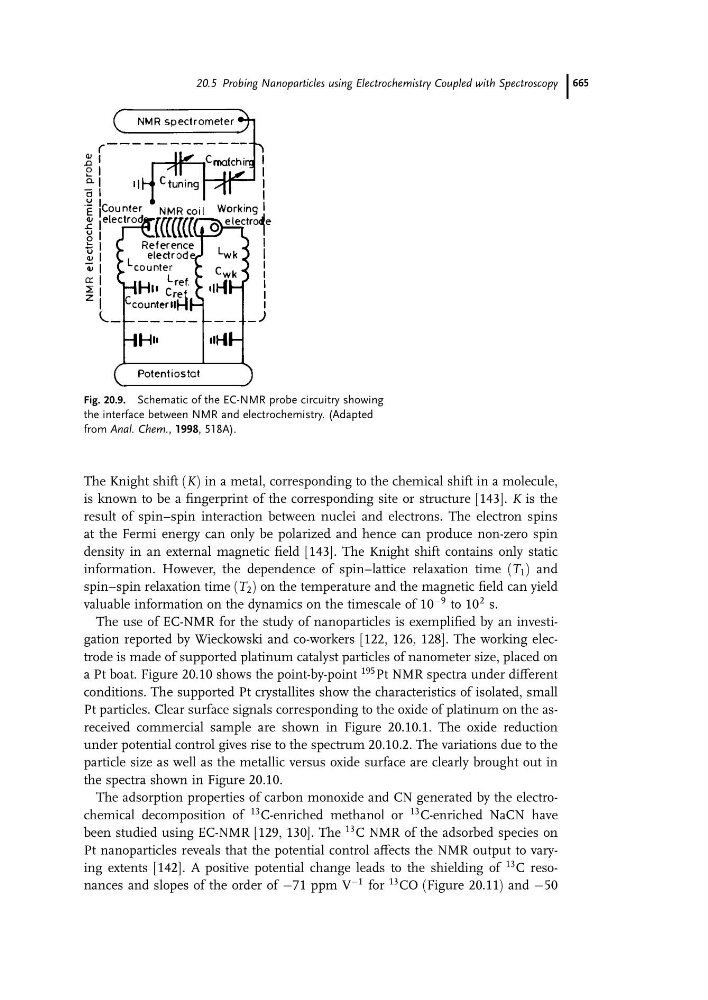
Fig. 20.9. Schematic of the EC-NMR probe circuitry showing
the interface between NMR and electrochemistry. (Adapted
from Anal. Chem., 1998, 518A).
20.5 Probing Nanoparticles using Electrochemistry Coupled with Spectroscopy 665